Ingro EMS: Energy management system (EMS) for BESS, made in India. One controller runs your battery, or your whole site.

The Ingro EMS controller sits in your plant room and runs battery storage, rooftop solar and the diesel generator against your tariff and your limits. It works with any battery, PCS or inverter, keeps running with no internet, and you watch it live on a screen or your phone.

An engineer replies within one business day with a scope of supply and the controller datasheet.

At site
ingroENERGY MANAGEMENTEMS · liveIngro EMSController · console · reporting
On site or remote, anywhere
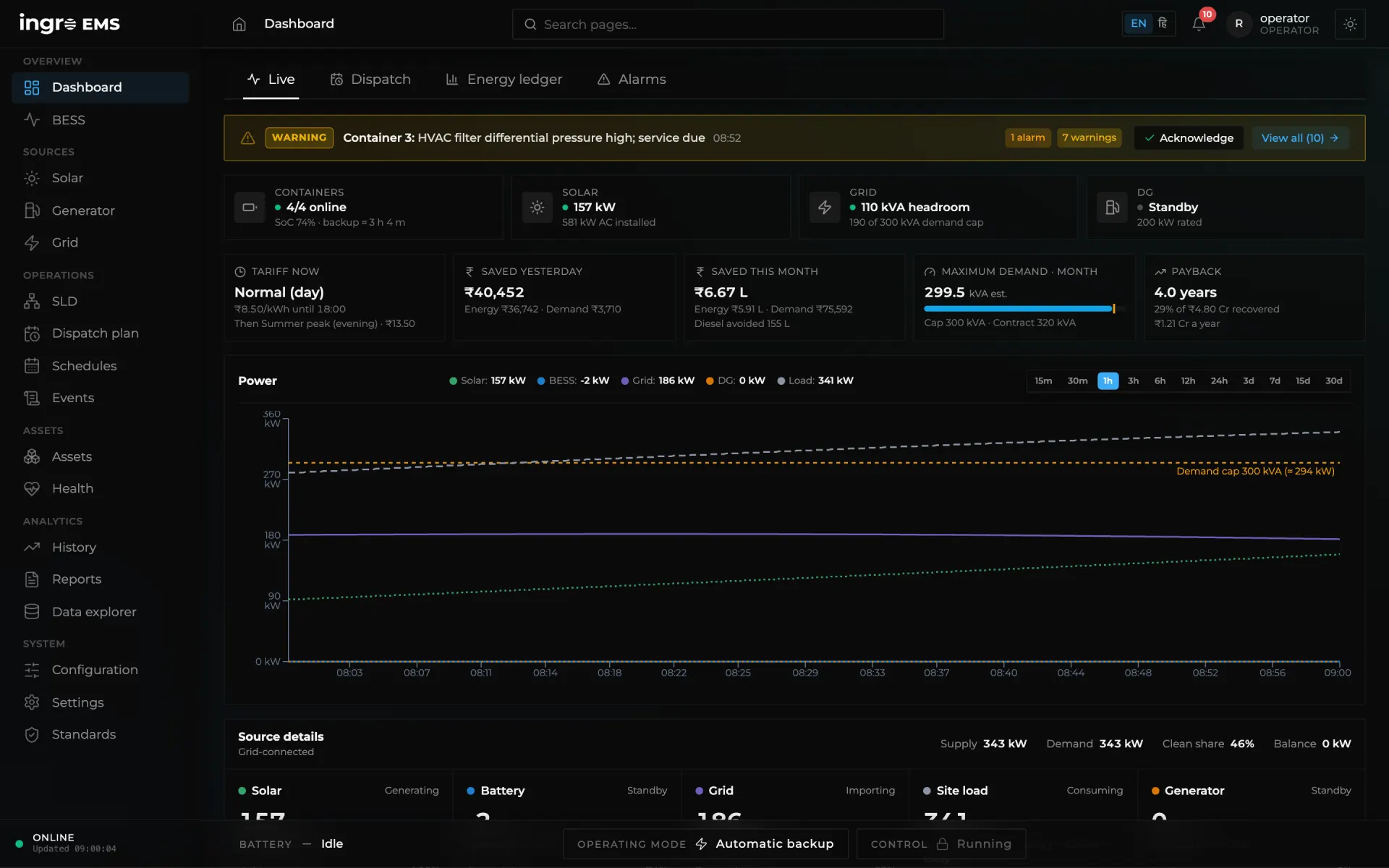
Operator console · Dashboard
Ingro EMS operator console: Dashboard screen, demo data
Ingro EMS mobile app, read-only dashboard
The Ingro EMS box at site, sending live data to the operator console on a laptop and to the mobile app, used on site or remotely from anywhere. Box illustrated; screens captured from the console with demo data.
What it is

What Ingro EMS Does for Your Site

An energy management system (EMS) is the controller that decides, moment to moment, which source carries a site's load and at what power: the solar array, the battery, a standby generator or the utility supply. Ingro EMS is that controller: an industrial computer installed in your plant room, plus the software your team runs it from.

A battery cannot do this for itself. Its BMS protects the cells and its PCS converts power at whatever level it is told; neither knows your tariff, your demand limit or what the solar array is producing. The EMS does, and it is what turns a battery into savings, backup and a record. Ingro EMS is deployed on site (offline), in the cloud, or as a hybrid of the two. In on-site and hybrid deployments, site control continues with no internet connection.

  • A lower electricity bill

    It holds your import under the demand limit you set, so a few minutes of peak never set the month's demand charge, and it buys energy in the cheap tariff window to use in the expensive one.

  • Power that stays on

    When the supply fails, the site moves to the battery without interruption. The diesel generator starts only if the outage outlasts the battery, and runs at a healthy load when it does.

  • Your solar, used on site

    Rooftop surplus charges the battery instead of going out at the feed-in rate, and solar keeps running while the generator is on instead of being switched off.

  • A record you can prove

    Every decision is logged with its reason. Thirteen reports, from a daily brief to a lender-ready savings statement, are generated and sent on schedule.

The longer answer: what is an EMS for BESS?

See it work

Watch Ingro EMS Run a Factory Day

A simulated working day under Ingro EMS. Switch the scenario, then drag across the chart to see what the controller is doing at any moment: the demand limit held, the battery taking the peak, the supply failing.

The bill at a factory, office or mall is set largely by its highest demand, and that is usually a few short peaks. EMS-CI meters the import continuously and lets the battery take whatever would cross the limit you set. Where the site has rooftop solar, the battery stores its surplus too.

A working day

Illustrative. Not measured data.

Low-tariff windowPeak window
Demand limit you set
Battery state of charge
NightMorningMiddayEveningNight
  • Demand
  • Demand limit you set
  • From the supply
  • Battery discharging
  • Battery charging

The battery charges in the low-tariff window, supplies the short peaks that would cross the limit, and discharges through the peak window. The supply never registers above the limit.

Order of preference

  1. 1The supply, up to the limitBilled maximum demand never registers above the figure you configured.
  2. 2The battery, above itShort peaks come from storage, not from the connection.
  3. 3The battery again, in the peak windowEnergy bought cheap is used when the tariff is highest.

This is a factory under Ingro EMS-CI. Each kind of site has its own day: critical power, charging hub, microgrid, solar & wind plants and utility-scale storage. Ask for yours

Battery health

Runs Your Battery So It Lasts

The EMS decides how hard the battery works every day. Ingro EMS keeps it inside the limits that protect its life, and shows you its health against the warranty.

The window it keeps the battery in

state of charge100%0%Headroom

Not parked at 100%: resting full ages cells faster

Working window

Tariff shifting, peak shaving and solar storage happen here

Reserve floor

Held back for outages, never spent on savings

BMS floor

The limits the BMS reports, re-checked every cycle

  • Charge rate set by the jobHow fast the battery charges and discharges follows what the site needs, not the inverter's maximum.
  • Limits re-checked every cycleCell voltages, temperatures and the limits the BMS reports are read on every control cycle, and the setpoint stays inside them.
  • No cycling on small swingsA deadband stops the battery charging and discharging back and forth on small changes in load or solar.

What you see, every month

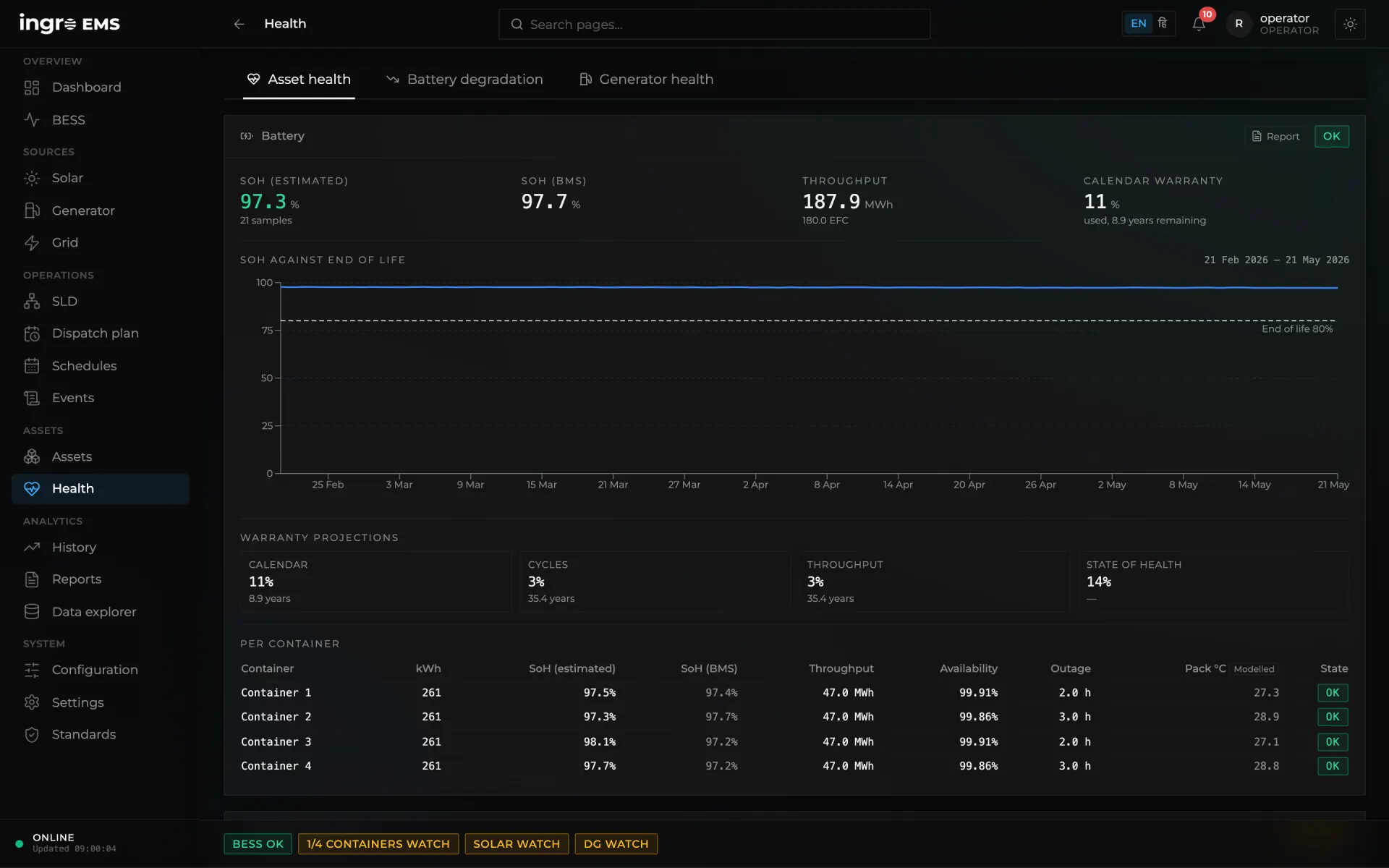
Ingro EMS · operator console · Battery health
Ingro EMS operator console: battery health screen with state of health against the warranty, demo data

State of health against end of life, warranty use by calendar, cycles and throughput, and availability per container. Real screen, demo data.

09Report · Monthly, annualBESS health & warranty trackingState of health (SoH), cycling cadence, RTE & OEM warranty runway. For o&m, lender, supplier.See a sample
Battery racks at Tata Power-DDL's Rohini substation, run by Ingro EMS

Tata Power-DDL · Rohini, Delhi

India's first grid-scale BESS, 10 MW / 10 MWh

The same batteries, a different controller. The plant was commissioned in 2019; by 2023 its original control system could not manage the uneven ageing of its batteries and inverters. In 2024 Ingro replaced the EMS, not the hardware.

PCS units under one Ingro EMS
124
lower annual degradation
~41%
longer usable life, same batteries
~70%

Want to know what is ageing your battery, and be warned before a cell fails? Ingro Brain is AI battery health software that reads the same data. A separate product: it works with Ingro EMS or on its own, for any battery.

See Ingro Brain
Integration

Works With the Equipment You Already Have

Any make of battery, BMS, PCS, inverter, generator, charger or meter. Integration is configuration, not new hardware, and your own SCADA keeps reading the plant.

  • Battery BMScell voltages, temperatures, SoC, alarmsModbus TCP
  • PCS & inverterspower setpoints, stateModbus · SunSpec
  • Solar invertersoutput, active-power limitSunSpec · Modbus
  • Diesel generatorstart, stop, loadingModbus RTU · I/O
  • Cooling & auxiliariesHVAC, fire panel stateModbus RTU · I/O
  • Energy metersincomer and sub-meters, every cycleModbus RTU / TCP
  • EV chargerscharging load, limitsModbus · gateway
  • Switchgear & relaysbreaker state, tripsIEC 61850 · I/O
  • Building managementflexible loads, where you allow itOPC-UA · Modbus
  • Site SCADA & PPCthe plant's existing controlIEC 61850 · DNP3

Your own SCADA or dashboard reads the plant from the EMS over REST and WebSocket. The cloud link is optional and never needed for control.

Any make

Battery, BMS, PCS, inverter, generator, charger or meter. Integration is register-map driven, so the equipment you have already bought, or the equipment your integrator prefers, is the equipment it runs.

The protocols

Modbus TCP, Modbus RTU over RS485, SunSpec, IEC 61850, DNP3 and OPC-UA, plus dry contacts, digital I/O and aggregator gateways.

Already have a battery running?

Ingro EMS also replaces a locked or underperforming controller on a battery that is already in service, keeping the hardware.

Smart retrofit

Everything Ingro EMS integrates with

We support every size

Every Battery Size, One EMS

Ingro EMS supports every battery size, from a 10 kWh home battery to a grid-scale plant of 10 MW and more. One cabinet or a yard of containers: the same controller runs them, and the same console shows them. Numbered as in the picture.

ingro123456Ingro EMS
  1. 1A home inverter with a batteryEMS-H runs inside the inverter: typically up to about 10 kW, and not limited to that.
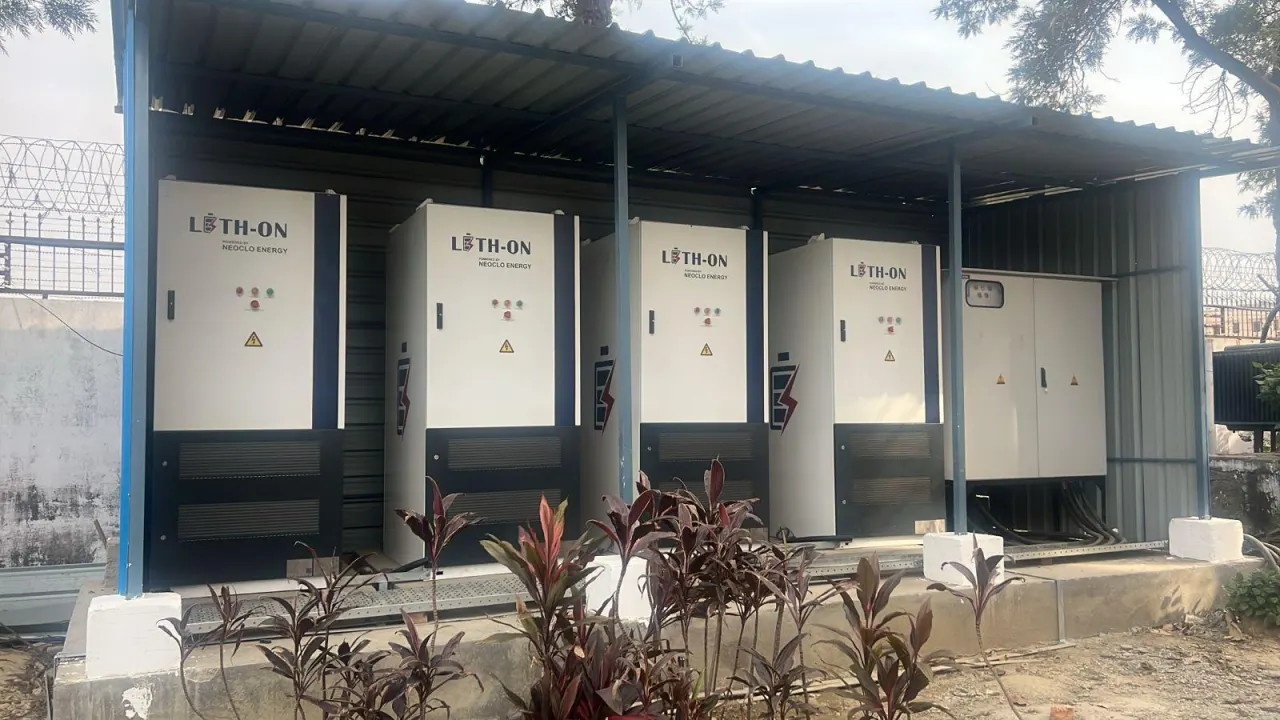
  2. 2One battery cabinetA factory, office or charging hub's first battery, indoors or outside, with its PCS beside it.
  3. 3A row of cabinets, run as one batteryInvertis University: four cabinets, 500 kW / 1.04 MWh, one lead source and three followers.
  4. 4A containerised battery20 ft or 40 ft, with the racks, BMS and cooling inside and the PCS alongside.
  5. 5A container plantTata Power-DDL, Rohini: 10 MW / 10 MWh, 124 PCS units under one Ingro EMS.
  6. 6Ingro EMSThe same controller and software for all of them. Only the enclosure and the wiring change.

Cells, racks and BMS from any maker, LFP, NMC or sodium-ion; PCS from string inverters to central units. The controller's own enclosure follows the site: wall cabinet, floor cabinet, control-room rack or a redundant pair.

Find the EMS for your battery size

Battery sizeUsuallyIngro EMSPage
5 kW / 10 kWhHome inverter with a wall or floor batteryEMS-HSee
50 kW / 100 kWhOutdoor all-in-one battery cabinetEMS-CI, EMS-EVSee
100 kW / 215 kWhOutdoor liquid- or air-cooled battery cabinetEMS-CI, EMS-CPSee
125 kW / 261 kWhOutdoor liquid-cooled battery cabinetEMS-CI, EMS-CP, EMS-EVSee
500 kW / 1 MWhA row of four cabinets, or a small containerEMS-CI, EMS-CPSee
1 MW / 2 MWhEight cabinets, or a container with a 1 MW PCSEMS-CI, EMS-EVSee
2.5 MW / 5 MWh20 ft container, about 5 MWhEMS-CI, EMS-RE, EMS-GSSee
5 MW / 10 MWhTwo 5 MWh containers with PCS and MV skidsEMS-RE, EMS-CISee
10 MW+ / 10 MWh+A container yard at a substationEMS-GS, EMS-RESee

Your size not listed? The same EMS runs it. Compare all sizes

The software

The Screens You Operate Every Day

The console in your plant room, in a browser, and read-only on a phone. Click through the real screens.

Ingro EMS · operator console · Dashboard
Ingro EMS operator console: dashboard screen
Dashboard

The whole site on one screen

Battery, solar, grid headroom and generator at a glance, live power for every source, and what the site saved today.

  • Live power by source
  • Tariff now and savings to date
  • Active alarms on top

Real screens from the Ingro EMS operator console, shown with demo data. The same console runs on the screen in your plant room, in a browser and, read-only, on a phone.

13 reports included, from a daily brief to a lender-ready savings statement.See the reports →
The hardware

The Ingro EMS Controller, Installed on Your Site

Wired and tested before it ships, then commissioned by our engineers against your equipment.

ingroENERGY MANAGEMENTEMS · liveIngro EMSController · console · reporting
The Ingro EMS Controller, wall-cabinet build. Illustration.

In the cabinet

  • The Ingro EMS Controller, an industrial computer running the control loop and historian
  • A managed network switch and the serial-to-Modbus gateways for your devices
  • The on-site screen with the operator console
  • Wired, configured and tested before it reaches site, then commissioned against your plant

The control loop runs on the controller, on every configuration. If the internet drops, the site keeps running on the same rules; data is buffered and back-filled when the link returns.

Options

  • A second controller in hot standby, taking over without interrupting control
  • Tropicalised build: higher ingress protection, anti-condensation heating and conformal-coated electronics
  • Optional cloud link — for people, reports and support, never needed for control
Enclosures and technical specifications

One controller, four enclosures

Wall cabinetEMS-CI
Factories, warehouses, offices and campuses, with or without rooftop solar. Mounted in or beside the LV panel room; a floor cabinet where a DG is added.
Floor cabinetEMS-CPEMS-MGEMS-EV
Critical sites with a DG, microgrids and charging hubs, where there are more devices to wire.
Control-room rackEMS-RE
Storage at solar and wind plants, in the plant's control room beside the existing PPC.
Redundant pairEMS-GS
Grid-scale storage: two controllers at the substation, the second in hot standby.

Control

Control response
Control response is specified per project — sub-millisecond, 4 ms, 10 ms or 20 ms — to match the grid code, the connection agreement or the client's own requirement. Each cycle reads the plant, resolves the order of preference, issues setpoints and records the decision with its reason.
Deployment
Ingro EMS is deployed on site (offline), in the cloud, or as a hybrid of the two. In on-site and hybrid deployments, site control continues with no internet connection.
Interlocks
Device limits and prohibitions are re-evaluated on every cycle. A deadband governs the cycling of storage.
Operating authority
In automatic operation the controller holds authority over setpoints. Manual operation transfers that authority to the operator, under role.
Loss of supply
Confirmed by voltage hysteresis. Storage establishes the site's voltage and frequency reference, and the array continues to generate against it.
Return of supply
A stability hold precedes resynchronisation, after which the load is transferred back automatically or on operator confirmation.

Measurement and record

Metering
Each source feeder is metered. Site load is derived as the signed sum of metered flows.
Historian
One-minute resolution, to a local time-series database on site.
Energy ledger
Each site-day is closed by differencing cumulative meter counters — the same arithmetic as the utility bill.
Provenance
Every energy figure carries its basis — metered, derived or modelled — and the proportion of the period covered by data.
Retention
Raw device telemetry, months. Dispatch decisions, years. The minute rollup, longest. The daily energy ledger, retained indefinitely.
Audit
Every command is attributed and retained together with the controller's response. Alarm state is preserved across a restart.

Interfaces

Field protocols
Modbus TCP, Modbus RTU over RS485, SunSpec, IEC 61850, DNP3 and OPC-UA, plus dry contacts, digital I/O and aggregator gateways.
Device integration
Register-map driven. A model not previously encountered is added as configuration.
Upstream integration
REST and WebSocket interfaces for a customer's own SCADA, corporate dashboard or portfolio system.
Reporting output
PDF and XLSX, paginated to A4, written to the filesystem and distributed on schedule.

Ratings, I/O, dimensions and ingress protection are set out on the datasheet issued with each quotation.

Request the datasheet

Want an engineer to call you?

Leave your details. An Ingro engineer gets back to you within one business day, no obligation.

Or tell us about your site ↓
Get a proposal

Tell Us About Your Site, and We Send the Proposal

A few chips and your name are enough. An engineer replies within one business day with a scope of supply and the controller datasheet.

Your kind of site
What is on site today (pick any)

With your message we also receive the pages you viewed on our site, so we can reply more usefully. Privacy policy

Seven kinds of site, one controller

Which Ingro EMS Is Yours?

The same controller, set up for the kind of site. Pick yours and it goes into your enquiry, or read its page first.

  • Commercial & industrial

    EMS-CIMost of our work

    Factories, warehouses, offices, malls and campuses: a lower demand charge, rooftop solar stored, backup through outages.

    Read about EMS-CI
  • Critical power

    EMS-CP

    Hospitals, airports and data centres: power that stays on through outages, with the generator only when it must.

    Read about EMS-CP
  • Charging hub

    EMS-EV

    Charging hubs: more chargers on the grid connection you already have.

    Read about EMS-EV
  • Microgrid

    EMS-MG

    Microgrids and off-grid sites: solar, battery and diesel run as the site's own grid.

    Read about EMS-MG
  • Solar & wind plants

    EMS-RE

    Solar and wind plants: storage that works with the plant's own controller.

    Read about EMS-RE
  • Utility-scale storage

    EMS-GS

    Grid-scale storage: run to the tender schedule and the grid code.

    Read about EMS-GS
  • Homes

    EMS-H

    Homes: solar first and a reserve for power cuts, inside the home inverter, through inverter makers.

    Read about EMS-H
Common questions

Ingro EMS, Answered

6 questions

An energy management system is the controller that decides, moment to moment, which source carries a site's load and at what power — the solar array, battery storage, standby generation or the utility supply. Ingro EMS resolves that order of preference on every control cycle, issues a setpoint to each source, and records every decision with the reason for it. It is deployed on site (offline), in the cloud, or as a hybrid.

Yes. The platform is manufacturer-independent and register-map driven: any make of inverter, battery, converter or generator integrates over Modbus TCP, Modbus RTU over RS485, SunSpec, IEC 61850, DNP3 and OPC-UA, plus dry contacts, digital I/O and aggregator gateways. A model not previously encountered is added as configuration, not as new hardware.

Four elements, quoted as one item: the controller installed and commissioned against your plant, the operator console, the read-only mobile view, and the reporting suite generated and distributed automatically — together with handover documentation and training for the operating team.

Match the site. A factory, warehouse, office, school, mall or campus is EMS-CI (a building is configured with a larger backup reserve and a link to its building management system); a hospital, airport or data centre that must never drop is EMS-CP; a charging hub behind a limited connection is EMS-EV; a site running its own grid on solar, battery and diesel is EMS-MG; a battery co-located with a solar or wind plant is EMS-RE; tendered standalone storage at a substation is EMS-GS; and the EMS inside a home inverter is EMS-H. Rooftop solar and a DG are options within the package, not a different code.

Yes, in on-site and hybrid deployments. The controller operates the plant from the plant room, so site control continues with no connectivity at all; the network connection serves reporting, forecasting and remote support — not the control loop.

Equipment for a new installation typically requires around three months to arrive and be installed, and that period is used to model the plant against your asset counts, loads, tariff and load profile before anything ships. Commissioning, handover and training follow.

Want the background first? What is an EMS for BESS?

Where next