
India's grid needs more than hardware, it needs intelligence. Ingro's AI powered BESS stabilizes frequency, eliminates curtailment, and stacks revenue across ancillary services, arbitrage, and capacity markets.
Grid-scale BESS anchors India's renewable transition by absorbing surplus solar and wind during off-peak hours and dispatching it precisely when demand peaks. From CERC-compliant frequency regulation to transmission deferral in congested corridors like Rajasthan and Tamil Nadu, utility-scale storage turns intermittent renewables into firm, dispatchable power, at a fraction of the cost of new peaking plants.
But the real differentiator isn't the battery, it's the software. Ingro's Cloud EMS and AI dispatch engine optimize every megawatt-hour across multiple revenue streams simultaneously, turning a capital asset into a continuously optimized profit center. With 12.8 GWh already auctioned and the CEA targeting 48 GW / 236 GWh by 2032, the market is here. The question is who captures the most value from every installed megawatt-hour.
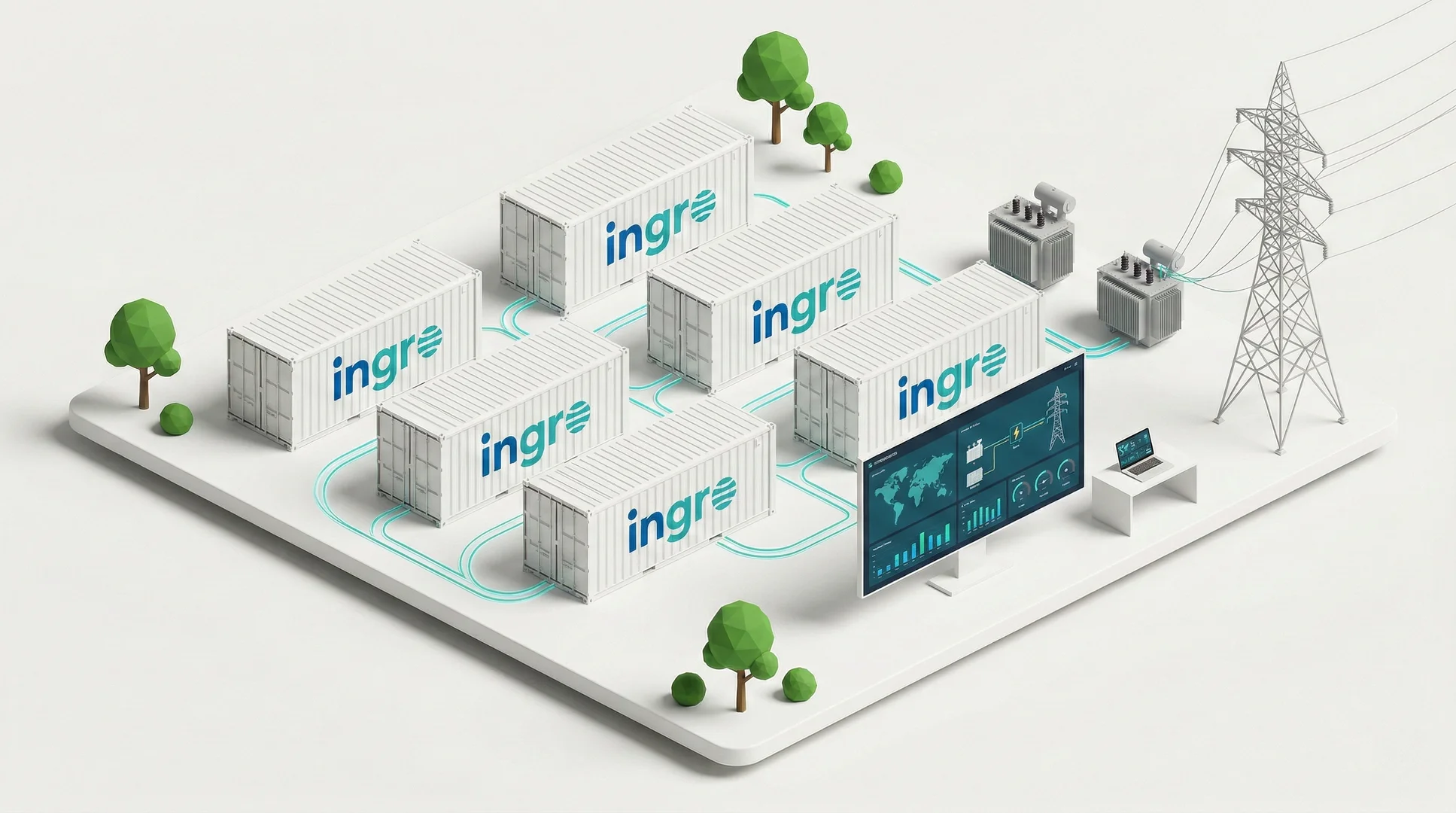
India added 18 GW of solar in FY2024 alone, but the grid infrastructure hasn't kept pace. The result is billions of kilowatt-hours of clean energy going to waste and a grid that struggles to stay balanced, creating both a crisis and an enormous opportunity.
Sub-50ms frequency response under CERC Ancillary Services Regulations 2022
4-hour duration systems shift 100+ MWh from midday surplus to evening peak
Co-location at renewable-rich substations alleviates transmission congestion
AI-optimized dispatch maximizes revenue across all grid services simultaneously
Ingro's grid-scale BESS systems don't just store energy, they think. Our software stack optimizes every electron from cell-level thermal management to portfolio-wide dispatch across CERC ancillary markets, power exchanges, and DISCOM capacity contracts.
The result: firm, dispatchable renewable power that grid operators can rely on, paired with revenue-maximized operation that makes every installed megawatt-hour work harder than the competition.
Any integrator can install batteries. The value is in what happens after commissioning, and that's where Ingro's software stack creates an unassailable edge.
Monitor every cell voltage, temperature, and state-of-charge across your entire BESS fleet from a single dashboard. Remote control capabilities let operators adjust dispatch strategies, respond to grid events, and manage maintenance schedules from anywhere, no site visits required.
Our machine learning models analyze 72 hours of weather forecasts, grid frequency trends, power exchange prices, and DISCOM schedules to optimize dispatch across all revenue streams simultaneously. The AI rebalances every 5 minutes, capturing value that static schedules miss.
Thermal and electrochemical models track degradation patterns at the cell level, predicting failures 30-60 days before they occur. Proactive thermal management and charge rate optimization extend usable battery life by 15-20%, protecting the single largest capital investment in the system.
Automated bid generation, telemetry reporting, and settlement reconciliation for CERC Ancillary Services participation. The system maintains continuous compliance with IEGC frequency standards (49.90-50.05 Hz), automatically adjusting response profiles as regulations evolve.
Simultaneously optimize across frequency regulation, energy arbitrage, capacity commitments, and transmission deferral. The engine dynamically allocates battery capacity to the highest-value service at each interval while honoring all contractual obligations.
Before deploying a single battery, our digital twin models the complete system, from cell chemistry behavior to grid interconnection dynamics. Simulate 10 years of dispatch under varying tariff, regulation, and degradation scenarios to validate project economics with confidence.
Purpose-built for India's grid challenges, from CERC compliance to revenue maximization.
Meet and exceed CERC's Ancillary Services requirements with response times under 50 milliseconds. BESS provides both primary and secondary frequency response, far faster than any thermal generator can ramp.
Absorb excess solar during midday peaks and redispatch during evening demand. Directly addresses the 12% curtailment that wastes 1.5 GWh daily across Rajasthan, Gujarat, and Tamil Nadu during peak months.
Convert intermittent solar and wind into firm, schedulable power that grid operators can rely on. 4-hour duration systems shift 100+ MWh per cycle from surplus to scarcity windows.
Co-located storage at renewable-rich substations alleviates bottlenecks that currently delay 15-20 GW of planned solar capacity from reaching demand centers, without costly line upgrades.
AI-driven dispatch stacks multiple revenue streams, frequency regulation, arbitrage, capacity, and congestion relief, to maximize returns across every hour of every day.
LFP chemistry with predictive thermal management and AI-optimized cycling delivers 8,000+ cycles at 90% depth-of-discharge. Augmentation planning ensures rated capacity throughout the contract term.
A proven 4-step journey to deploy utility-scale BESS that meets CERC compliance and maximizes grid value.
Analyze grid topology, congestion corridors, frequency deviation data, renewable curtailment patterns, and substation capacity to identify optimal BESS siting and sizing for maximum grid value.
Engineer the complete BESS solution, LFP cell selection, inverter and transformer sizing, grid interconnection design, and CERC compliance architecture. Digital twin validates economics across 10-year dispatch scenarios.
Procure Tier-1 LFP modules, PCS inverters, and balance-of-system components. Execute civil works, electrical installation, fire safety systems, and grid interconnection, typically 12-18 months from financial close.
Complete grid synchronization, CERC compliance testing, and performance acceptance. Cloud EMS takes over with AI-driven optimization, continuous monitoring, and 12-year operations and maintenance support.
Grid-scale BESS unlocks 4+ simultaneous revenue streams. Ingro's AI dispatch engine optimizes allocation across all of them in real time.
Earn ancillary service payments under CERC's Regulations 2022 by providing sub-second frequency response. BESS bids into NLDC's secondary and tertiary reserve markets at rates of INR 12-18/kWh, the highest margin revenue stream available.
Charge during off-peak hours at INR 2.5-3.5/kWh and discharge during evening peak demand windows at INR 6-9/kWh. The 4-6 PM ramp period consistently delivers INR 3-5/kWh spreads across most Indian power exchanges.
Provide firm, dispatchable capacity to DISCOMs under long-term PPAs. SECI's bundled RE+storage tenders guarantee fixed capacity charges of INR 1.5-2.5 lakh/MW/month, providing a stable revenue floor regardless of dispatch.
Co-located BESS at congested substations in Rajasthan, Gujarat, and Tamil Nadu defers transmission upgrades worth INR 3-5 crore per km. Utilities compensate storage operators through congestion relief payments and preferential scheduling.
Combined Revenue Potential
By stacking all four revenue streams, Ingro's AI powered BESS consistently delivers INR 8-12 lakh per MW per month , 30-40% higher than single-service dispatch strategies. The AI engine continuously rebalances allocation as market conditions shift, ensuring optimal returns throughout the asset lifecycle.
Partner with Ingro to deploy AI powered, utility-scale BESS that earns revenue from ancillary services, arbitrage, and capacity markets, while powering India's renewable transition. Our team will assess your grid location and model projected returns within weeks.