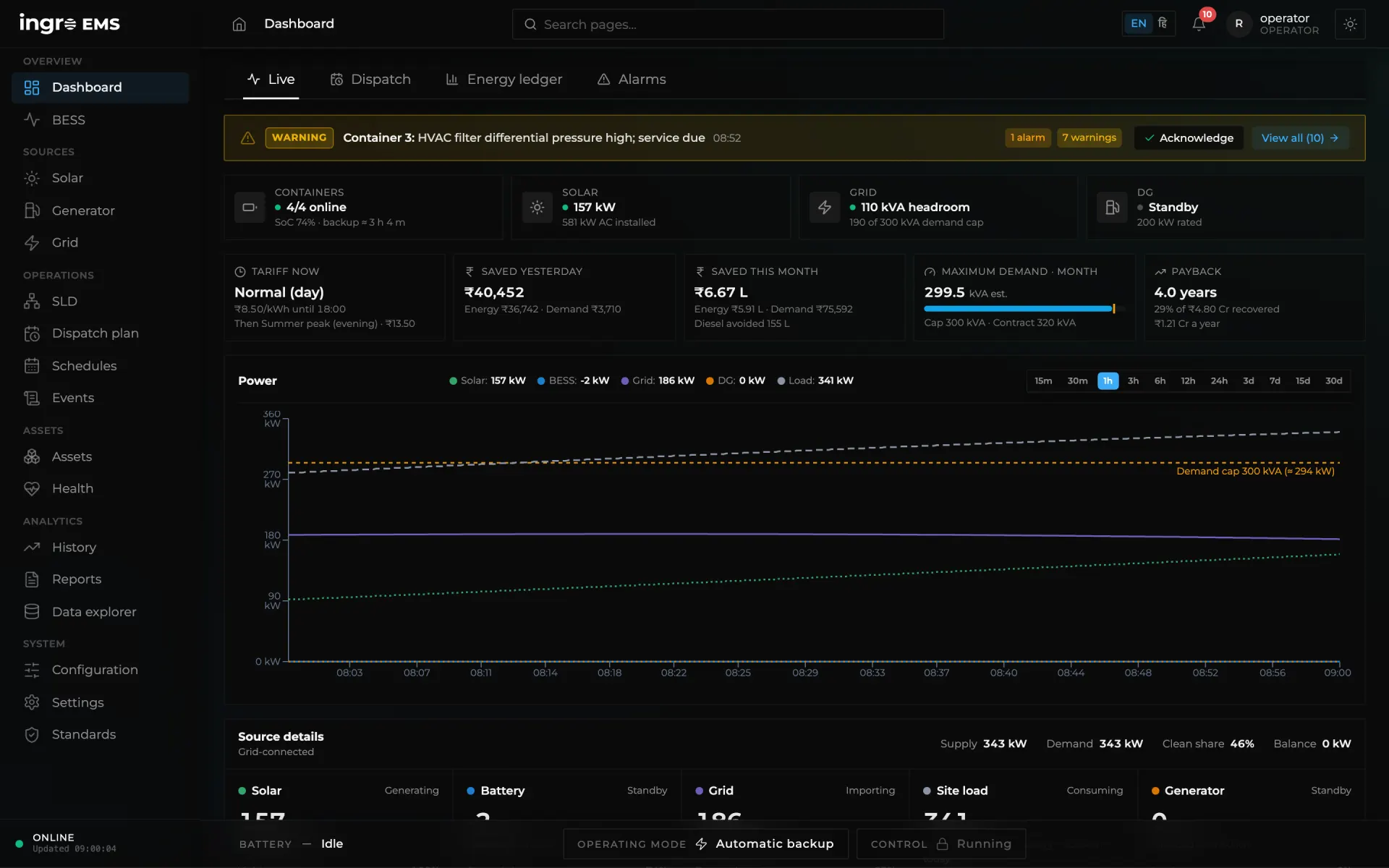
Pairing solar plus BESS lets a plant store surplus midday generation and release it when it is most valuable, converting a variable resource into a firm, dispatchable one. But a solar-plus-storage EMS decides when to charge, discharge, and hold. A rules-based controller leaves value on the table; an AI-powered EMS for solar BESS forecasts, optimises, and captures far more of it.
Key takeaways
Adding a BESS turns a variable solar plant into a firm, dispatchable asset, enabling time-shifting, clipped-energy recovery, curtailment reduction, and RTC and peak-power PPA compliance.
DC-coupled solar-plus-storage excels at capturing clipped energy behind a shared inverter; AC-coupled suits retrofits and grid-plus-solar charging with independent sizing.
Dispatching one battery against solar variability, price volatility, degradation, and firm PPA commitments is a hard, forecast-dependent optimisation that fixed rules cannot solve well.
A rules-based EMS makes locally reasonable but globally suboptimal choices and leaves significant revenue and asset life on the table.
An AI-powered EMS forecasts solar and prices, sources and discharges energy optimally, and protects battery health; Ingro Cloud EMS plus Battery AI does this by re-optimising every five minutes.
A standalone solar plant can only sell what the sun gives it, at the moment it gives it. Generation peaks around midday and collapses by evening, exactly when demand and market prices climb. Adding a battery energy storage system lets a solar developer decouple when energy is produced from when it is delivered, and that flexibility unlocks several distinct sources of value at once.
In the Indian context, storage has moved from optional to strategic. Round-the-clock (RTC) and Firm and Dispatchable Renewable Energy (FDRE) tenders now require developers to supply committed blocks of power across the day, grid codes impose ramp-rate limits, and curtailment eats into revenue at high-renewable substations. A co-located BESS is the most practical way to meet these obligations without over-building solar capacity.
Firming and smoothingBuffer fast fluctuations from passing clouds so plant output stays stable and predictable rather than spiking and dipping.
Time-shiftingStore cheap, abundant midday generation and discharge it into the evening peak when tariffs and demand are highest.
Recovering clipped energyCapture DC generation that would otherwise be lost when solar output exceeds inverter or interconnection limits.
Reducing curtailmentAbsorb energy the grid cannot accept during high-renewable periods instead of spilling it, avoiding lost revenue and penalties.
Meeting RTC and peak-power PPAsDeliver the firm, scheduled blocks that round-the-clock and peak-power contracts demand, avoiding shortfall penalties.
Grid-code complianceHold ramp rates within limits and provide voltage and frequency support required for grid connection.
Self-consumption for C&I solarShift rooftop or captive solar into evening operating hours to cut grid imports and demand charges.
Open access valueArbitrage across time-of-day tariffs and exchange prices while honouring wheeling and banking arrangements.
02
DC-Coupled vs AC-Coupled Solar-Plus-Storage
How the battery connects to the solar array shapes what value it can capture. There are two common architectures, and the right choice depends on whether the priority is recovering clipped energy or retrofitting storage onto an existing plant.
The distinction matters to the EMS because it defines the charging pathways available: whether the battery can draw directly from the PV DC bus, from the AC side, or from the grid, and therefore how the optimisation problem is framed.
DC-Coupled Systems
In a DC-coupled design, the solar array and the battery share a common DC bus behind a single inverter (or a DC-DC converter feeds the battery). Its biggest advantage is capturing clipped energy: when the array generates more DC power than the inverter can export, that surplus charges the battery instead of being lost. It typically offers higher round-trip efficiency for solar charging because energy is not converted DC-AC-DC. The trade-off is a more tightly coupled design that is harder to retrofit and sizes the battery around the array.
AC-Coupled Systems
In an AC-coupled design, the solar plant and the battery each have their own inverter and meet on the AC side. This makes it the natural choice for retrofitting storage onto an existing solar plant and for larger, independently sized systems. The battery can charge from the array, from the grid, or from both, which widens arbitrage and open-access strategies. The cost is an extra conversion stage, so surplus DC generation that exceeds the solar inverter rating cannot be recovered as easily as in a DC-coupled system.
DC-coupled
Solar and battery meet on the DC side and share one hybrid inverter.
AC-coupled
Each keeps its own inverter, and they meet on the AC side.
Either way, the EMS decides how much power the battery takes or gives, and when.
03
The Operational Challenge: Many Objectives, One Battery
Bolting a battery onto a solar plant creates value only if it is dispatched well, and dispatching it well is genuinely hard. The operator faces several fast-moving, interacting variables and a single asset that can only do one thing at a time. Every decision to charge from solar is a decision not to export; every discharge into a price spike is a cycle not saved for a PPA commitment later that evening.
The core difficulty is that the right answer changes minute to minute and depends on information that has not happened yet, notably tomorrow evening's price and this afternoon's cloud cover. The main sources of complexity are:
Solar variabilityOutput swings with cloud cover, season, and soiling, so the energy available to store is uncertain even a few hours ahead.
Price volatilityDay-ahead and real-time market prices, and DISCOM time-of-day tariffs, move constantly and reward precise timing.
Forecasting dependenceGood decisions need accurate forecasts of both solar generation and prices, which rules-based logic cannot produce.
Battery degradationEvery cycle and every period at high state of charge or high temperature ages the cells, so aggressive arbitrage can quietly erode asset life.
Competing objectivesMaximising arbitrage, honouring firm PPA and RTC blocks, respecting ramp-rate limits, and protecting battery health often pull in different directions at the same moment.
04
Why a Rules-Based EMS Leaves Money on the Table
Most conventional energy management systems run on fixed rules: charge the battery whenever solar exceeds the export limit, discharge between 18:00 and 22:00, stop at a set state of charge. These heuristics are transparent and easy to commission, and on a calm, average day they work acceptably. The problem is that no day is average.
A static rule cannot see that tomorrow's evening price will be double today's, so it discharges early and misses the peak. It cannot tell that a cloud bank will cut generation in an hour, so it exports energy it should have stored to meet an RTC block. It treats every cycle as free, ignoring the degradation cost of holding the battery full through a hot afternoon. Because the rules are blind to forecasts and cannot weigh competing objectives against each other, they consistently make locally reasonable but globally suboptimal choices. Across a year, that gap between good-enough and optimal is where the returns of a solar-plus-storage asset are won or lost.
05
How an AI-Powered EMS Extracts More Value
An AI-powered EMS for solar BESS replaces fixed rules with forecasting and continuous optimisation. Instead of reacting to the current instant, it looks ahead across the day, weighs every objective simultaneously, and computes the dispatch schedule that maximises value while respecting every hard constraint. As new data arrives, it re-solves the problem, so the plan stays optimal as conditions change.
Concretely, an intelligent EMS closes the gap that rules-based control leaves open in five ways:
ForecastingIt predicts solar output from weather and irradiance data and forecasts power-exchange and tariff prices, turning uncertain futures into actionable schedules.
Optimal sourcingIt decides intelligently whether to charge from surplus solar or from the grid at low prices, and reserves capacity for when discharge is worth most.
Capturing clipped energyIt prioritises storing DC or AC surplus that would otherwise be curtailed or clipped, recovering energy the plant has already paid to generate.
Constraint-aware arbitrageIt maximises price arbitrage while guaranteeing that firm PPA and RTC blocks are met and ramp-rate limits are honoured, so revenue never comes at the cost of a penalty.
Battery healthIt factors degradation cost into every dispatch decision, avoiding needless cycling and harmful state-of-charge and temperature conditions to protect long-term asset value.
06
How Ingro Cloud EMS and Battery AI Do This
Ingro Cloud EMS is a cloud-based, hardware-agnostic energy management system built in India for exactly this problem. It provides the real-time foundation, monitoring a solar-plus-storage asset down to cell level, running centralised and remote dispatch control, and delivering fleet-wide analytics, multi-level alerts, and automated CERC and SERC compliance reporting. It connects to existing plant hardware over Modbus TCP/RTU, IEC 61850, DNP3, and OPC-UA through edge gateways, with sub-second to sub-10ms edge control for grid-code and ramp-rate response.
On top of that foundation sits Battery AI, Ingro's self-learning optimisation layer. It ingests power-exchange prices, weather, load patterns, and grid signals, and re-optimises dispatch every five minutes to balance revenue against battery health. That five-minute loop is what turns the decisions above from theory into operation: as the solar forecast shifts or prices move, the system re-plans rather than waiting for the next fixed rule to fire.
Cloud EMS is a module of the Ingro EMS platform and feeds both Battery AI and the Battery Passport. The approach is proven in the field: Ingro operates one of India's oldest grid-scale BESS sites at 99.5%-plus availability, coordinating 124 inverters at a single site.
07
Benefits of an AI-Powered EMS for Solar-Plus-Storage
For a solar IPP, developer, EPC, or C&I owner, the practical payoff of pairing solar plus BESS with an intelligent EMS shows up across revenue, compliance, and asset life:
Higher revenue per MWh by time-shifting midday solar into evening price and demand peaks.
More energy recovered from clipping and curtailment instead of being spilled.
Reliable delivery of RTC, FDRE, and peak-power PPA blocks, reducing shortfall penalties.
Automatic grid-code and ramp-rate compliance, with automated CERC and SERC reporting.
Lower grid imports and demand charges for C&I and captive solar through self-consumption.
Longer battery life from degradation-aware dispatch that avoids needless cycling.
Fleet-wide visibility and control across multiple solar-plus-storage sites from one platform.
Better open-access economics from arbitrage that respects wheeling and banking rules.
A controller installed in your plant room, a console on site and on your phone, and reports your finance team can use. Supplied on its own for your battery, or as a complete battery system.
Ingro EMS Controller, wired and commissioned on site
Operator console, mobile app and 13 reports
Add Cloud EMS, Ingro Brain or Battery Passport when you need them
Solar-plus-storage pairs a solar PV plant with a battery energy storage system so surplus midday generation can be stored and released later. This lets the plant deliver firm, dispatchable power into evening peaks, recover clipped and curtailed energy, and meet round-the-clock and peak-power PPA obligations that standalone solar cannot satisfy on its own.
A rules-based EMS follows fixed schedules and cannot see future prices or solar forecasts, so it discharges at the wrong time, misses peaks, and ignores battery degradation. An AI-powered EMS forecasts generation and prices, optimises across competing objectives, and captures clipped energy, extracting more revenue while honouring PPA commitments and protecting battery health.
Ingro Cloud EMS provides cell-level monitoring, remote dispatch control, and automated CERC and SERC reporting over protocols like Modbus, IEC 61850, DNP3, and OPC-UA. Its Battery AI layer ingests exchange prices, weather, load, and grid signals and re-optimises dispatch every five minutes to maximise revenue while protecting battery health.
In a DC-coupled system the battery and solar array share a DC bus behind one inverter, which is best for capturing clipped energy and offers higher solar-charging efficiency. In an AC-coupled system each has its own inverter and meets on the AC side, making it ideal for retrofits and for charging from both solar and the grid.
Round-the-clock and Firm and Dispatchable Renewable Energy tenders require developers to supply committed blocks of power across the day. A co-located BESS stores surplus solar and discharges it during hours when generation is low, letting the plant deliver firm, scheduled output and avoid shortfall penalties without over-building solar capacity.
Yes. When the grid cannot accept output or when DC generation exceeds inverter or interconnection limits, that energy is normally curtailed or clipped and lost. A BESS absorbs this surplus and stores it for later discharge. An AI-powered EMS prioritises capturing this otherwise-wasted energy, improving overall plant yield and returns.
Ingro EMS is designed, built and supported in India, for C&I sites and grid-scale BESS. Ingro EMS is deployed on site (offline), in the cloud, or as a hybrid of the two. In on-site and hybrid deployments, site control continues with no internet connection.