EMS control room monitoring a BESS fleet across India
FAQ

BESS, EMS & Solar: Frequently Asked Questions

Straight answers on battery energy storage (BESS), the energy management systems (EMS) that run it, and rooftop solar, home batteries and EV charging for Indian homes and businesses.

Energy Management (EMS)

Energy Management (EMS)

Ingro Cloud EMS

Read more

What is an EMS for BESS?

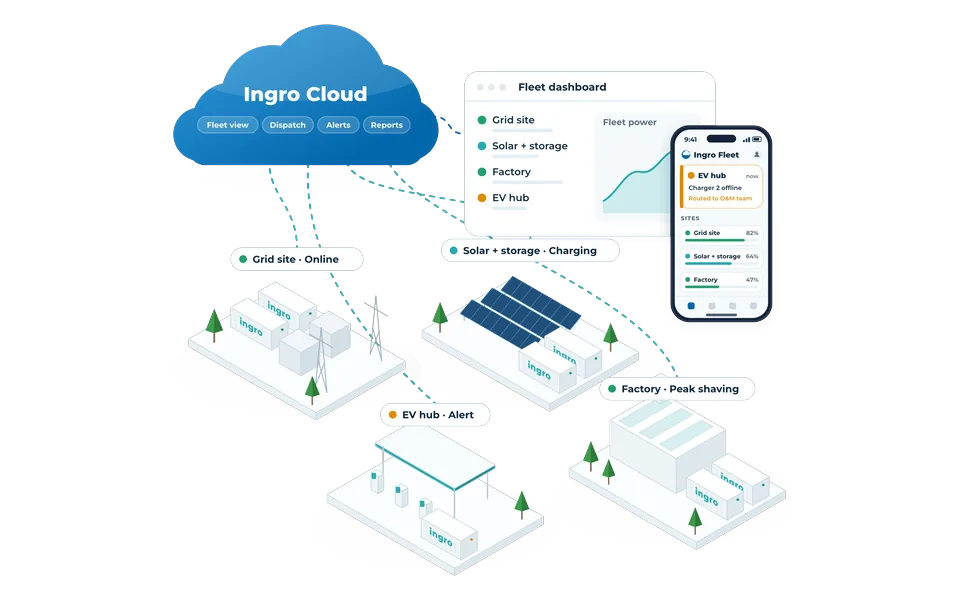
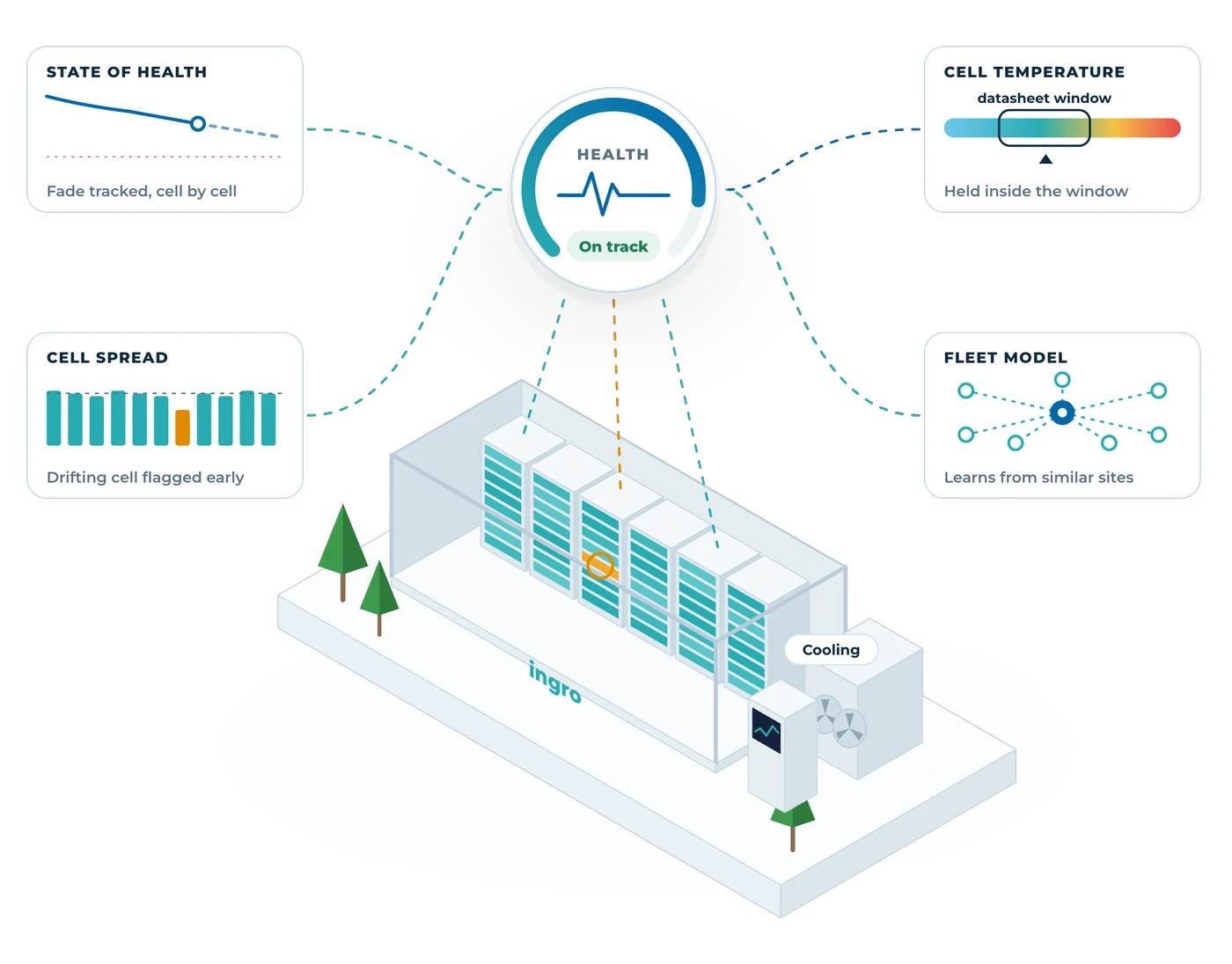
An energy management system (EMS) for BESS is the software and control layer that monitors, dispatches, and optimizes a battery energy storage system in real time. Ingro Cloud EMS gives operators fleet-wide visibility down to individual cells, remote dispatch control, multi-level alerts, and automated regulatory reporting from a single cloud dashboard.

Does Ingro Cloud EMS work with any BMS, PCS, or SCADA?

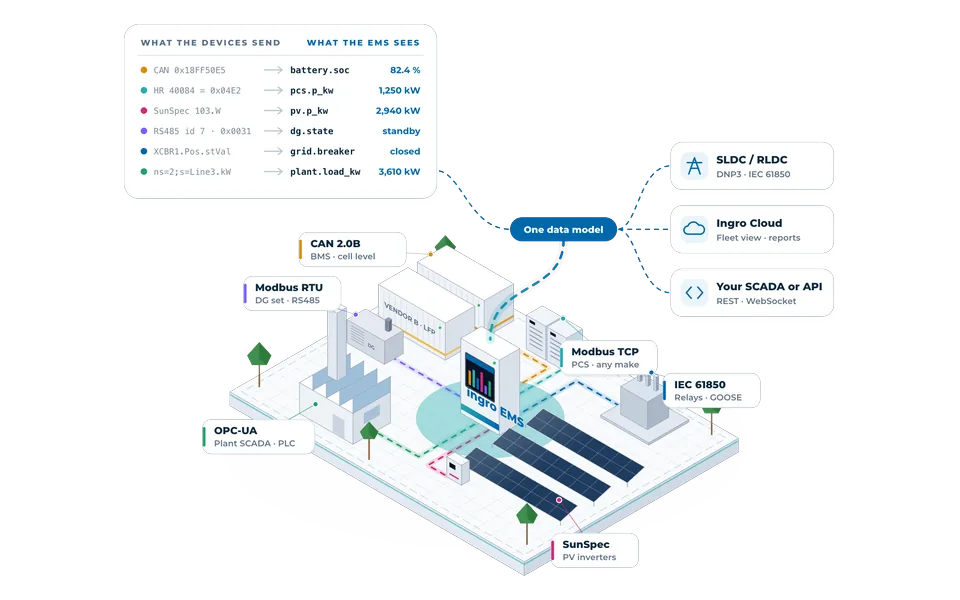
Yes. Cloud EMS connects to on-site SCADA, PLC, PCS, and BMS hardware through every major industrial protocol, Modbus TCP/RTU, IEC 61850, DNP3, and OPC-UA, so it stays vendor-agnostic across battery, inverter, and grid equipment.

Is Ingro's EMS for BESS made in India?

Yes. Ingro Cloud EMS is a made-in-India energy management system and operates one of India's oldest grid-scale BESS sites at 99.5%+ availability. An Indian-made EMS can also help qualify grid-scale projects for Viability Gap Funding (VGF) under MNRE guidelines.

Does the EMS support CERC/SERC compliance reporting?

Yes. Cloud EMS automates CERC/SERC regulatory compliance reporting and provides the real-time state-of-charge visibility and sub-second dispatch needed for frequency regulation, energy arbitrage, and ancillary-service market participation.
What is an EMS

Read more

What is an EMS in a battery energy storage system?

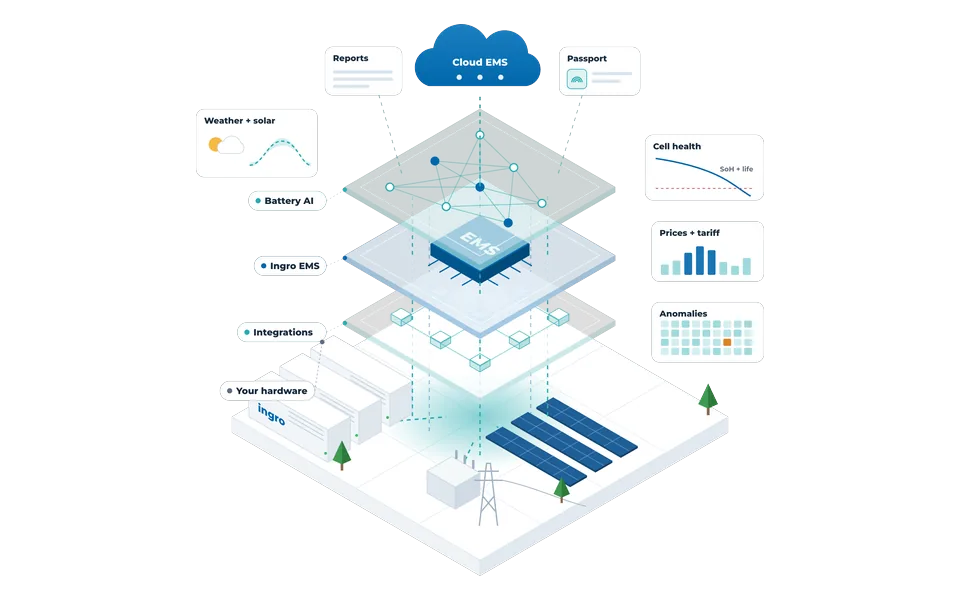
An EMS (energy management system) is the software layer that controls a BESS. It reads data from the battery, inverters and meters, decides when to charge, discharge or hold, and issues dispatch commands, all while keeping the asset within safe limits and meeting grid and market obligations. It is the decision-making brain of the storage plant.

What is the difference between an EMS and a BMS?

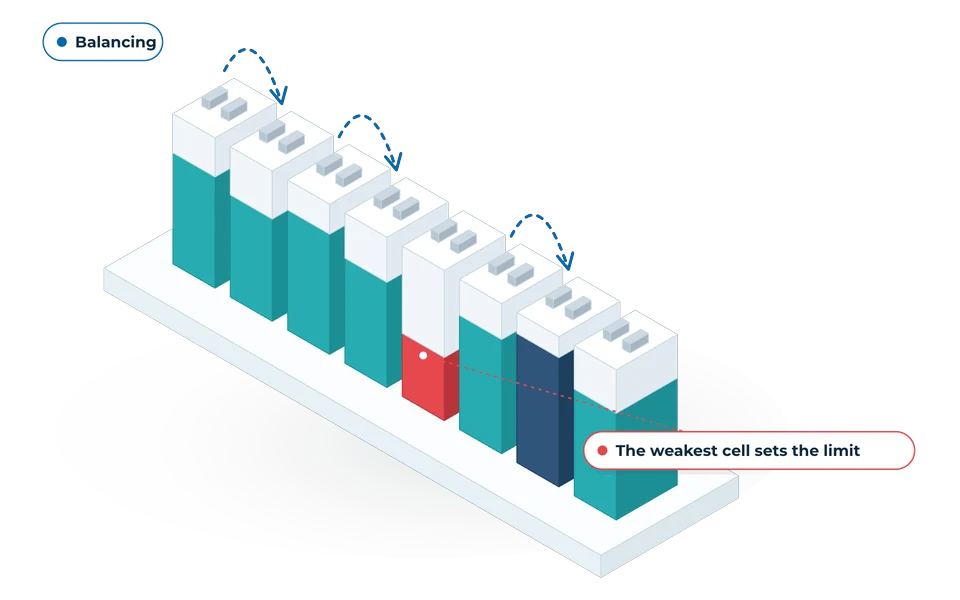
A BMS (battery management system) protects the cells, balancing them and tracking state of charge, health and temperature inside the battery. An EMS sits above it, deciding the plant's overall charge and discharge strategy against price, grid and compliance goals. The BMS keeps the battery safe; the EMS decides what the battery should do.

Is an EMS the same as SCADA?

No. SCADA is primarily a monitoring and telemetry layer that displays data and relays operator commands. An EMS adds intelligence on top, optimising dispatch, running arbitrage, and orchestrating the plant against market and grid objectives. Many modern platforms combine SCADA-style monitoring and EMS control into one system, but the optimisation logic is what makes it an EMS.

Why is the EMS important for BESS ROI?

The battery sets the physical limits, but the EMS decides how well they are used. Better dispatch, tighter energy arbitrage and stacking multiple value streams into the same battery directly raise revenue, while safe cycling extends battery life. A weak EMS leaves value unused and can shorten asset life, so it often makes or breaks the business case.

Does a BESS in India need an EMS for compliance?

Effectively, yes. Operating within CERC and SERC rules and the grid code requires accurate scheduling, response to grid signals, and detailed reporting for settlement and audits. An EMS automates this compliance reporting and keeps the audit trail. A made-in-India EMS can also help grid-scale projects qualify for Viability Gap Funding under MNRE guidelines.

SCADA vs EMS

Read more

What is the difference between SCADA and EMS in a BESS?

SCADA (Supervisory Control and Data Acquisition) monitors and supervises: it collects telemetry, visualises it on an HMI, raises alarms and lets operators issue commands. An EMS (energy management system) decides and optimises: it schedules charging and discharging to meet commercial and grid objectives. SCADA reports state; the EMS turns that data into strategy.

Can an EMS replace SCADA for a battery storage project?

Not by removing the function, but by absorbing it. Modern EMS platforms increasingly include SCADA-grade monitoring, real-time telemetry, dashboards and alarms, so you no longer need a standalone SCADA system. You still need supervisory monitoring; you simply get it inside the EMS rather than as a separate product.

Do I need both SCADA and EMS for a BESS?

Functionally, yes. You cannot safely operate a battery without supervisory monitoring, and you cannot capture its full value without optimisation. The practical decision is whether to buy separate SCADA and EMS systems or a unified platform that delivers both from one data model and one interface.

Where do SCADA and EMS sit in the BESS control stack?

From the cells up: the BMS protects the battery, the PCS converts DC to AC power, SCADA aggregates and visualises site data, and the EMS sits on top setting objectives and dispatch. Commands flow down (EMS to SCADA to PCS) while telemetry flows up (BMS to PCS to SCADA to EMS).

Why do Indian utilities require a SCADA link for BESS?

State load-dispatch centres (SLDCs) need real-time visibility and, often, control of grid-connected assets for stability and dispatch. They typically mandate a SCADA or telemetry link over DNP3 or IEC 61850 to the load-dispatch centre. This requirement is separate from, and complementary to, the EMS that optimises the battery commercially.

What protocols connect SCADA and EMS to BESS hardware?

The common industrial protocols are Modbus TCP/RTU, IEC 61850, DNP3 and OPC-UA. Modbus is widespread for device-level data, IEC 61850 and DNP3 are typical for utility and substation interfaces, and OPC-UA suits higher-level integration. Edge gateways handle protocol translation and local buffering between the field and the platform.

Cloud vs Local EMS

Read more

What is the difference between a cloud EMS and a local EMS for BESS?

A cloud EMS runs optimisation, analytics and dispatch on remote servers accessed over the internet, giving multi-site control and continuous updates. A local or on-premise EMS runs on hardware at the site, works offline and controls only that asset. Hybrid designs combine local edge control with cloud intelligence to get the benefits of both.

Does a cloud EMS stop working if the internet connection fails?

A pure-cloud EMS would lose control during an outage, but a properly designed hybrid EMS does not. Edge gateways at the site keep controlling the battery locally, buffer data during the outage, and re-synchronise with the cloud once connectivity returns, so operations continue safely without data loss.

Is on-premise EMS more secure than cloud EMS?

On-premise EMS suits air-gapped sites that must stay physically disconnected, which is a genuine security advantage. However, cloud platforms centralise encryption, monitoring and security patching, often closing vulnerabilities faster than manual site-by-site updates. The right choice depends on isolation requirements and data-sovereignty rules.

Which is cheaper, cloud EMS or on-premise EMS?

Cloud EMS typically shifts spend to a predictable subscription (opex) with minimal on-site IT, while on-premise EMS front-loads capital for servers, integration and ongoing maintenance. Cloud is usually more cost-effective across a multi-site fleet; a single isolated asset may favour local depending on tender and financing structures.

What is a hybrid edge and cloud EMS?

A hybrid edge-and-cloud EMS puts time-critical, safety-related control on an edge gateway at the site and runs optimisation, fleet analytics, remote dispatch and compliance reporting in the cloud. It combines the sub-second response and offline resilience of local systems with the scalability and intelligence of the cloud.

Can a cloud EMS handle CERC and SERC compliance reporting?

Yes. A cloud EMS can automate CERC and SERC compliance reporting by continuously collecting operational data across the fleet and generating the required reports centrally. Ingro Cloud EMS includes automated CERC/SERC reporting alongside real-time monitoring to cell level, fleet-wide analytics and multi-level alerts.

Hardware-Agnostic EMS

Read more

What is a hardware-agnostic EMS for BESS?

A hardware-agnostic EMS for BESS is an energy management system that monitors and controls batteries, PCS, meters and other equipment from any manufacturer, rather than only the OEM's own hardware. It relies on open protocols and edge gateways so the control intelligence lives in software, letting operators run mixed-vendor, multi-site portfolios from one platform.

How is a vendor-agnostic EMS different from an OEM-bundled EMS?

An OEM-bundled EMS typically communicates only with its own manufacturer's equipment, tying you to one supplier for spares, expansions and software. A vendor-agnostic EMS speaks open industrial protocols, so it works across brands and hardware generations. The practical difference is freedom: competitive procurement, mixed fleets and no forced same-brand refresh.

Which protocols does a hardware-agnostic BESS EMS use?

A capable hardware-agnostic EMS supports the main open industrial protocols: Modbus TCP/RTU for most PCS, BMS and meters; IEC 61850 for substation-grade communication with switchgear; DNP3 for utility SCADA telemetry; and OPC-UA for secure, structured data exchange. Edge gateways translate between these protocols and normalise the data into a common model.

Can a hardware-agnostic EMS retrofit an existing battery site?

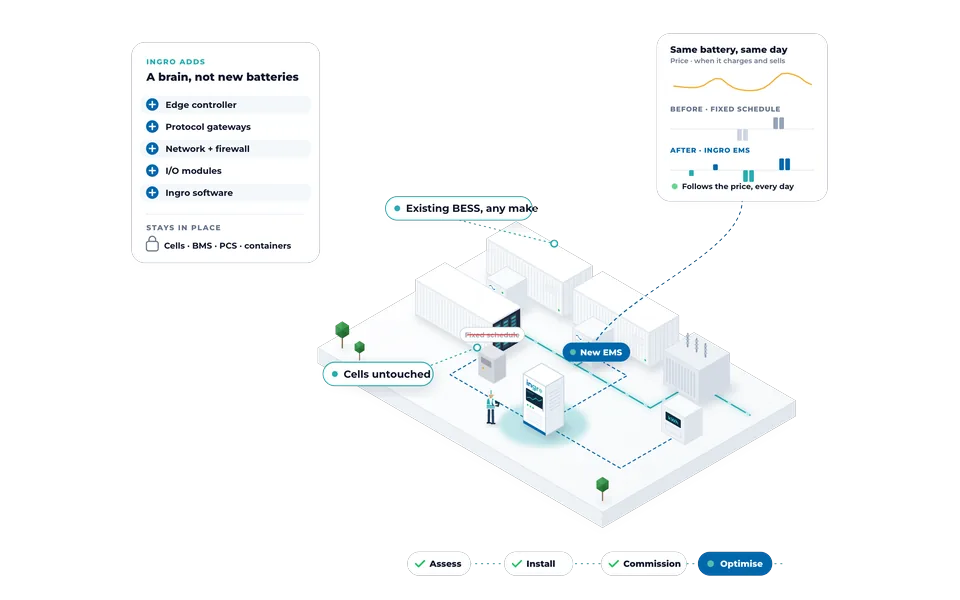
Yes. Because it connects through open protocols rather than proprietary interfaces, a hardware-agnostic EMS can be added as a control and analytics layer on top of existing or ageing (brownfield) hardware. This lets operators modernise monitoring, dispatch and compliance without ripping out functioning batteries or inverters, protecting the original capital investment.

Does a hardware-agnostic EMS create cybersecurity risks?

Connecting many vendors does widen the attack surface, so cybersecurity must be designed in. Secure edge gateways, network segmentation, encrypted protocols such as OPC-UA, and strict access control keep multi-vendor systems safe. The risk is manageable and should not be a reason to accept vendor lock-in; it is a reason to vet the EMS partner carefully.

Can a made-in-India EMS help with VGF for BESS projects?

Yes. Using a made-in-India EMS, such as Ingro Cloud EMS, can help grid-scale battery storage projects qualify for Viability Gap Funding (VGF) under MNRE guidelines. This is increasingly relevant for developers bidding into government-backed storage tenders, where domestic content and local capability strengthen the case for support.

Grid-Connected BESS

Read more

What is the difference between a grid-connected BESS and an off-grid BESS?

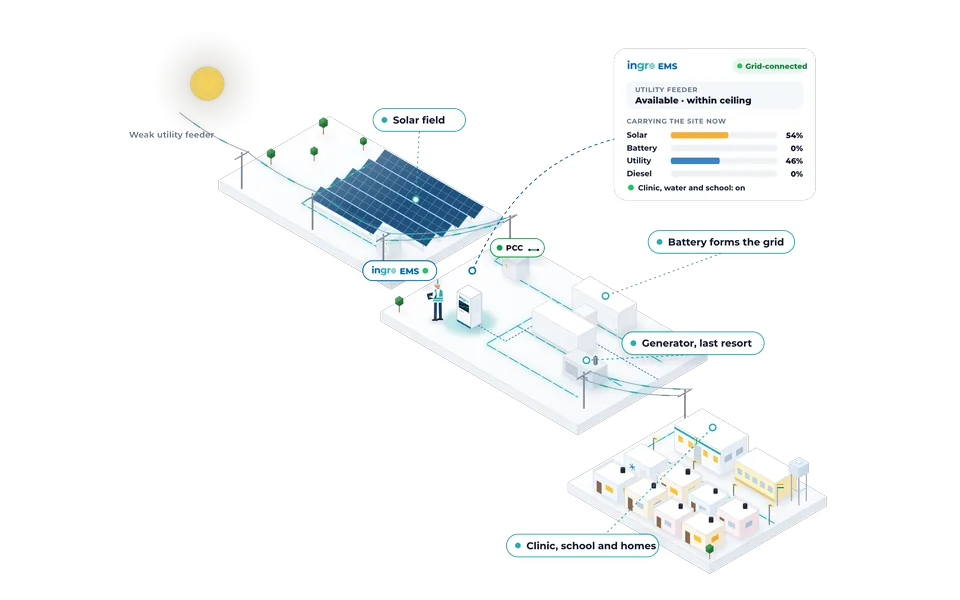
A grid-connected BESS is tied to the utility grid and can import and export power, follow despatch signals and earn from markets and ancillary services. An off-grid or islanded BESS serves an isolated load or microgrid with no continuous grid link, so its role is reliable local supply rather than market participation.
Why is grid-connected storage important for India's grid?

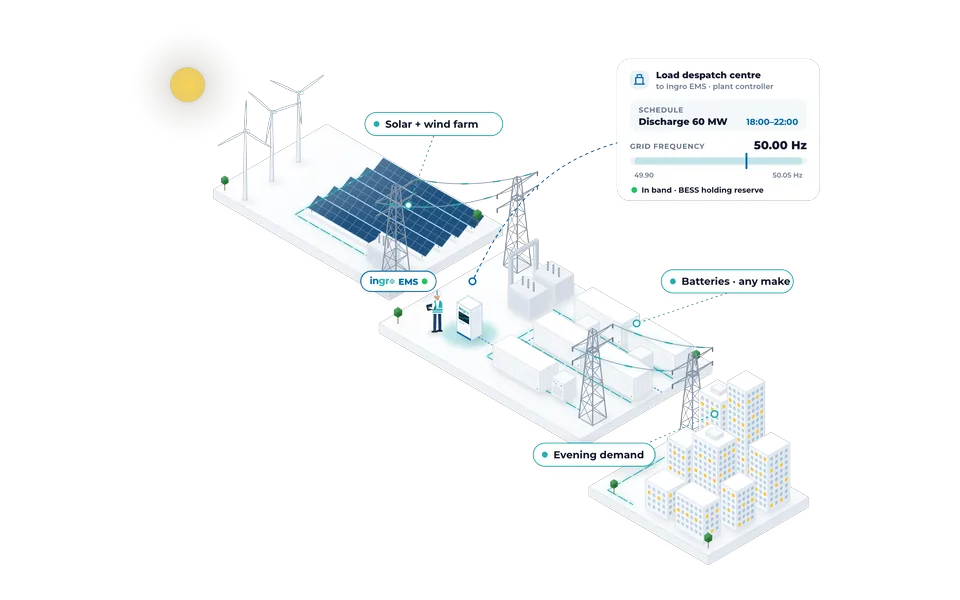
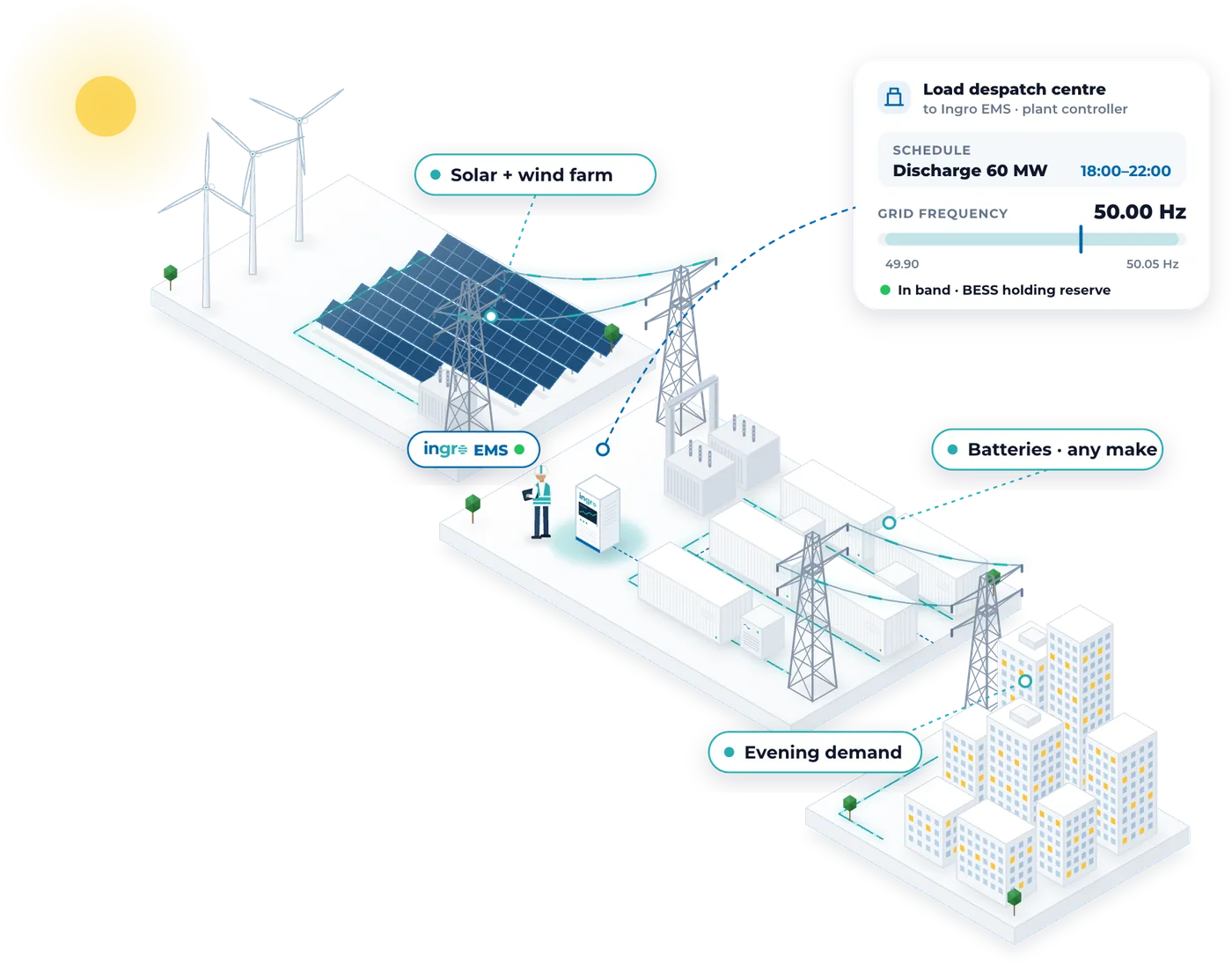
As solar and wind grow, India's grid faces steep evening ramps and rising variability. Grid-connected storage shifts midday solar to the evening peak, firms renewable output for RTC and FDRE tenders, and provides fast frequency response. It is the most flexible tool for keeping a renewable-heavy grid stable and dispatchable.

What value streams can a grid-connected BESS provide?

The main ones are frequency regulation and ancillary services, peak shaving and capacity firming, renewable integration and ramp control, energy arbitrage, black-start and reactive-power support, and transmission and distribution deferral. Economics improve when one asset serves several of these streams, which requires an EMS able to arbitrate between them safely.

What compliance obligations come with connecting a BESS to the grid?

A grid-connected BESS must meet the applicable CERC and SERC grid code, provide real-time telemetry to the RLDC or SLDC, follow scheduling and despatch instructions, and maintain accurate metering. It is exposed to the Deviation Settlement Mechanism and must submit periodic regulatory compliance and performance reports.

Why does a grid-connected BESS need a smart EMS?

The battery only sets the potential; the EMS captures the value. A smart EMS for grid-connected BESS dispatches in real time against grid signals and prices, participates in markets, forecasts, stacks multiple value streams, protects battery health and state of charge, and automates compliance reporting, turning identical hardware into a higher-return asset.

How does Ingro Cloud EMS support grid-connected BESS projects?

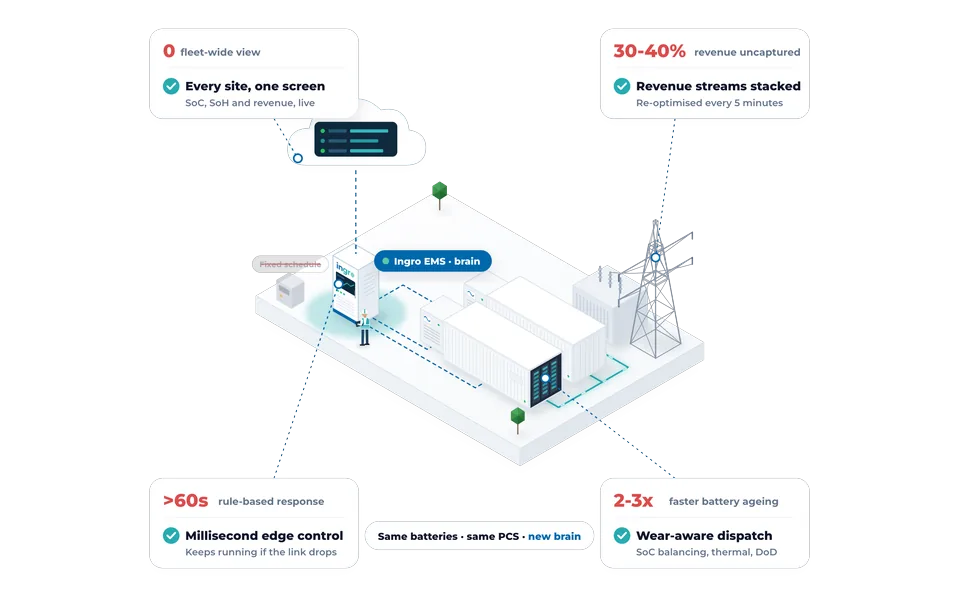
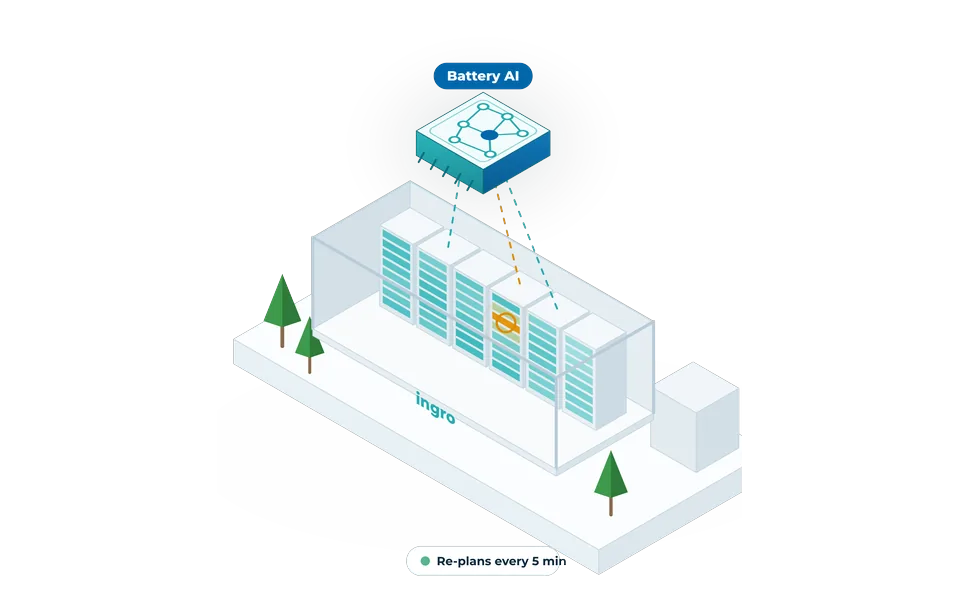
Ingro Cloud EMS is a made-in-India, hardware-agnostic platform offering cell-level monitoring, centralised dispatch, sub-10ms edge control and automated CERC and SERC reporting. It supports Modbus, IEC 61850, DNP3 and OPC-UA, re-optimises dispatch every five minutes, and feeds Battery AI for revenue optimisation across the asset.

Solar + BESS + AI EMS

Read more

What is solar-plus-storage?

Solar-plus-storage pairs a solar PV plant with a battery energy storage system so surplus midday generation can be stored and released later. This lets the plant deliver firm, dispatchable power into evening peaks, recover clipped and curtailed energy, and meet round-the-clock and peak-power PPA obligations that standalone solar cannot satisfy on its own.

What is the difference between DC-coupled and AC-coupled solar-plus-storage?

In a DC-coupled system the battery and solar array share a DC bus behind one inverter, which is best for capturing clipped energy and offers higher solar-charging efficiency. In an AC-coupled system each has its own inverter and meets on the AC side, making it ideal for retrofits and for charging from both solar and the grid.

Why is an AI-powered EMS better than a rules-based EMS for solar BESS?

A rules-based EMS follows fixed schedules and cannot see future prices or solar forecasts, so it discharges at the wrong time, misses peaks, and ignores battery degradation. An AI-powered EMS forecasts generation and prices, optimises across competing objectives, and captures clipped energy, extracting more revenue while honouring PPA commitments and protecting battery health.
How does a BESS help meet RTC and FDRE tender obligations in India?

Round-the-clock and Firm and Dispatchable Renewable Energy tenders require developers to supply committed blocks of power across the day. A co-located BESS stores surplus solar and discharges it during hours when generation is low, letting the plant deliver firm, scheduled output and avoid shortfall penalties without over-building solar capacity.

How does Ingro Cloud EMS optimise a solar-plus-storage plant?

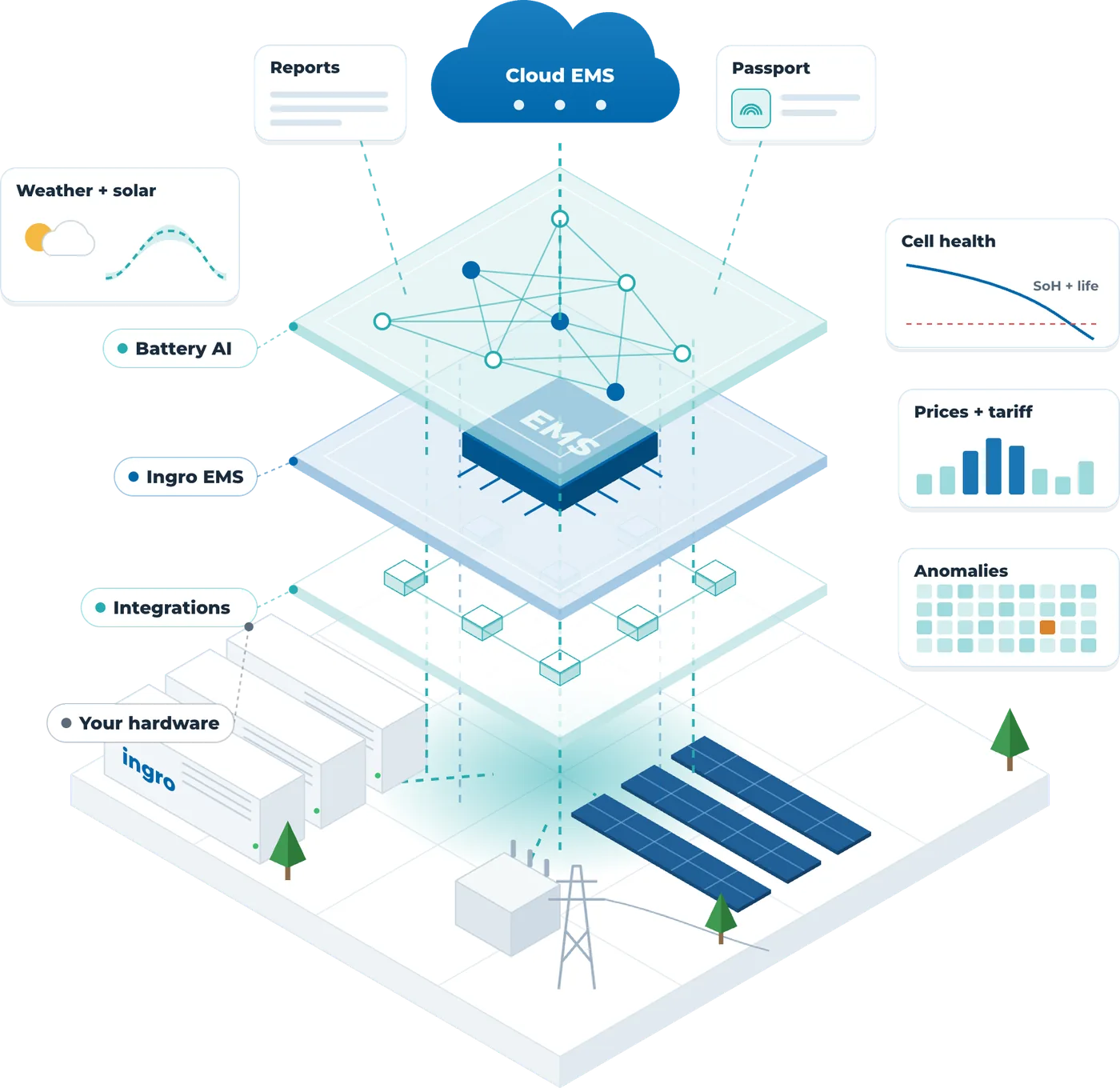
Ingro Cloud EMS provides cell-level monitoring, remote dispatch control, and automated CERC and SERC reporting over protocols like Modbus, IEC 61850, DNP3, and OPC-UA. Its Battery AI layer ingests exchange prices, weather, load, and grid signals and re-optimises dispatch every five minutes to maximise revenue while protecting battery health.

Can a BESS reduce solar curtailment and clipping losses?

Yes. When the grid cannot accept output or when DC generation exceeds inverter or interconnection limits, that energy is normally curtailed or clipped and lost. A BESS absorbs this surplus and stores it for later discharge. An AI-powered EMS prioritises capturing this otherwise-wasted energy, improving overall plant yield and returns.

EMS for C&I

Read more

What is an EMS for C&I?

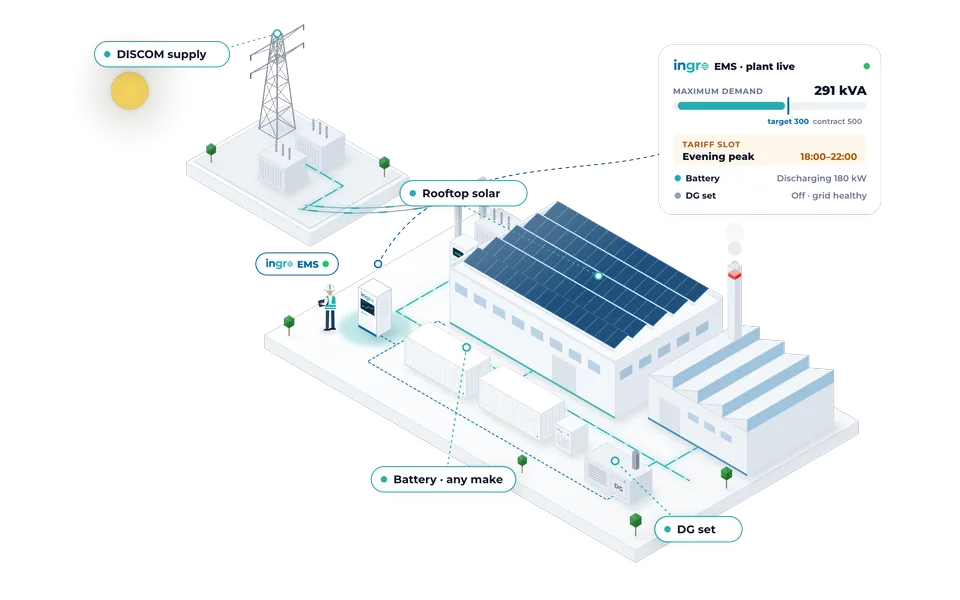
An EMS for C&I is an energy management system that monitors and controls every power source on a commercial or industrial site, grid, solar, diesel generator and BESS, from one platform. It automates dispatch to cut demand charges, shift load out of peak tariffs, maximise solar self-consumption and reduce diesel use, replacing several siloed control systems with a single dashboard.

How does a C&I EMS reduce demand charges?

Demand charges are set by a site's highest kVA or kW peak in the billing period, so a single spike can inflate the fixed cost for the whole month. A C&I EMS uses the BESS to shave those peaks, discharging stored energy the moment demand rises, so the metered peak stays low and the demand charge falls.

Can an EMS reduce diesel generator costs?

Yes. By coordinating battery storage and solar with the load, an EMS serves demand from stored and on-site energy first and starts the diesel generator only when it is genuinely the least-cost or only option. During outages, edge control fails over to battery and solar in milliseconds, cutting DG runtime, fuel burn and wear.
Does an EMS work with existing solar and generators?

It should. A hardware-agnostic EMS connects to existing solar inverters, DG controllers, meters and batteries through open protocols such as Modbus, IEC 61850, DNP3 and OPC-UA. This means most Indian C&I sites can be retrofitted, adding coordination and intelligence to equipment already installed, rather than replacing working hardware.

What is Time-of-Day arbitrage for a C&I site?

Time-of-Day (ToD) tariffs price electricity higher during peak hours and lower off-peak. ToD arbitrage means charging the battery with cheap off-peak or surplus solar energy and discharging it during expensive peak windows to serve load. A C&I EMS automates this every day, timing charge and discharge to the tariff schedule to lower energy spend.

How does Ingro Cloud EMS orchestrate a C&I site?

Ingro Cloud EMS brings grid, solar, diesel and BESS into one dashboard, connecting hardware through open protocols via its Integrations layer and edge gateways. Battery AI re-optimises dispatch every five minutes across peak shaving, arbitrage, solar use and diesel runtime, while edge control gives sub-second failover. It can be retrofitted onto existing sites and automates CERC/SERC compliance reporting.

Fleet Cloud EMS

Read more

What is a fleet EMS for BESS?

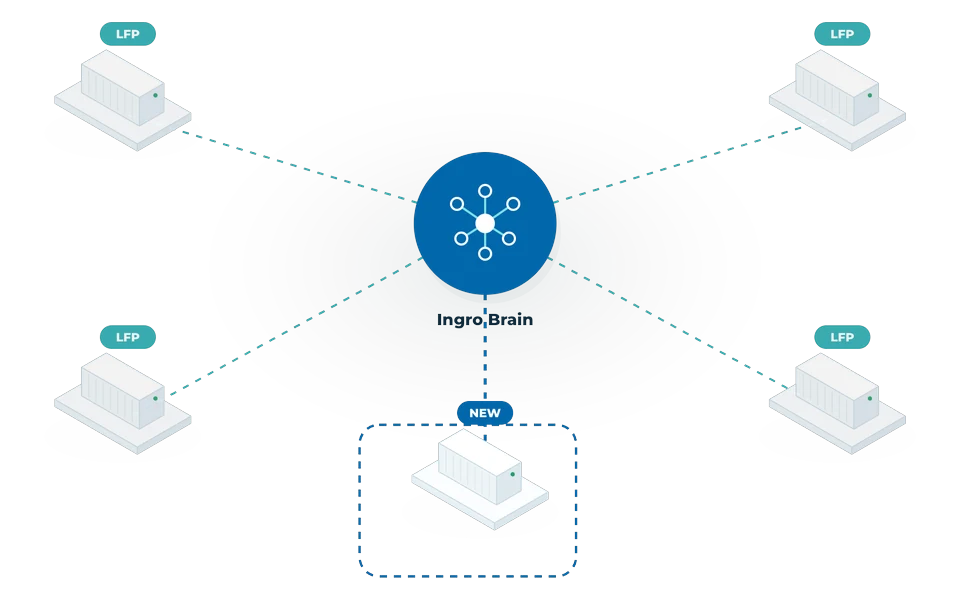
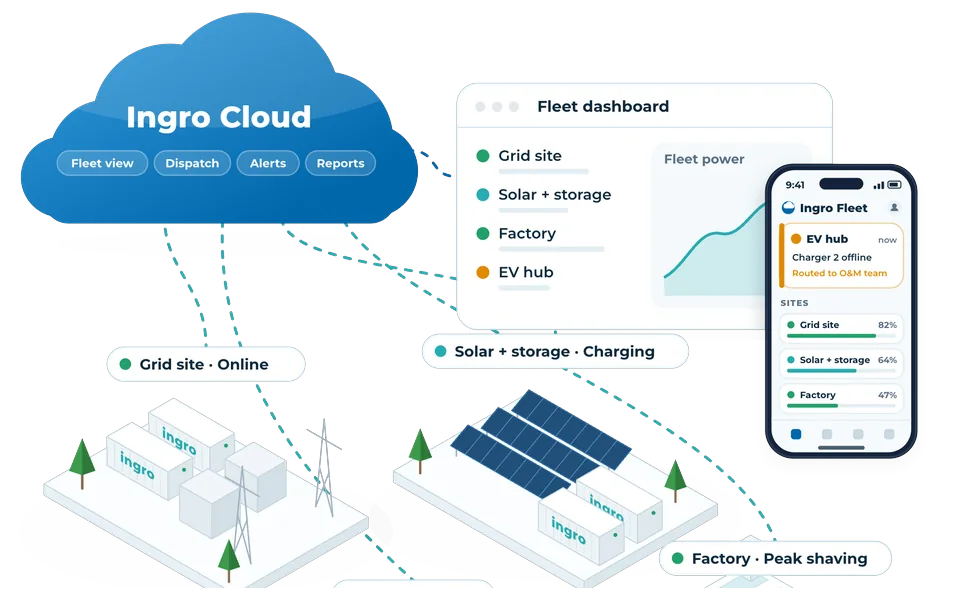
A fleet EMS is a cloud energy management system that operates many battery storage sites as one portfolio. It normalises data from mixed OEM hardware into a single dashboard, enabling real-time monitoring, aggregated and per-site dispatch, cross-site benchmarking and centralised diagnostics, so operators manage a fleet rather than a collection of isolated facilities.

How does a cloud EMS reduce site visits and truck rolls?

By streaming live telemetry from every site to a central platform, a cloud EMS lets engineers monitor, diagnose and often resolve issues remotely. Anomaly detection flags problems early, configuration can be pushed from the control room, and only genuine hardware faults require a visit, which then arrives targeted and parts-ready rather than exploratory.

Can one EMS manage BESS sites from different manufacturers?

Yes. A hardware-agnostic fleet EMS such as Ingro Cloud EMS integrates mixed OEM equipment over standard protocols like Modbus, IEC 61850, DNP3 and OPC-UA, then maps everything to a common data model. Operators get consistent metrics and controls across every site regardless of the battery, inverter or PCS vendor underneath.

How do you manage BESS compliance across multiple Indian states?

A portfolio spanning several states faces different SERC rules, scheduling and ABT metering norms, with inter-state assets under CERC. A fleet cloud EMS standardises data capture and automates reporting to each jurisdiction's format, so compliance and SLA evidence scale with the fleet instead of requiring a separate manual process per site and per off-taker.

Does adding more BESS sites require proportionally more staff?

Not with a fleet EMS. Because monitoring, dispatch, diagnostics and reporting are centralised and automated, a single control room can oversee many sites while human attention focuses on exceptions. Templated onboarding and remote diagnostics mean a growing portfolio adds capacity and revenue without adding operators in proportion to the number of sites.

How does fleet monitoring improve BESS revenue?

Seeing the whole portfolio lets the EMS optimise dispatch across sites rather than in isolation, allocating each obligation to the site with the lowest marginal cost or healthiest cells. Cross-site benchmarking surfaces under-performers early, and re-optimising dispatch frequently, every five minutes in Ingro Cloud EMS, keeps decisions aligned with changing prices and state of charge.

Battery Storage (BESS)

Battery Storage (BESS)

What is BESS

Read more

What is a BESS in simple terms?

A BESS, or battery energy storage system, is a rechargeable system that stores electricity in batteries and releases it when needed. It combines battery cells, power electronics, thermal management, and control software so that power produced at one time can be used at another, improving reliability and cutting costs.

What are the main components of a battery energy storage system?

A BESS has six core components: battery cells and modules that store energy, a battery management system (BMS) that protects them, a power conversion system (PCS) or inverter that converts between DC and AC, an energy management system (EMS) that controls dispatch, thermal management, and the enclosure with safety and control gear.

How does a BESS work?

During charging, a BESS takes in electricity, converts it from AC to DC through the inverter, and stores it in batteries as chemical energy. During discharging, it converts that stored DC back to grid-quality AC and delivers it to the load. An EMS decides the optimal timing based on grid conditions, prices, and battery health.

What is a BESS used for in India?

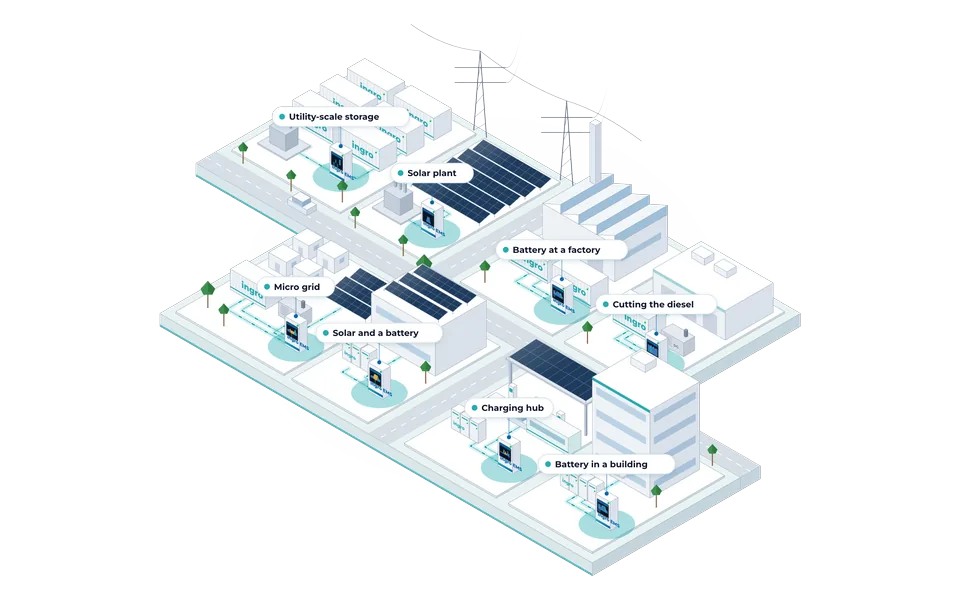
In India, BESS is used for grid-scale frequency regulation and reserves, commercial and industrial peak shaving and demand-charge reduction, EV charging support, microgrids, solar and wind firming, and open-access energy arbitrage. Policy support from CERC, SERCs, MNRE, and VGF schemes is accelerating adoption across these applications.

Why is the EMS considered the brain of a BESS?

The EMS is the brain because it turns battery capacity into useful, profitable output. Sitting above the BMS and inverter, it monitors the system down to cell level, makes real-time dispatch decisions, raises alerts, and automates compliance reporting. Two identical batteries perform very differently depending on the intelligence of the EMS controlling them.

Is a made-in-India EMS important for BESS projects?

Yes. Beyond data sovereignty and local support, a made-in-India EMS such as Ingro Cloud EMS can help grid-scale projects qualify for Viability Gap Funding (VGF) under MNRE guidelines. It also automates the CERC and SERC compliance reporting that Indian regulators increasingly require from storage operators.

BESS Types & Chemistries

Read more

What are the main types of BESS?

BESS are grouped by application and scale, spanning utility or grid-scale (multi-MW), commercial and industrial behind-the-meter, residential, and portable or containerised systems, and by electrical architecture as DC-coupled or AC-coupled. Each type suits different duty cycles and site constraints, which in turn influence the most appropriate battery chemistry and safety design.

Which battery chemistry is best for grid-scale storage in India?

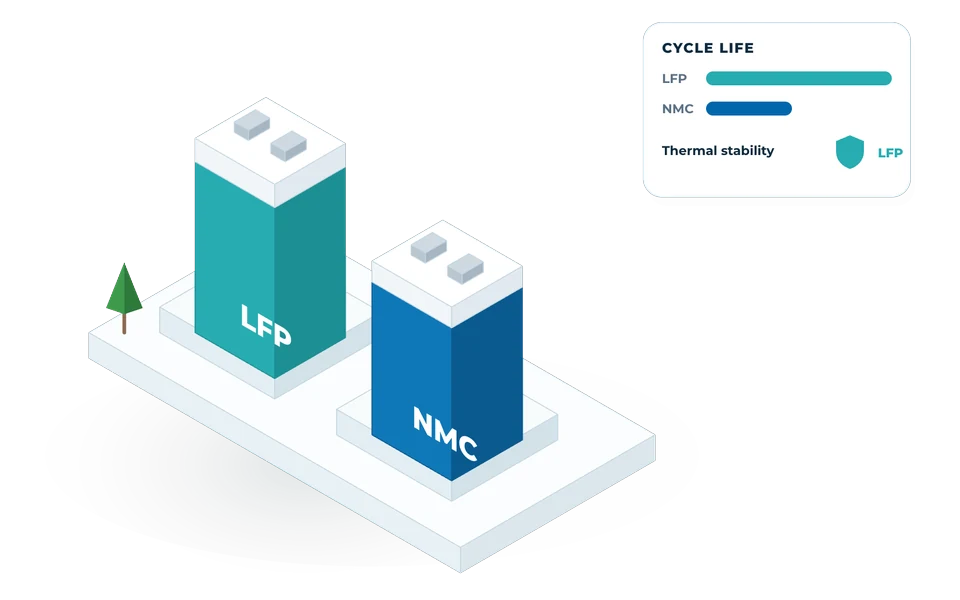
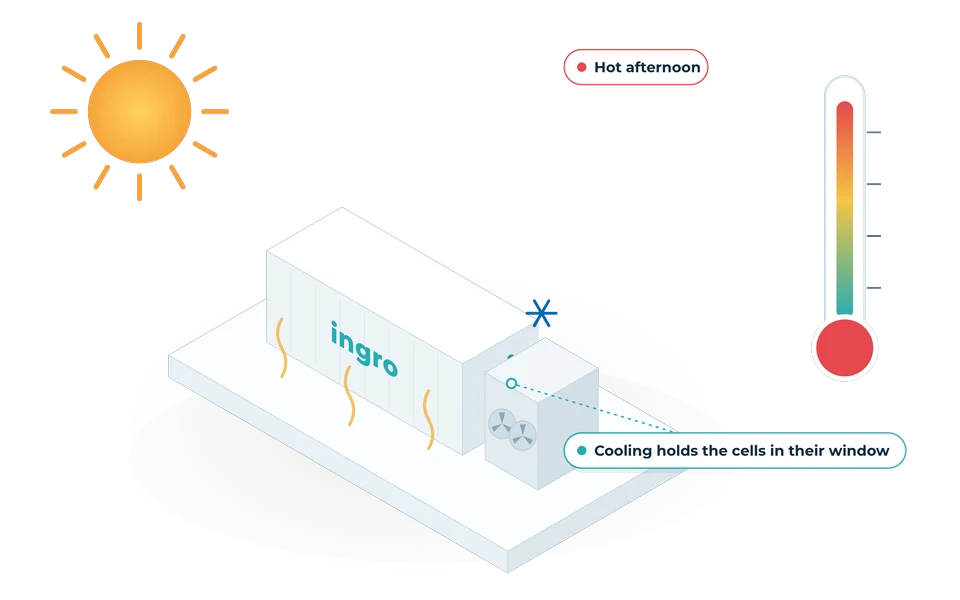
LFP (lithium iron phosphate) is generally the best fit for Indian grid-scale storage. Its strong thermal stability suits high ambient temperatures, its long cycle life handles daily deep cycling, and its cobalt-free make-up lowers cost and supply risk. NMC is reserved for cases where limited space or weight makes its higher energy density essential.

What is the difference between LFP and NMC batteries?

Both are lithium-ion. LFP (LiFePO4) offers better safety, longer cycle life and lower cost, but only moderate energy density. NMC packs more energy into less space and weight but is less thermally stable, shorter-lived under deep cycling and more expensive due to nickel and cobalt. LFP dominates stationary storage, while NMC leads in EVs.

Is sodium-ion a viable alternative to lithium-ion?

Sodium-ion is a promising emerging chemistry. It uses abundant, low-cost materials, avoids lithium and cobalt, and performs better in cold weather with good thermal safety. Its energy density is still below LFP and its commercial track record is limited, so it is maturing rather than mainstream, but it could ease supply constraints as volumes grow.

When should you use a flow battery instead of lithium-ion?

Consider flow batteries, such as vanadium redox, for long-duration storage of roughly four hours or more. They scale power and energy independently, last for very many cycles with little degradation, and use a non-flammable electrolyte. The trade-offs are low energy density, a large footprint and high upfront cost, so they suit stationary long-duration duty rather than compact installations.

Why does an EMS need to be chemistry-agnostic?

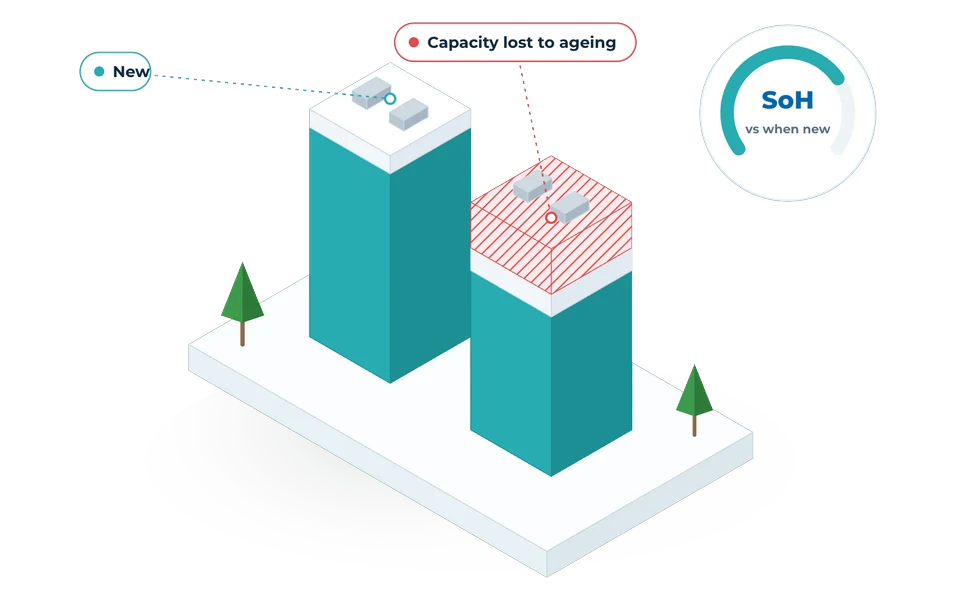
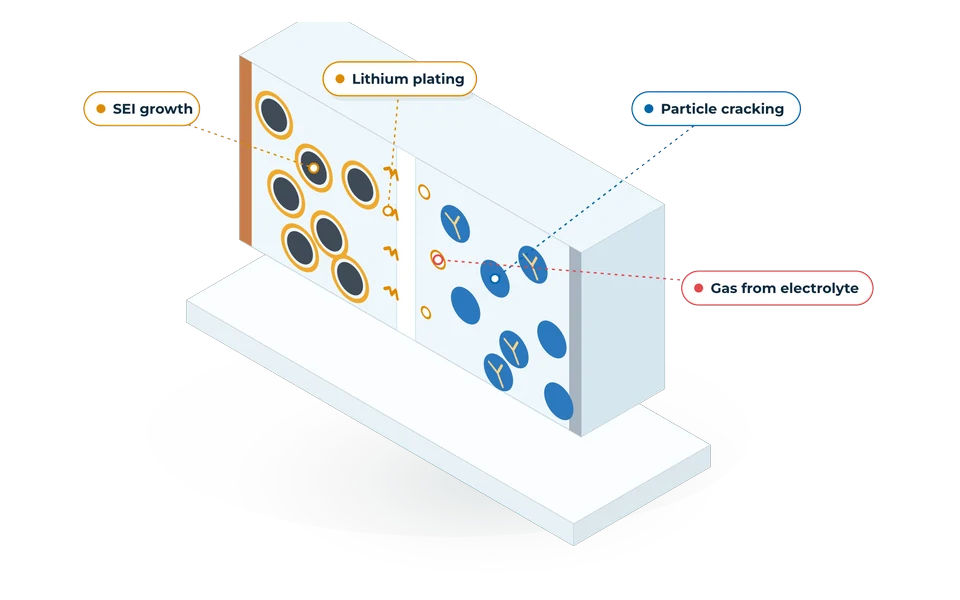
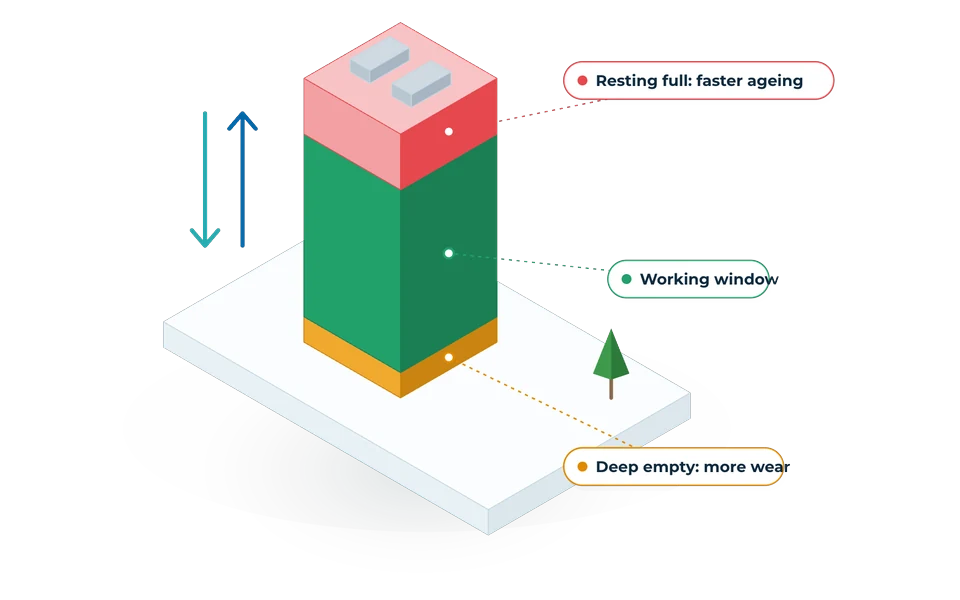
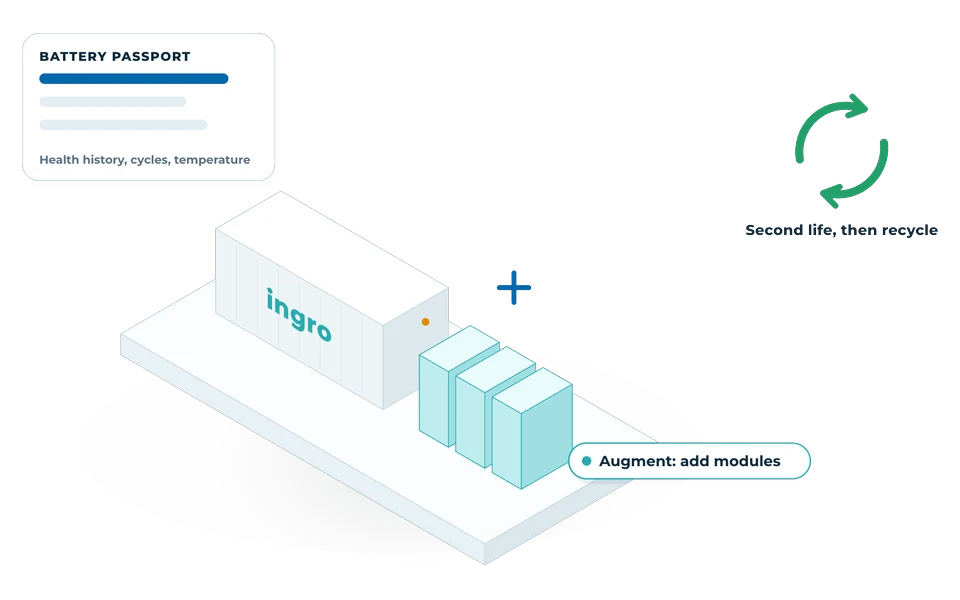
Storage portfolios often mix vendors and chemistries, and each ages differently. A chemistry-agnostic EMS like Ingro Cloud EMS integrates any battery via the BMS using open protocols, so monitoring, dispatch, analytics and compliance stay consistent across the fleet. Battery Passport then tracks health, including cycle counts, depth of discharge, thermal exposure and capacity fade, for any chemistry on one platform.

Solar & Home

Solar & Home

Home Solar + Battery

Read more

What is a home solar battery storage system?

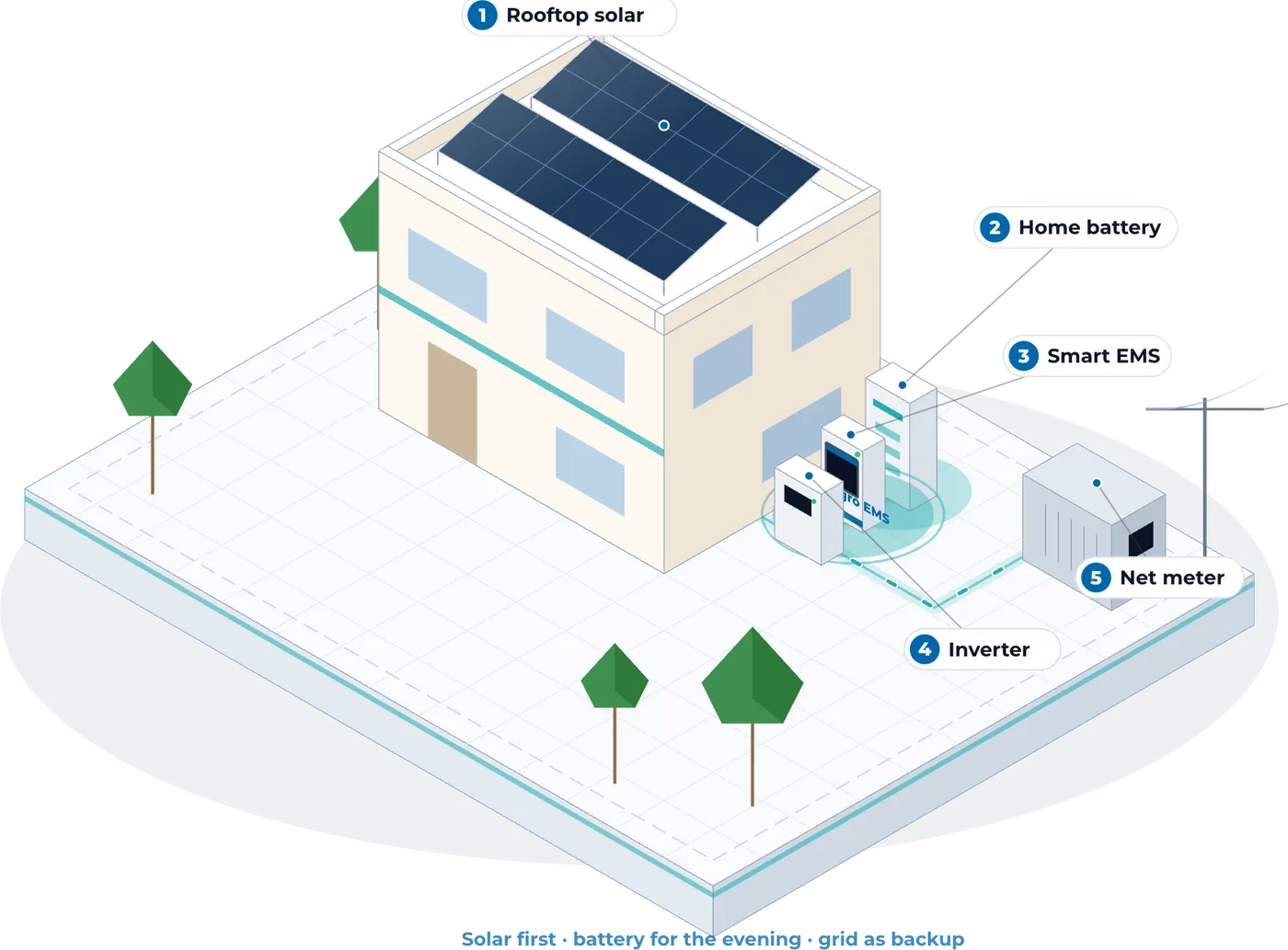
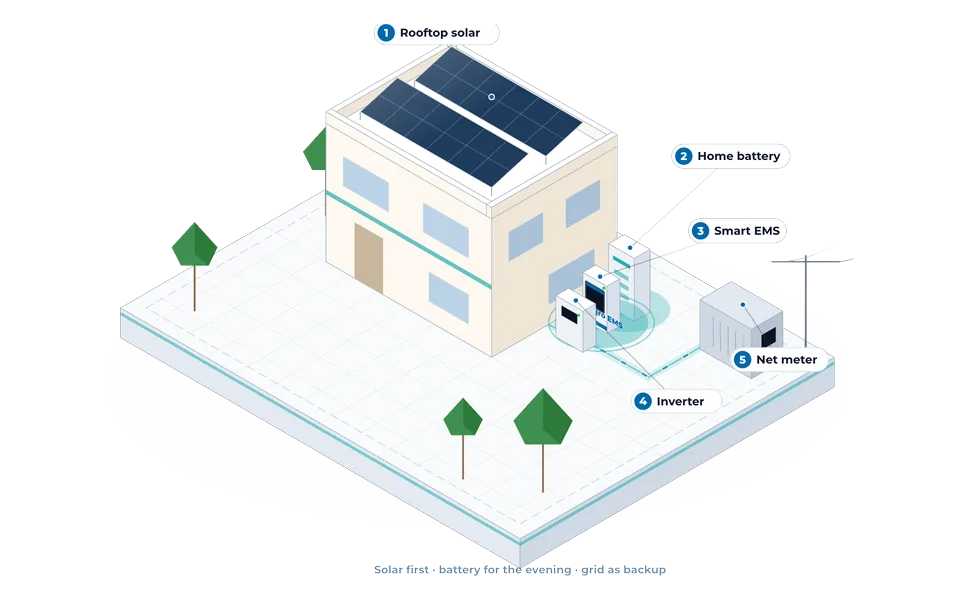
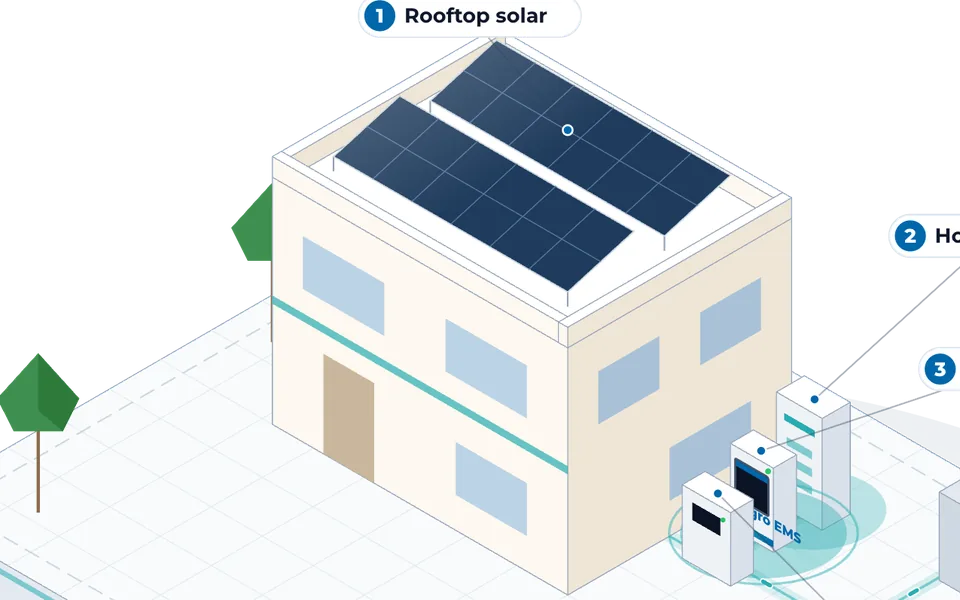
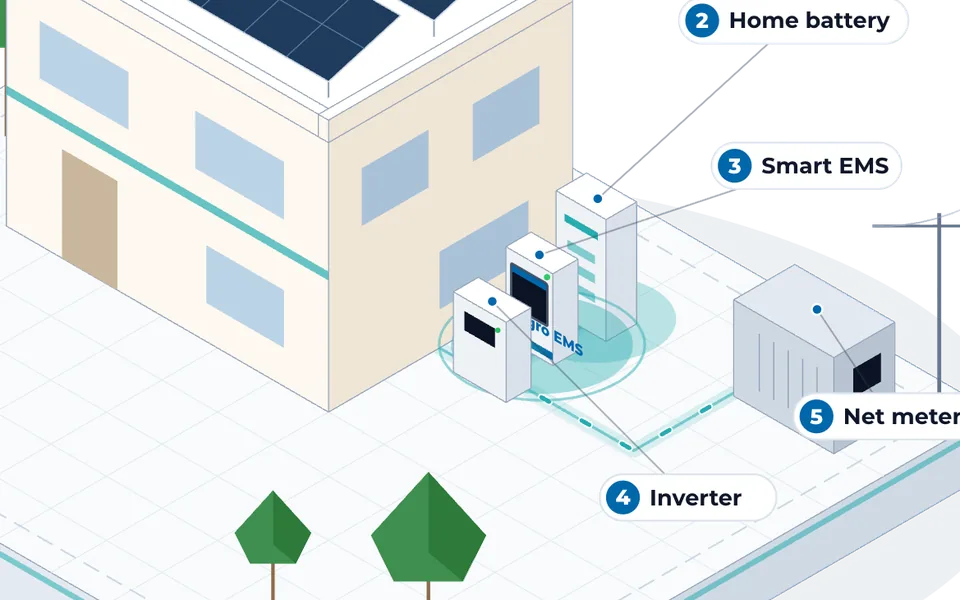
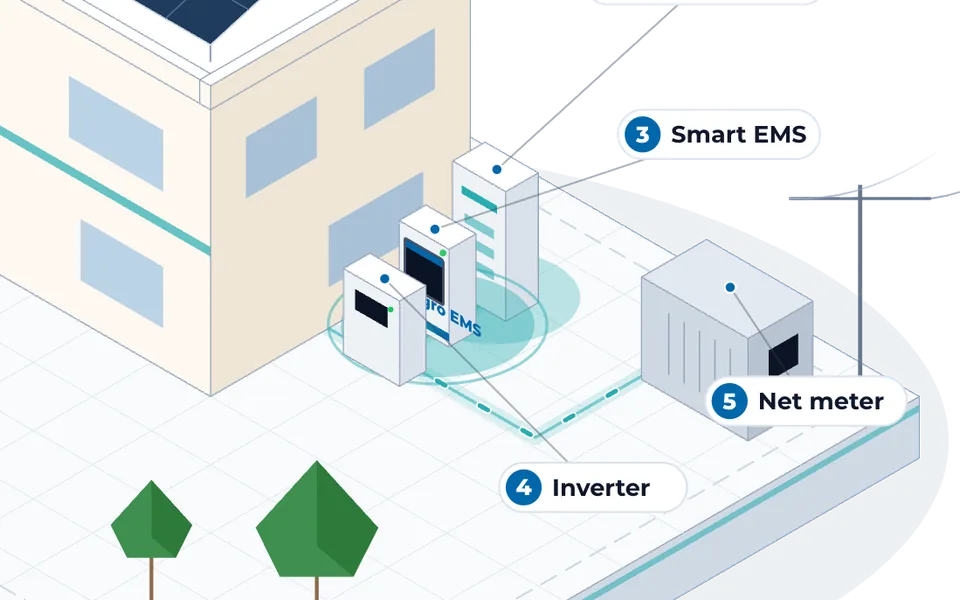
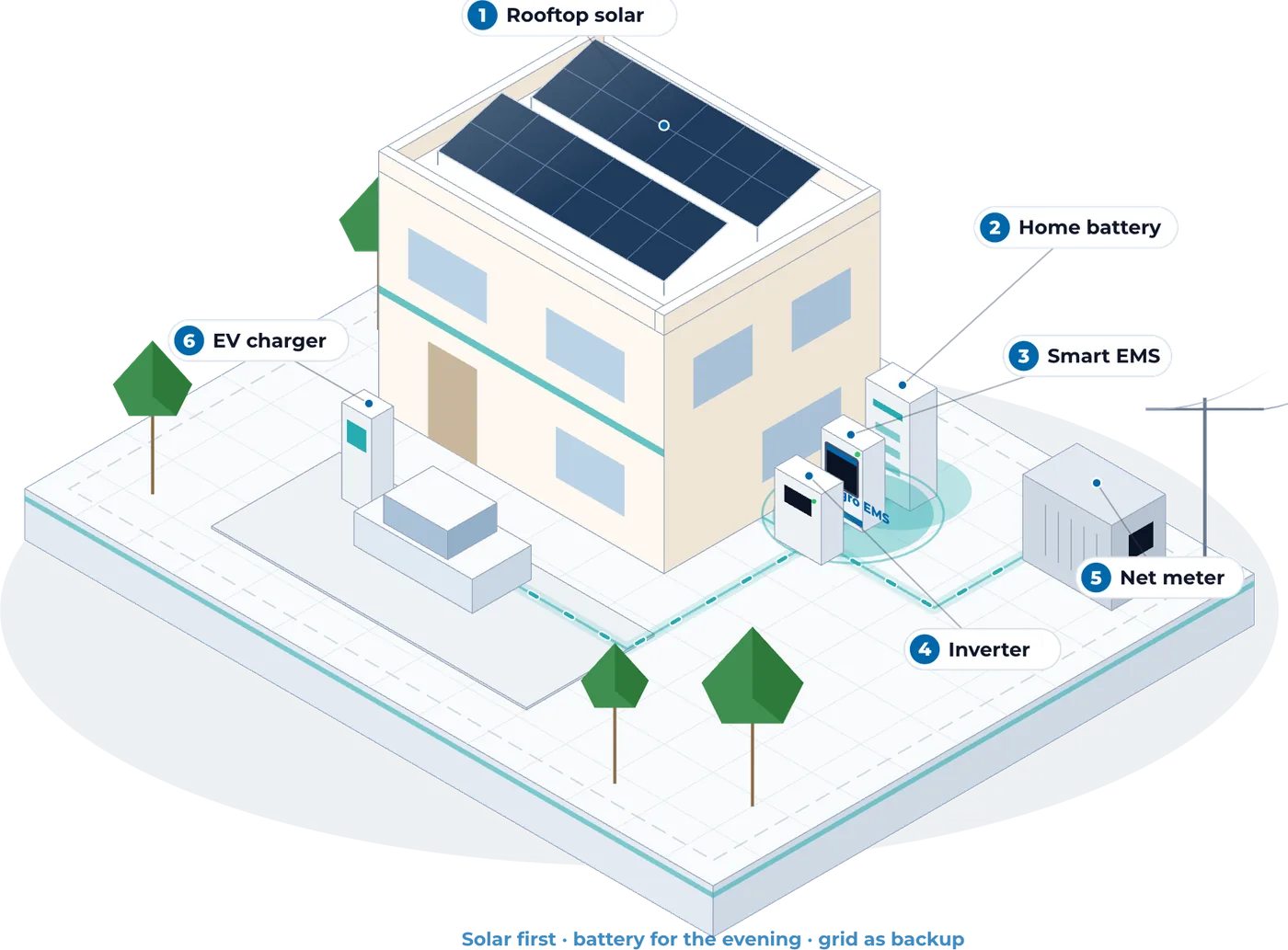
It is a rooftop solar setup paired with a battery. The panels generate electricity during the day, a hybrid inverter converts and directs that power, and the battery stores surplus energy so you can use your own solar after sunset or during a power cut. A smart controller manages the flow between solar, battery, home, and grid.

Do I really need a battery, or is grid-tied solar enough?

It depends on your grid. If your supply is reliable and your main goal is lower bills, grid-tied solar without a battery gives the best simple payback. If you face frequent cuts or want to use daytime solar in the evening, a battery is worth the extra cost. Many Indian homes choose a hybrid system for exactly this balance.

How long can a home battery run my house during a power cut?

That depends on the battery's capacity and how many appliances you run. Sized around essentials such as lights, fans, the router, and a fridge, a home battery can typically cover a normal evening outage, while heavy loads like air conditioners and water heaters drain it much faster. Sizing the battery to your backup priorities, not your whole house, keeps it practical and affordable.

Will solar and a battery work during the monsoon?

Yes, though generation drops on heavily overcast monsoon days. Panels still produce power in diffuse light, just less of it, and your battery and grid connection cover the shortfall. This is one reason hybrid systems suit India well: the grid acts as a backstop when several cloudy days in a row limit solar output.

What is net metering and how does it help me?

Net metering lets you send surplus solar to the grid and receive credit against the units you import later, so your bill reflects your net consumption. The exact rules, credit rates, and system-size caps are set by your state regulator and administered by your DISCOM, so confirm the current policy where you live before planning around it.

Is PM Surya Ghar the same as net metering?

No. Net metering is the billing arrangement for exporting surplus solar to the grid. PM Surya Ghar: Muft Bijli Yojana is a national scheme that supports residential rooftop solar for eligible households. They can work together, but because scheme details and figures change over time, verify the latest information on the official portal or with an empanelled installer.

Solar + Battery Worth It?

Read more

Is a home solar battery worth it in India?

It depends on your grid, tariff, and usage. Solar itself is often worth it for homes with high bills and decent daytime use. A battery is worth it mainly if you face frequent power cuts, pay time-of-day tariffs with a steep evening peak, or have poor net metering. If your grid is reliable and net metering is generous, solar-only usually makes more financial sense.

Does solar or solar-plus-battery pay back faster?

For most Indian homes with a working grid and fair net metering, solar-only pays back faster, because the grid effectively stores your surplus for free through net metering. A battery adds cost without generating extra power, so it typically lengthens payback unless it is clearly earning its keep through backup, peak-hour avoidance, or poor export credits.

How do I estimate payback from my own electricity bill?

Look at your monthly units, your per-unit tariff and slabs, whether you have time-of-day charges, how much you use in daylight versus at night, and how often your power goes out. High bills and steep slabs favour solar; night-heavy use, ToD peaks, poor net metering, and frequent outages favour a battery. Then get local quotes to turn that picture into real numbers.

When is a home battery not worth it?

A battery is usually not worth it if outages are rare and short, your tariff is flat and moderate with no steep evening peak, your net metering credits exports near the retail rate, and you already use most of your power during the day. In that situation a well-sized solar-only system is typically the smarter spend, and you can always revisit a battery later.

Do batteries need replacing, and does that affect payback?

Yes. Home batteries deliver a finite number of charge and discharge cycles and usually need replacing before the solar panels, which last much longer. Any honest payback calculation should treat that future replacement as a real cost. Ignoring it makes a battery look cheaper over its lifetime than it truly is.

Should I add solar now and a battery later?

Often, yes. Many homeowners size their solar well now, rely on net metering, and add a battery later if outages worsen, time-of-day tariffs are introduced, or battery prices fall further. Solar and battery can be installed separately, so you can capture solar savings first and make the battery decision once your situation and the numbers are clearer.

Sizing Home Solar & Battery

Read more

How do I calculate what size solar system my home needs?

Start with your electricity bill. Take your average monthly units (kWh), divide by 30 for a daily figure, then decide how much of that you want solar to cover. Divide that daily energy by your area's realistic sun-hours, often around four to five in India, to get an approximate array size in kW, and round up to allow for losses, dust and panel ageing.

What is the difference between kW and kWh when sizing a system?

kW (kilowatt) is power, the rate at which energy flows, and it rates your panels and inverter. kWh (kilowatt-hour) is energy, a quantity used or stored over time, and it measures your battery and your monthly bill. In practice you size solar arrays and inverters in kW and batteries in kWh.

How big a battery do I need for backup during power cuts?

List only the loads you truly need during an outage, note each one's wattage and how many hours you want it to run, and total the energy in kWh. Then divide by the battery's usable fraction, its depth of discharge, because you cannot safely use the full rated capacity. The rounded-up result is the rated battery size to look for.

Do I need net metering, and how does it affect sizing?

Net metering credits you for surplus solar you export to the grid, which improves the payback on a larger array. Rules, credit rates and export caps differ by state and change over time, so an oversized array can be limited by policy or by your sanctioned load. Confirm the current terms with your DISCOM before finalising your solar size.

What happens if I oversize or undersize my system?

Oversizing solar can generate more than you use or are allowed to export, and an oversized battery sits underused while it ages, both of which waste money. Undersizing leaves you short on savings or backup, and an undersized inverter can trip when several appliances or a motor start together. The goal is to keep the array, battery, inverter and your actual consumption in proportion.

Should I choose a hybrid inverter?

A hybrid inverter manages solar, battery and grid power in a single unit and can switch to backup quickly, which simplifies wiring and makes future expansion easier. Whatever type you pick, size it for your peak simultaneous demand and add headroom for the surge that motors in fridges, pumps and air conditioners create when they start.

Home Battery vs Inverter

Read more

Is a home battery better than an inverter?

It is not really an either-or choice, because a home battery still needs an inverter to work. The real comparison is between a lithium (LFP) home battery system and the traditional inverter with a lead-acid battery. Lithium usually offers longer life, deeper usable capacity, higher efficiency and less maintenance, while lead-acid is cheaper to buy upfront.

Can I put a lithium battery on my existing home inverter?

Sometimes, but not always. Lithium batteries need a charging profile and communication that many older lead-acid inverters were not built for, so you often need a lithium-compatible or hybrid inverter. Check compatibility with a qualified installer before mixing an old inverter with a new lithium pack.

Do lithium home batteries need water top-up or maintenance?

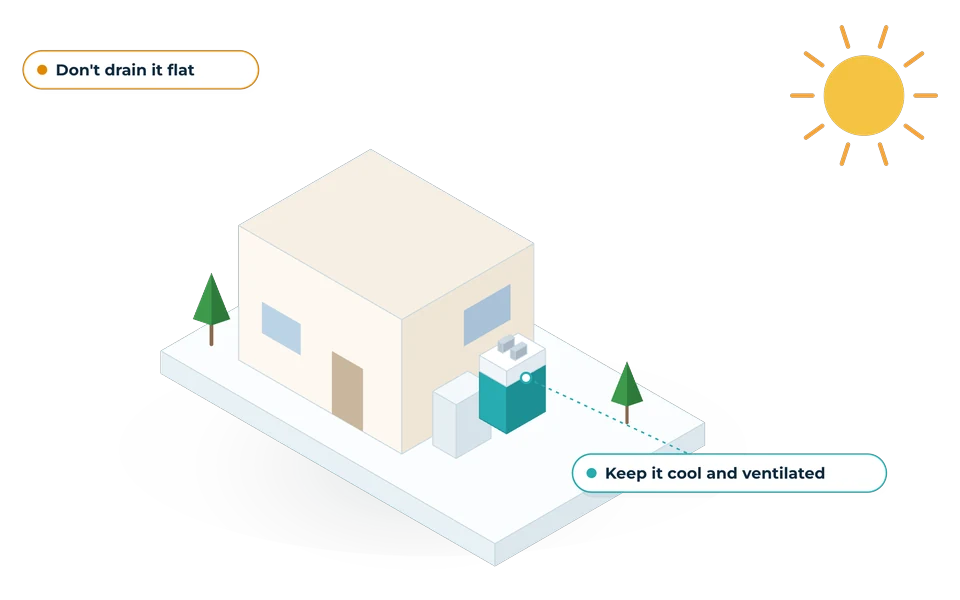
No. Unlike flooded or tubular lead-acid batteries, a sealed lithium (LFP) home battery does not need distilled-water top-ups and is essentially maintenance-free for the homeowner. You should still keep it in a cool, ventilated spot and have it installed by a professional.

Is a lithium (LFP) home battery safe for Indian homes?

LFP is one of the more thermally stable lithium chemistries and is widely used in homes when installed correctly. As with any electrical equipment, buy certified products, use a qualified installer, and place the unit in a suitable, ventilated location to keep it safe in Indian conditions.

Which is cheaper, an inverter with lead-acid or a lithium home battery?

Lead-acid is clearly cheaper to buy today. A lithium home battery costs more upfront but can be competitive over its lifetime because it lasts longer, lets you use more of its capacity and wastes less energy. Ask installers for quotes and expected life on both, then compare the total cost over several years rather than just the sticker price.

Do I need solar to benefit from a home battery?

No. A lithium home battery gives you cleaner, longer and lower-maintenance backup even on grid charging alone. But its value grows with rooftop solar, because a hybrid inverter and EMS can store daytime solar surplus and use it during evening peaks and outages.

Net Metering in India

Read more

What is net metering in simple terms?

Net metering is an arrangement that lets your rooftop solar send surplus power to the grid and get credited for it. A bidirectional meter records what you import and what you export, and at the end of the billing cycle you are charged only for the net units. In effect, the grid stores your extra solar and gives it back as a bill credit.

What is the difference between net metering and gross metering?

Under net metering you first use your solar at home and only the surplus goes to the grid, with exports offsetting imports so you settle the net. Under gross metering, all your generation is sent to the grid at a fixed feed-in rate, and you separately buy everything your home uses at the retail tariff. The right model for you depends on your state and DISCOM.

Do I need a special meter for rooftop solar?

Yes. A standard meter only counts power flowing into your home, so net metering needs a bidirectional or net meter that measures import and export separately. Your DISCOM installs or certifies this meter when your system is approved and commissioned, so it is part of the connection process rather than something you fit yourself.

Will I get paid for the extra solar I export?

It depends on your state and DISCOM. In many cases surplus is carried forward as a credit against future bills, and at the end of a settlement period any remaining surplus may be paid out, carried over, or allowed to lapse, sometimes at a rate lower than retail. Because these rules vary and change, confirm the current terms with your DISCOM.

Does adding a battery affect net metering?

A home battery stores your daytime surplus so you can use it in the evening, which means you import less and export less. Under models that credit exports below the retail rate, using your own stored solar is often more valuable than exporting it. Connecting a battery may also have its own DISCOM requirements worth checking.

How do I find the exact net metering rules for my state?

Net metering is a national concept, but the specifics are set by your state regulator and DISCOM. Details such as metering model, settlement period, surplus treatment, and system size caps differ by location and are revised over time. Check your DISCOM's website or customer service, and look at the sanctioned load on your electricity bill, before finalising your system.

PM Surya Ghar Subsidy

Read more

What is the PM Surya Ghar subsidy?

PM Surya Ghar: Muft Bijli Yojana is a central-government scheme that offers a subsidy to reduce the upfront cost of installing rooftop solar on Indian homes. The aim is to help households generate their own clean electricity and cut their monthly power bills. Applications are made through an official national portal, with your DISCOM and empanelled vendors involved in the process.

How much subsidy will I get under PM Surya Ghar?

The subsidy is set by the government and applies to eligible residential systems within a defined capacity range, but the exact amounts can be revised over time. For that reason this guide does not quote fixed figures. To see the current subsidy you may be entitled to, check the latest details directly on the official PM Surya Ghar portal before you apply.

Who is eligible to apply?

In broad terms, the scheme is for residential consumers who own their home (or have permission to install), have a structurally sound and largely shade-free rooftop, and hold a valid electricity connection with a DISCOM. The specific eligibility conditions are decided officially and can change, so confirm whether you qualify on the official portal rather than relying on general guidance.

How do I apply for rooftop solar under the scheme?

You register on the official national portal, submit an application, and choose a vendor empanelled by your DISCOM. The vendor surveys your roof and installs the system after approvals. Your DISCOM then inspects the installation and sets up net metering, and once the system is commissioned the applicable subsidy is processed as per the official procedure. Exact steps can vary slightly by state.

Do I need a battery to benefit from the scheme?

No. A standard grid-connected rooftop solar system does not require a battery, and you can enjoy lower bills with panels alone. A home battery is an optional add-on that stores surplus daytime solar for evening use and can provide backup during outages. Any storage-related incentives should be checked separately on the official portal.

Where can I verify the latest details?

Always confirm the current subsidy amounts, eligible system sizes, eligibility conditions and empanelled vendors on the official PM Surya Ghar portal, which is the authoritative source. Your local DISCOM office can also help with state-specific questions. Because the scheme's figures and rules can be updated, verifying at the source is the safest way to plan your rooftop solar project.

Solar + EV

Solar + EV

Solar EV Charging at Home

Read more

Can I charge my electric car directly from solar panels?

Yes, if the car is parked at home while the sun is shining. Rooftop panels feed your home supply, and the EV charger draws from it like any other appliance. During daylight the car charges mainly on solar, and you do not need a battery for this, only a car that is home during generating hours.

Do I need a battery to charge my EV with solar?

No, a battery is optional. If you can charge during the day, you use solar directly. If the car only comes home in the evening, you can either draw from the grid at night or store the day's surplus in a home battery for after dark. Many homeowners start with solar plus net metering and add a battery later if they want backup or more independence.

How much extra solar do I need to charge an EV at home?

It depends on your daily driving. Estimate your typical daily kilometres, convert that to units, and add it to your existing solar plan. Most city commutes need only a few extra panels' worth of generation on a sunny day, but ask your installer to size against your actual driving, roof space and shading rather than a generic figure.

Which EV charger is best for an Indian home, 3.3 kW or 7.4 kW?

A 3.3 kW charger (around 16 A, single phase) charges slowly and suits overnight or all-day solar charging. A 7.4 kW charger (around 32 A) is roughly twice as fast but draws more current, so check your sanctioned load and wiring, and you may need a DISCOM load enhancement. Chargers of 11 kW or more usually need a three-phase connection.

Is solar EV charging cheaper than charging from the grid?

On days when you charge directly from your own rooftop solar, the electricity is effectively free once the system has paid for itself, so it is cheaper than grid charging and far cheaper than petrol or diesel. Your actual savings depend on your tariff, how much you charge on solar versus the grid, and your net-metering credits.

Will charging my EV overload my home's electricity connection?

It can, if a fast charger runs alongside heavy loads like an air conditioner or geyser on a single-phase supply. Keeping the charger on a dedicated, properly earthed circuit helps, and an energy management system can throttle charging so the total draw stays within your sanctioned load. Confirm your capacity with your DISCOM before installing a high-power charger.

Solar + Battery + EV Integration

Read more

What does solar battery EV home integration mean?

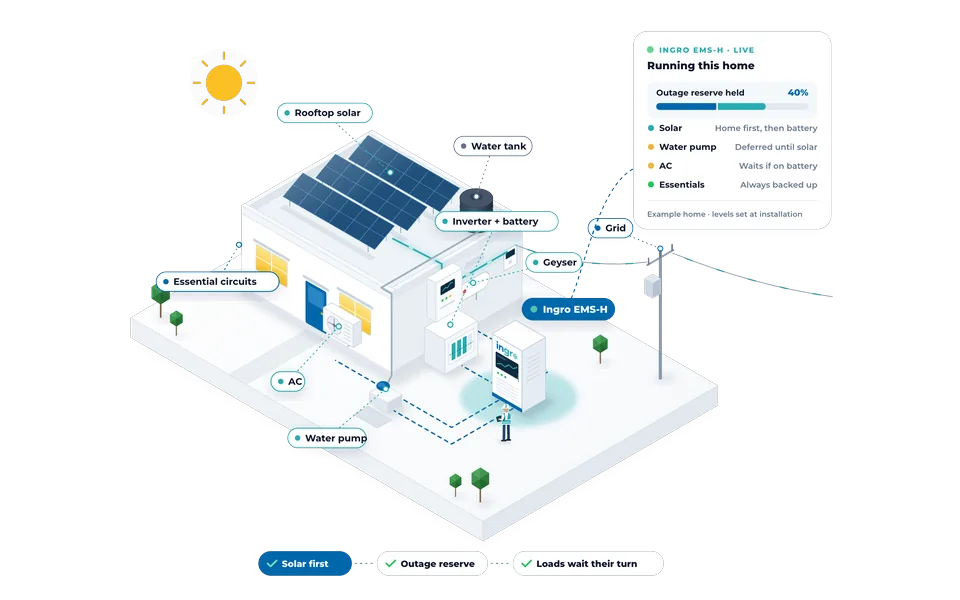
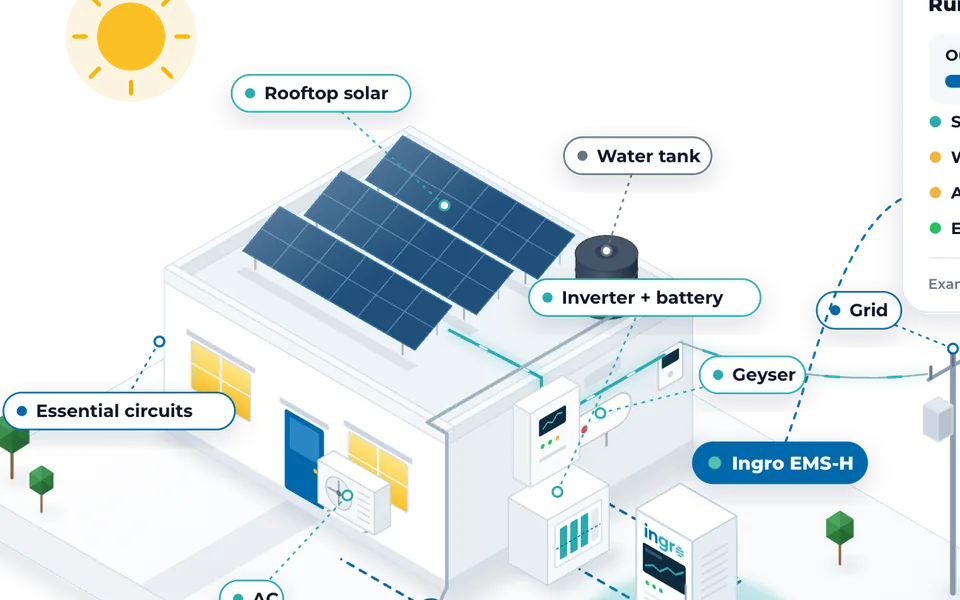
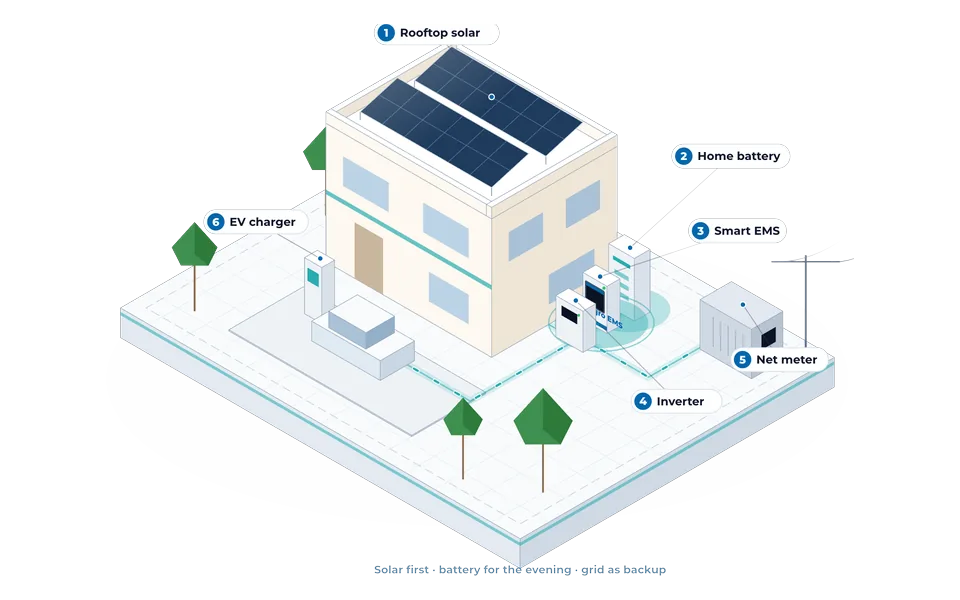
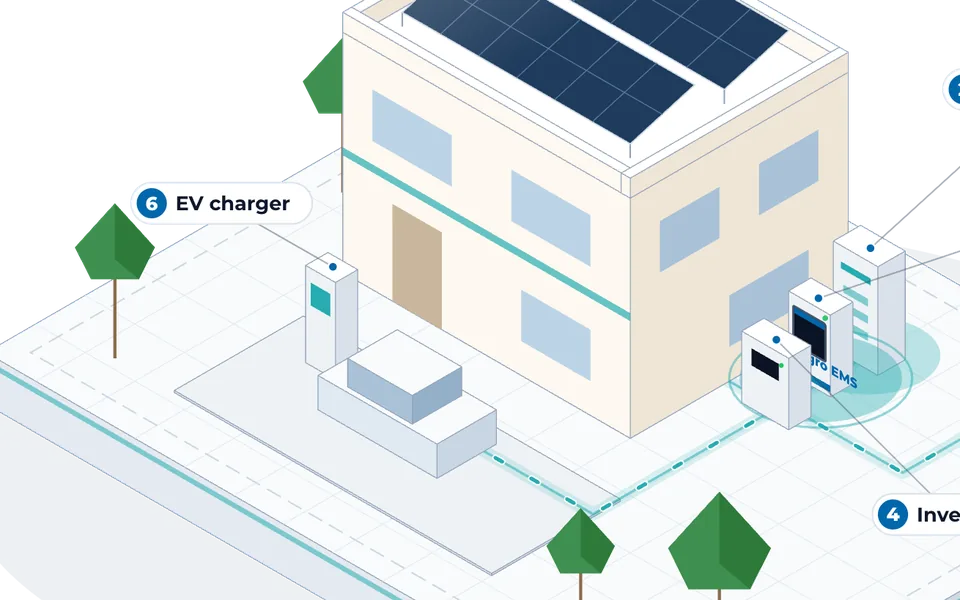
It means getting your rooftop solar, home battery, EV charger and grid connection to work as one coordinated system instead of four independent devices. A smart energy management system (EMS) senses what each is doing and directs energy so you use more of your own solar, charge the car at the right time and stay within safe electrical limits.

Can I charge my EV directly from solar?

Yes, if the system is coordinated. A home EMS can send surplus midday solar to your car instead of exporting it, so the EV effectively runs on your own generation. Without that coordination, the car often charges from the grid in the evening even though solar was available earlier in the day.

Will adding an EV charger overload my home's electricity connection?

It can, because an EV charger is a large, steady load that may combine with air conditioners and other appliances to exceed your sanctioned capacity and trip the main breaker. A home EMS with connection-limit awareness staggers or throttles heavy loads so the total draw stays within safe bounds.

Do I need an EMS if my solar and battery already have their own apps?

Usually those apps control only their own device. For a combined solar, battery and EV setup, coordination has to happen across all of them at once, which a single-device app cannot do. A true home EMS sees the whole picture and orchestrates everything together, which is where most of the savings come from.

How does a home EMS help with time-of-use tariffs?

As Indian DISCOMs introduce time-of-day pricing, an EMS can automatically shift flexible loads, such as EV and battery charging, to cheaper off-peak hours and avoid expensive peaks. Because it already tracks time and tariffs, it is well positioned to adapt as your tariff structure changes.

Can the system keep power for outages while still charging my EV?

Yes. A home EMS lets you set aside a backup reserve of battery charge for outages while still using the rest to run the house and charge the car. It balances these priorities automatically, so you keep essential power during a grid failure without giving up everyday EV charging.

Still have questions about your EMS for BESS?

Talk to the Ingro team, or explore Cloud EMS, our made-in-India energy management system for battery storage.