An EMS for C&I is an energy management system that coordinates every power source on a commercial or industrial site, grid, rooftop or captive solar, diesel generator and BESS, from a single platform. For Indian factories and facilities facing steep demand charges, Time-of-Day tariffs and costly diesel, this orchestration is where the savings are made.
Key takeaways
An EMS for C&I coordinates grid, solar, diesel and BESS from one platform, turning several disconnected assets into a single least-cost energy system.
In India, the biggest savings come from cutting demand charges, shifting load out of costly ToD peaks, maximising solar use and minimising diesel runtime, all automated.
Manual coordination of a multi-source site is impossible; value depends on an EMS making real-time dispatch decisions continuously.
Open access, captive solar and the ability to retrofit existing sites make orchestration especially valuable in the Indian C&I context.
Ingro Cloud EMS plus Battery AI brings this automation and intelligence into one location, connecting hardware through open protocols and re-optimising dispatch every five minutes.
For commercial and industrial (C&I) consumers in India, the electricity bill is rarely just about how many units you use. A large share of the cost sits in demand charges levied on your peak kilovolt-ampere (kVA) or kilowatt (kW) draw, and in Time-of-Day (ToD) tariffs that make power during evening peak hours far more expensive than off-peak energy. A single spike in load can set the demand charge for the entire billing cycle.
On top of tariff design, most sites carry the cost and complexity of keeping production running through an unreliable grid. Diesel generators (DG) burn expensive fuel during outages and are sometimes run through peak periods, while rooftop or captive solar is frequently under-used because it is not coordinated with load or storage. The result is a set of disconnected systems, each managed separately, with no single view of what the site is actually spending.
Demand chargesA brief peak in kVA/kW demand can inflate a fixed charge across the whole month.
ToD and peak tariffsEnergy drawn during evening peak windows costs far more than off-peak power.
Diesel dependenceDG sets run during grid outages and peaks, at a high and volatile fuel cost per unit.
Under-used solarRooftop or captive PV is curtailed or exported cheaply when generation and load are not matched.
Siloed controlsThe grid meter, solar inverter, DG controller and any battery each run in isolation.
02
The Multi-Source C&I Site: Why Manual Coordination Fails
A modern C&I site is no longer a single grid connection. It is a small energy system in its own right, combining the grid, solar (rooftop or captive and open access), a diesel generator, increasingly a battery energy storage system (BESS), and the plant loads that must keep running. Each source has different costs, constraints and response times, and the cheapest, cleanest way to serve load changes minute by minute as tariffs, solar output and demand move.
Coordinating these sources by hand is effectively impossible. Deciding, every few minutes, whether to draw from the grid, discharge the battery, lean on solar or start the DG, while respecting the demand-charge ceiling, the ToD window and the battery's state of charge, is far beyond manual operation or simple timers. This is precisely the gap a smart EMS is built to fill.
03
What a Commercial and Industrial EMS Does
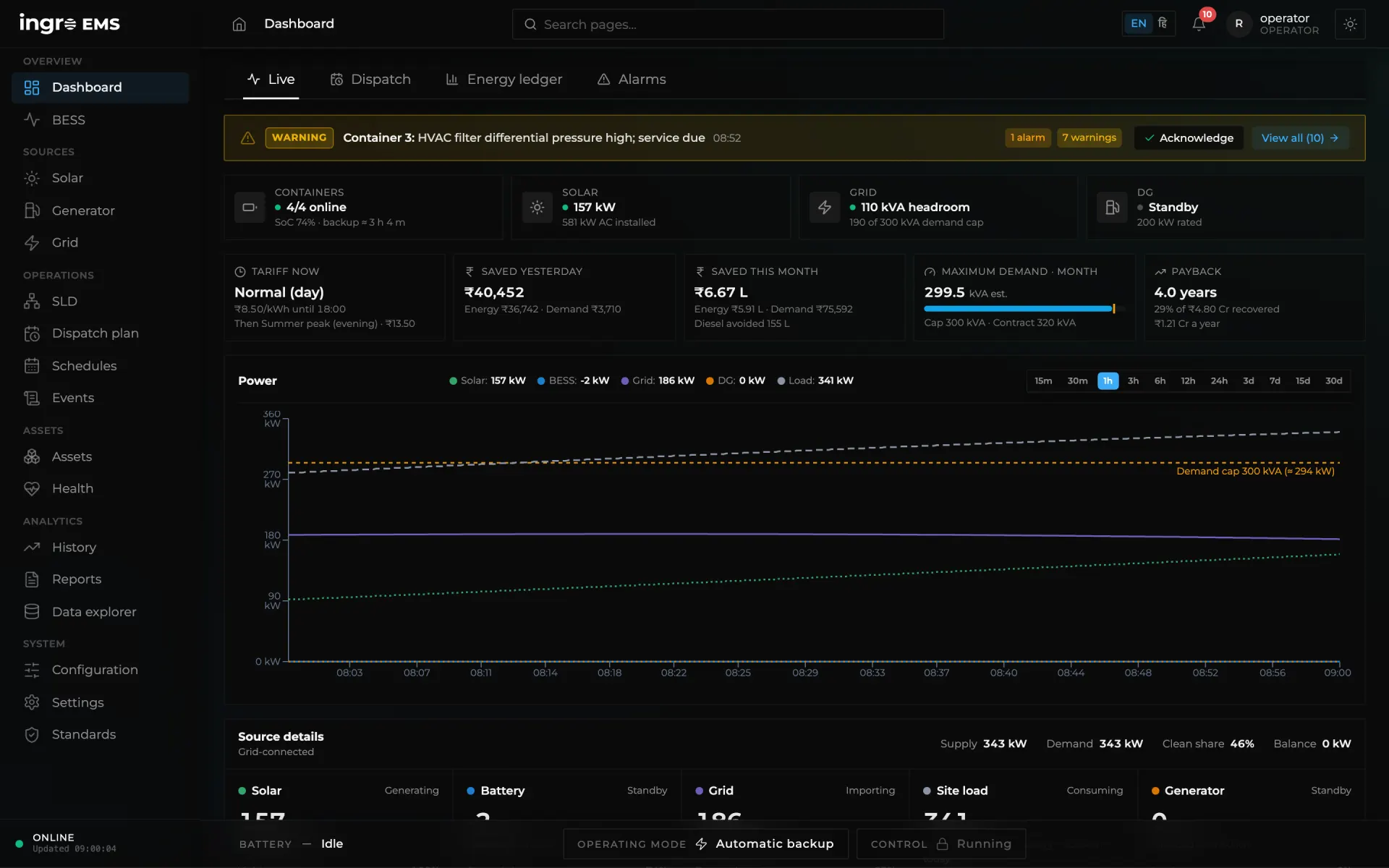
A commercial and industrial EMS is the software layer that brings every source and all of the site's intelligence into one location. Instead of a wall of separate controllers, it gives operators a single dashboard for monitoring, control and reporting, and it acts automatically on that data rather than waiting for a human to intervene.
The value comes from automation. Because the EMS continuously sees load, tariffs, solar generation, grid status and battery state together, it can make the least-cost dispatch decision in real time and repeat it around the clock. It turns four or five disconnected assets into one coordinated system with a single objective: serve the load reliably at the lowest possible cost.
Everycontrol cycle
1Read the plantevery source feeder metered
2Resolve the orderthe least-cost compliant way to carry the load
3Issue setpointsone to each source, within device limits
4Record the decisionwith the reason for it
1Read the plantevery source feeder metered
2Resolve the orderthe least-cost compliant way to carry the load
3Issue setpointsone to each source, within device limits
4Record the decisionwith the reason for it
…then again, every control cycle.
The same loop runs in every product. Only the assets and the configured values change.
The default order of preference
1. SolarConsumed first; surplus stored in preference to export.
2. Battery storageCovers the costliest hours and answers every interruption.
3. Utility supplyCarries the balance, within its demand ceiling.
4. GeneratorOnly when demand exceeds what storage can deliver.
This is the supplied default and it is configurable. On a site without one of these sources, the order simply closes up where it would have sat.
04
How a Smart EMS Creates Value for C&I Sites
For a C&I operator, the return on a smart EMS is concrete even before you attach a number to it. Every lever below reduces a real line item on the bill or a real operational risk, and the EMS pulls them all automatically from one place.
Peak shaving and demand-charge reductionThe EMS discharges the BESS to cap kVA/kW peaks, lowering the fixed demand charge that a single spike would otherwise set for the month.
ToD energy arbitrageIt charges the battery from cheap off-peak or surplus solar energy and discharges during costly peak windows, shifting spend to the lowest-price hours.
Maximised solar self-consumptionIt aligns solar generation, storage and load so on-site PV displaces grid and diesel energy instead of being exported cheaply or curtailed.
Optimised diesel runtimeIt minimises DG hours and fuel burn by using stored energy first and running the generator only when it is genuinely the least-cost or only option.
Seamless failover during outagesEdge control detects grid loss and switches the site to battery and solar in milliseconds, cutting reliance on the DG and protecting sensitive loads.
One dashboard instead of silosMonitoring, dispatch, alerts and compliance reporting live in a single platform, reducing manual effort and blind spots across the site.
05
The Indian Commercial Context: Open Access, Captive Solar and Retrofits
India's C&I energy landscape has features that make orchestration especially valuable. Open access lets larger consumers buy power from the wider market, and captive or group-captive solar is increasingly used to cut tariffs and meet sustainability targets. Both introduce more sources and more price signals for the EMS to optimise against.
Open access and captive solar
When a site draws from open access power or a captive solar plant alongside the grid and a DG, the number of variables rises sharply. A smart EMS can weigh open access schedules, captive generation and storage against demand charges and ToD windows automatically, capturing value that manual scheduling would miss. Ingro's Open Access Energy service pairs naturally with an EMS-managed site.
Retrofitting existing sites
Most Indian C&I facilities already have solar, a DG and metering in place; they do not need to be rebuilt. Because a capable EMS connects through open protocols, it can be retrofitted onto existing hardware to add coordination and intelligence without ripping out working equipment, the principle behind a Smart Retrofit.
06
How Ingro Cloud EMS Orchestrates Solar, Diesel, Grid and BESS
Ingro Cloud EMS is a cloud-based, hardware-agnostic EMS, made in India, built to bring exactly this automation and intelligence into one location. It orchestrates grid, solar, diesel generator and BESS from a single dashboard, with real-time monitoring down to cell level, centralised remote dispatch and multi-level alerts across the site.
The Integrations layer connects existing hardware through open protocols, Modbus TCP/RTU, IEC 61850, DNP3 and OPC-UA, while edge gateways handle protocol translation, local buffering and sub-second (to sub-10ms) control, so failover during an outage stays seamless even if the network link drops. On top of this, Battery AI is a self-learning optimiser that ingests prices, weather, load and grid signals and re-optimises dispatch every five minutes, continuously balancing peak shaving, arbitrage, solar self-consumption and diesel use.
The same platform automates CERC/SERC compliance reporting and, through Smart Retrofit, can be added to existing C&I sites without replacing working equipment, while the Open Access Energy service extends the value to market-sourced power. Ingro already operates one of India's oldest grid-scale BESS sites at over 99.5% availability, applying the same orchestration discipline that C&I sites need to cut their energy costs.
A controller installed in your plant room, a console on site and on your phone, and reports your finance team can use. Supplied on its own for your battery, or as a complete battery system.
Ingro EMS Controller, wired and commissioned on site
Operator console, mobile app and 13 reports
Add Cloud EMS, Ingro Brain or Battery Passport when you need them
An EMS for C&I is an energy management system that monitors and controls every power source on a commercial or industrial site, grid, solar, diesel generator and BESS, from one platform. It automates dispatch to cut demand charges, shift load out of peak tariffs, maximise solar self-consumption and reduce diesel use, replacing several siloed control systems with a single dashboard.
Yes. By coordinating battery storage and solar with the load, an EMS serves demand from stored and on-site energy first and starts the diesel generator only when it is genuinely the least-cost or only option. During outages, edge control fails over to battery and solar in milliseconds, cutting DG runtime, fuel burn and wear.
Time-of-Day (ToD) tariffs price electricity higher during peak hours and lower off-peak. ToD arbitrage means charging the battery with cheap off-peak or surplus solar energy and discharging it during expensive peak windows to serve load. A C&I EMS automates this every day, timing charge and discharge to the tariff schedule to lower energy spend.
Demand charges are set by a site's highest kVA or kW peak in the billing period, so a single spike can inflate the fixed cost for the whole month. A C&I EMS uses the BESS to shave those peaks, discharging stored energy the moment demand rises, so the metered peak stays low and the demand charge falls.
It should. A hardware-agnostic EMS connects to existing solar inverters, DG controllers, meters and batteries through open protocols such as Modbus, IEC 61850, DNP3 and OPC-UA. This means most Indian C&I sites can be retrofitted, adding coordination and intelligence to equipment already installed, rather than replacing working hardware.
Ingro Cloud EMS brings grid, solar, diesel and BESS into one dashboard, connecting hardware through open protocols via its Integrations layer and edge gateways. Battery AI re-optimises dispatch every five minutes across peak shaving, arbitrage, solar use and diesel runtime, while edge control gives sub-second failover. It can be retrofitted onto existing sites and automates CERC/SERC compliance reporting.
Ingro EMS is designed, built and supported in India, for C&I sites and grid-scale BESS. Ingro EMS is deployed on site (offline), in the cloud, or as a hybrid of the two. In on-site and hybrid deployments, site control continues with no internet connection.