Types of BESS and Battery Chemistries Explained
BESS Fundamentals9 min read

Types of BESS and Battery Chemistries Explained

A practical guide to BESS types, architectures and the battery chemistries, from LFP to flow, that power stationary storage in India.

Understanding the types of BESS and the battery chemistries behind them is the first step to specifying safe, cost-effective storage. This guide explains how battery energy storage systems are classified by scale and architecture, compares the major chemistries, including the LFP vs NMC choice that dominates stationary projects, and shows what matters most for Indian conditions.

Types of BESS by Application and Scale

A battery energy storage system (BESS) can be classified in two useful ways: by where and how it is deployed, and by its internal electrical architecture. Grouping projects by application and scale helps match the right chemistry, duty cycle and safety design to the job.

  • Utility and grid-scale: multi-MW to multi-hundred-MW systems for peak shifting, frequency regulation, renewable firming and time-of-day arbitrage; usually containerised and connected at the substation or transmission level.
  • Commercial and industrial (C&I) / behind-the-meter: kW to a few MW, sited at factories, campuses or commercial buildings for demand-charge reduction, backup and solar self-consumption.
  • Residential: small kWh-scale units paired with rooftop solar for self-consumption and backup during outages.
  • Portable and containerised: standardised, transportable enclosures (often 20-foot containers) that speed deployment for grid-scale and temporary or rental power; containerisation is a form factor, not a chemistry.

BESS Architecture: DC-Coupled vs AC-Coupled

Beyond scale, systems differ in how the battery connects to solar and the grid. The choice affects round-trip efficiency, cost and control flexibility.

  • DC-coupled: the battery and solar PV share a DC bus and a common inverter; efficiency is higher for solar-plus-storage because power is not converted twice, and clipped solar energy can be captured. Best when storage is added alongside new solar.
  • AC-coupled: the battery has its own inverter and connects on the AC side; more flexible and easier to retrofit to existing solar or deploy as standalone storage, at a small efficiency penalty.

Main Battery Chemistries Explained

Most stationary storage today uses lithium-ion, but several chemistries compete on safety, cost, cycle life and energy density. The characteristics below are qualitative ranges; actual performance depends on cell design, temperature and how the system is operated.

Lithium Iron Phosphate (LFP / LiFePO4)

LFP is the workhorse of stationary storage. Its phosphate cathode is thermally stable and does not readily release oxygen, giving it the best safety profile among mainstream lithium-ion chemistries.

  • Safety: excellent thermal stability and a high thermal-runaway threshold; the least fire-prone lithium-ion chemistry.
  • Cycle life: very long, typically several thousand cycles to 80% capacity, well suited to daily grid-scale cycling.
  • Energy density: moderate and lower than NMC, so packs are larger and heavier for the same energy.
  • Cost: low and falling; iron- and phosphate-based, with no cobalt or nickel, easing raw-material and supply-chain risk.
  • Temperature: tolerates heat better than NMC but loses capacity in the cold, needing a heater in very cold climates.

Lithium Nickel Manganese Cobalt / NCA (NMC / NCA)

NMC and the closely related NCA pack more energy into less space and weight, which is why they dominate electric vehicles. In stationary use they appear where footprint or weight is constrained.

  • Energy density: highest among mainstream chemistries, making packs compact and light.
  • Safety: lower thermal stability than LFP; can release oxygen at high temperature, so it demands more robust thermal management and fire protection.
  • Cycle life: good but generally shorter than LFP under deep daily cycling.
  • Cost: higher and more volatile due to nickel and cobalt content; cobalt also raises supply and sustainability concerns.
  • Temperature: high ambient heat accelerates degradation, a drawback in hot Indian conditions.

Sodium-Ion (Emerging)

Sodium-ion is the most watched emerging chemistry. It uses abundant sodium instead of lithium and avoids cobalt, promising lower cost and greater supply security once volumes scale.

  • Cost and supply: built on abundant, low-cost, widely available materials, with no lithium or cobalt.
  • Safety: good thermal stability; cells can be transported and stored fully discharged at zero volts.
  • Temperature: notably better cold-weather performance than lithium-ion.
  • Energy density: currently lower than LFP, though improving with each generation.
  • Maturity: early commercialisation; cycle life and supply ecosystem are still maturing, so real-world track record is limited.

Flow Batteries (Vanadium Redox)

Flow batteries store energy in liquid electrolyte tanks rather than solid electrodes. Because power (the cell stack) and energy (tank volume) scale independently, they suit long-duration storage of four hours or more.

  • Long duration: decoupled power and energy make extended discharge economical to size.
  • Cycle life: extremely long with minimal capacity fade; the electrolyte can be reused almost indefinitely.
  • Safety: aqueous, non-flammable electrolyte gives an inherently low fire risk.
  • Energy density: low, with a large physical footprint, so unsuitable where space is tight.
  • Cost: high upfront capital cost, offset over time in long-duration, high-cycle applications.

Lead-Acid (Legacy)

Lead-acid is the oldest rechargeable chemistry and remains common in backup and off-grid roles, but it is steadily being displaced by lithium-ion in new storage projects.

  • Cost: lowest upfront cost, with a mature and fully recyclable supply chain.
  • Cycle life: short, typically a few hundred to about a thousand cycles, with limited usable depth of discharge.
  • Energy density: low and heavy, making it bulky for grid-scale energy.
  • Efficiency and upkeep: lower round-trip efficiency, and flooded types need regular maintenance.
  • Temperature: heat shortens life significantly.
LFP vs NMC: Which Chemistry Wins for Stationary Storage?

The practical chemistry decision for most Indian stationary projects comes down to LFP vs NMC. Both are lithium-ion, but they optimise for different things: LFP for safety, longevity and cost; NMC for energy density.

For grid-scale and C&I storage, where physical space is rarely the binding constraint, LFP's advantages usually win. That is why it has become the default for utility BESS in India and globally, while NMC stays dominant where compactness matters most, such as in EVs.

  • Choose LFP when safety and fire risk are priorities, the system cycles daily, long calendar and cycle life matter, and lifecycle cost must be minimised, which is typical of grid-scale and C&I projects.
  • Choose NMC when energy density is the binding constraint, such as a limited footprint or weight budget, and premium thermal management is acceptable.
  • Safety: LFP is markedly safer under abuse and high temperature.
  • Cost: LFP is cheaper and less exposed to cobalt and nickel price swings.
  • Longevity: LFP generally delivers more cycles under deep daily use.
  • Energy density: NMC leads, packing more energy per kilogram and per litre.

Choosing a BESS Chemistry for Indian Conditions

India's operating environment shapes the chemistry choice. High ambient temperatures, stringent fire-safety expectations and demanding grid-scale duty cycles all favour robust, thermally stable chemistries.

  • Heat: much of India runs hot for large parts of the year; LFP's thermal stability and better high-temperature behaviour reduce degradation and fire risk compared with NMC.
  • Safety and compliance: publicised battery fire incidents have raised scrutiny, so safer chemistries paired with proper thermal management and monitoring ease approvals and insurance.
  • Duty cycles: grid-scale tenders often demand daily deep cycling over many years, a profile that suits LFP's long cycle life.
  • Policy and supply: domestic manufacturing incentives such as the ACC PLI scheme, alongside MNRE and CERC frameworks, are steering the market toward LFP and locally viable chemistries.
  • Long-duration needs: where four or more hours of storage are required, flow batteries deserve evaluation alongside lithium-ion.

Match the Chemistry to the Duty, Not the Datasheet

No single chemistry is best for every use case. Match the chemistry to the duty cycle, site conditions and safety requirements rather than to a headline energy-density figure, and model total lifecycle cost rather than upfront price alone.

Why Your EMS Must Be Chemistry-Agnostic

Because the right chemistry varies by project, and because portfolios often mix vendors and chemistries over time, the energy management system that runs your storage should not be locked to one battery type. A chemistry-agnostic EMS lets you standardise operations, reporting and compliance across a diverse fleet.

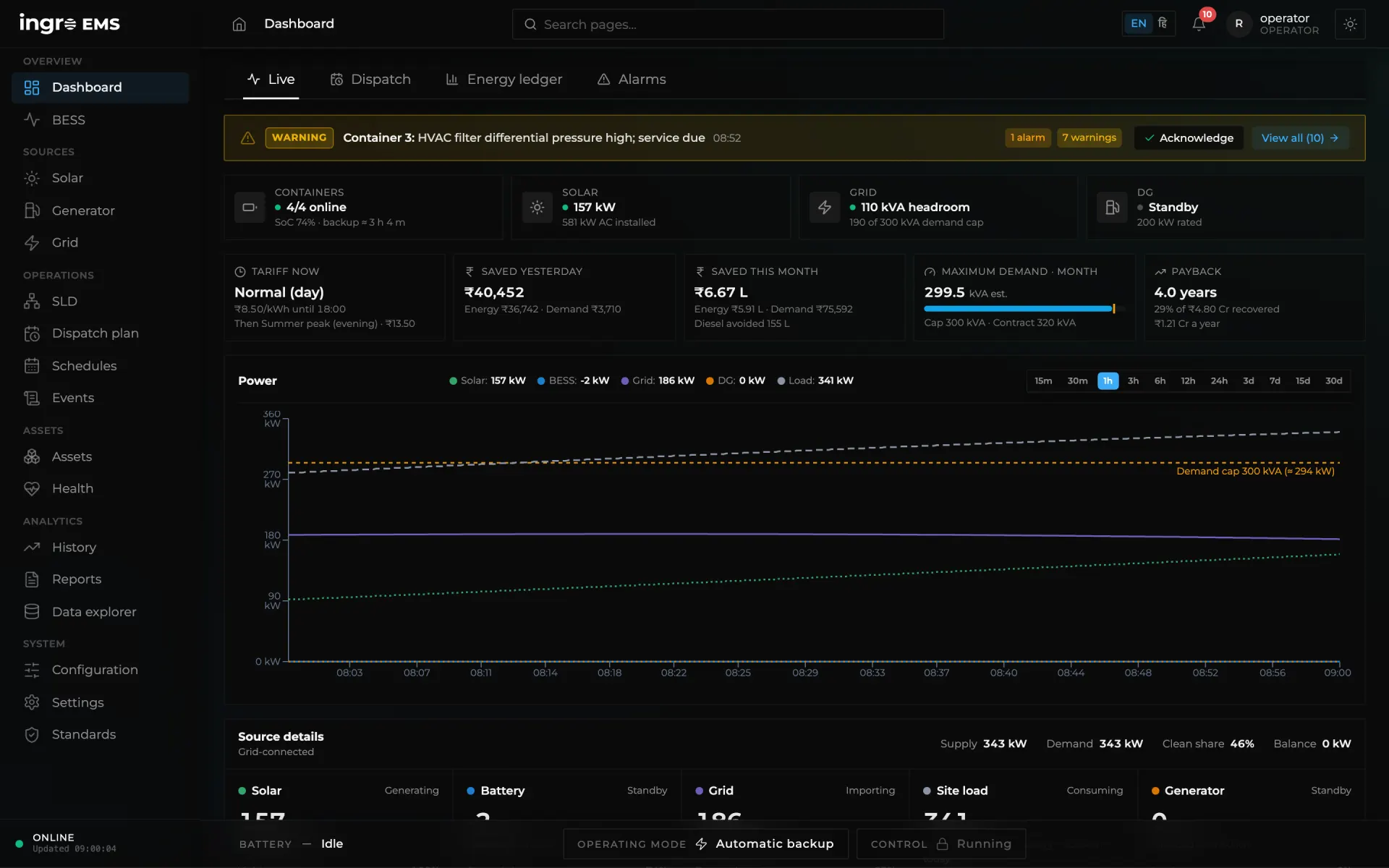
Ingro Cloud EMS is hardware- and chemistry-agnostic by design. It integrates with any battery via the BMS using open protocols such as Modbus, IEC 61850, DNP3 and OPC-UA, delivering real-time monitoring down to cell level, dispatch control, analytics, alerts and CERC/SERC compliance, whatever chemistry sits behind the BMS.

Each chemistry ages differently, so tracking health consistently matters. Ingro's Battery Passport builds a lifecycle record of cycle counts, depth of discharge, thermal exposure and capacity fade for any chemistry, and Battery AI uses that data for health-aware optimisation. Together they let operators compare and manage LFP, NMC, sodium-ion or flow assets on one platform. See Cloud EMS, Battery Passport and Integrations to learn more.

Key Takeaways

  • BESS are classified by application and scale (utility or grid-scale, C&I, residential, portable/containerised) and by architecture (DC-coupled vs AC-coupled).
  • LFP dominates stationary and grid-scale storage in India thanks to superior safety, long cycle life and lower cost; NMC wins where energy density is critical.
  • Sodium-ion (low cost, emerging), flow batteries (long duration) and lead-acid (legacy) each fill specific niches.
  • India's heat, safety expectations and daily grid-scale cycling reinforce the case for thermally stable LFP.
  • An EMS should be chemistry-agnostic; Ingro Cloud EMS and Battery Passport monitor and track health across any chemistry.
FAQ

Frequently Asked Questions

What are the main types of BESS?

BESS are grouped by application and scale, spanning utility or grid-scale (multi-MW), commercial and industrial behind-the-meter, residential, and portable or containerised systems, and by electrical architecture as DC-coupled or AC-coupled. Each type suits different duty cycles and site constraints, which in turn influence the most appropriate battery chemistry and safety design.

Which battery chemistry is best for grid-scale storage in India?

LFP (lithium iron phosphate) is generally the best fit for Indian grid-scale storage. Its strong thermal stability suits high ambient temperatures, its long cycle life handles daily deep cycling, and its cobalt-free make-up lowers cost and supply risk. NMC is reserved for cases where limited space or weight makes its higher energy density essential.

What is the difference between LFP and NMC batteries?

Both are lithium-ion. LFP (LiFePO4) offers better safety, longer cycle life and lower cost, but only moderate energy density. NMC packs more energy into less space and weight but is less thermally stable, shorter-lived under deep cycling and more expensive due to nickel and cobalt. LFP dominates stationary storage, while NMC leads in EVs.

Is sodium-ion a viable alternative to lithium-ion?

Sodium-ion is a promising emerging chemistry. It uses abundant, low-cost materials, avoids lithium and cobalt, and performs better in cold weather with good thermal safety. Its energy density is still below LFP and its commercial track record is limited, so it is maturing rather than mainstream, but it could ease supply constraints as volumes grow.

When should you use a flow battery instead of lithium-ion?

Consider flow batteries, such as vanadium redox, for long-duration storage of roughly four hours or more. They scale power and energy independently, last for very many cycles with little degradation, and use a non-flammable electrolyte. The trade-offs are low energy density, a large footprint and high upfront cost, so they suit stationary long-duration duty rather than compact installations.

Why does an EMS need to be chemistry-agnostic?

Storage portfolios often mix vendors and chemistries, and each ages differently. A chemistry-agnostic EMS like Ingro Cloud EMS integrates any battery via the BMS using open protocols, so monitoring, dispatch, analytics and compliance stay consistent across the fleet. Battery Passport then tracks health, including cycle counts, depth of discharge, thermal exposure and capacity fade, for any chemistry on one platform.

Keep Learning

Related Guides

See the Cloud EMS for BESS in action

Ingro Cloud EMS gives you real-time monitoring, remote dispatch, and fleet-wide control across every BESS site, from a single dashboard.