Open Access Turns Your Power Bill Into a Lever
India's industrial sector treats electricity as a fixed cost. It does not have to be. Open Access allows companies to procure power at market rates — turning the energy bill from a liability into a competitive lever.

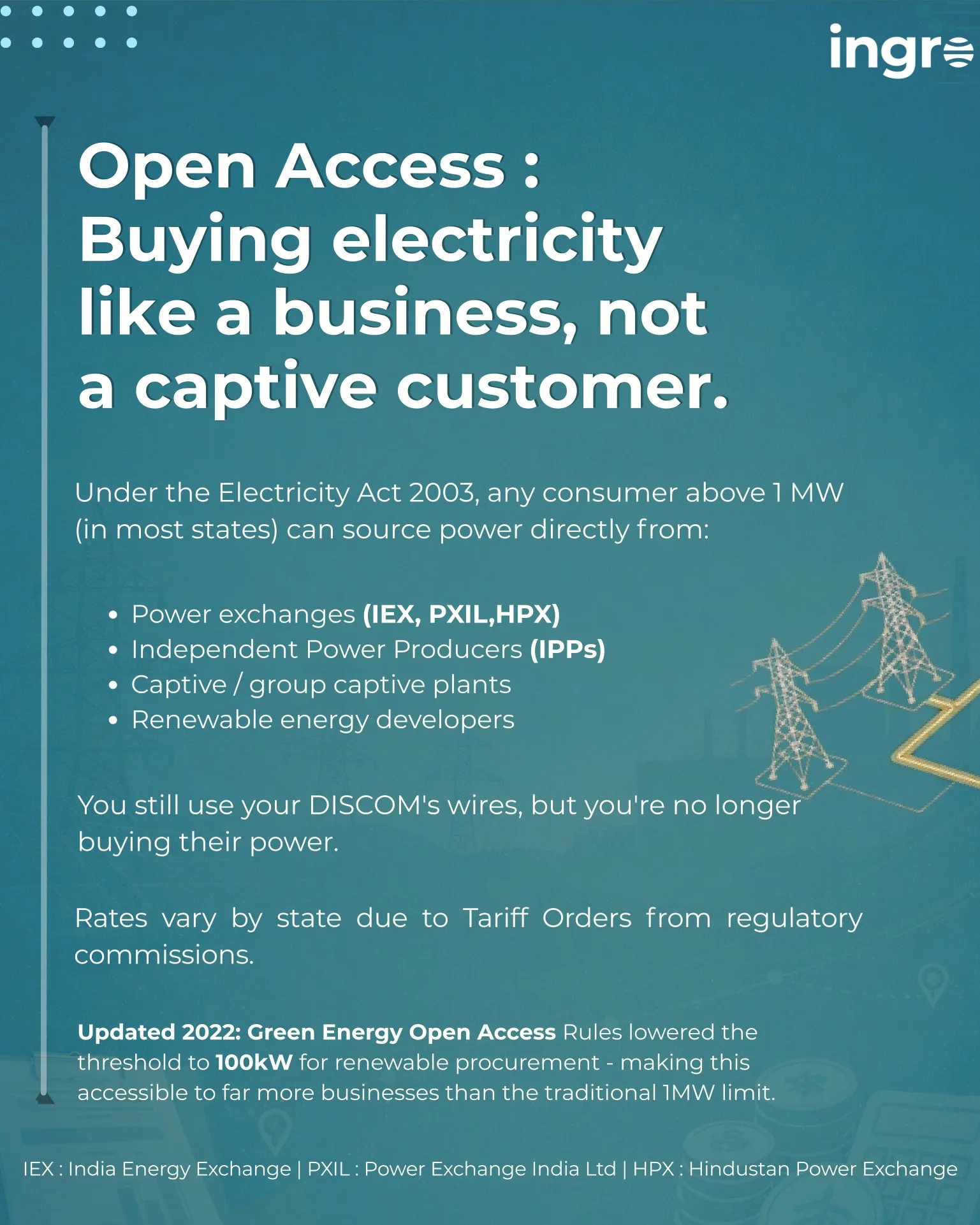


5 slides — scroll or use the arrows
India's industrial sector treats electricity as a fixed cost. It does not have to be.
Procurement is a choice
Open Access allows companies to procure power at market rates rather than accepting the DISCOM tariff as given. For an energy-intensive manufacturer, electricity can run to a double-digit share of operating cost — which means the procurement decision sits alongside raw materials and labour in its effect on unit economics, not below them.
The businesses that figure this out early will have a structural cost advantage over those that do not. Structural, because it compounds every year and cannot be matched by a competitor who has not done the regulatory and contracting work.
What makes it hard to execute
Open Access is not simply a cheaper tariff. It brings its own exposures:
- Wheeling, transmission and cross-subsidy surcharges that vary by state and change with tariff orders
- Banking rules that are tightening in several states, limiting how much generation can be time-shifted through the grid
- Deviation settlement exposure when contracted schedules are not met
- Retrospective billing disputes, which have hit Open Access consumers in more than one state
Where storage and visibility come in
Each of those exposures is reduced by the same two things: the ability to shift energy in time, and independent measurement of what was actually injected and drawn. Behind-the-meter storage addresses the first. An EMS with real-time data addresses the second — and gives you a record of your own to argue from when a bill arrives that you did not expect.
Your power bill is a lever. Are you using it?
Opens the original post on LinkedIn — like, comment, or share it there.