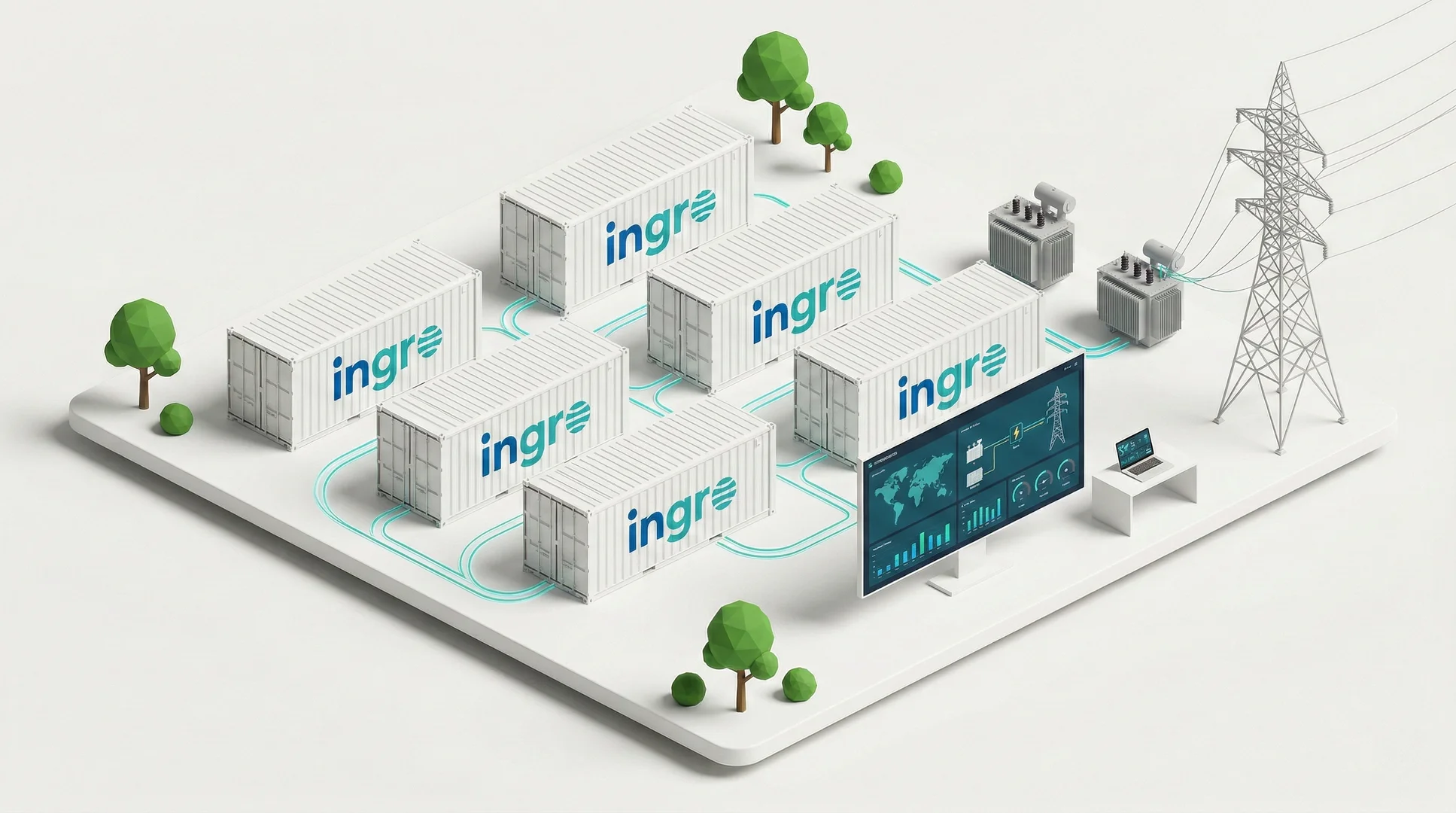
What a BESS is, why Indian sites buy one, what it is built from, how it is sized and paid for, and which layer actually determines what it earns. Written by an Indian BESS and EMS company, for people about to spend money on one.
A battery energy storage system (BESS) is an installation that stores electrical energy in batteries and returns it to a site or to the grid on demand. In India it is bought for four reasons: to hold billed maximum demand below a contracted ceiling, to move consumption out of expensive time-of-day windows, to displace diesel during outages, and to make on-site solar useful after the sun has set.
Storage in India is not one market. A tendered grid-scale plant at a substation, a battery behind a factory meter, a hospital holding a reserve back for its wards and a mine running with no utility connection at all are four different problems that happen to share a component. What decides whether any of them pays is not the battery — it is the energy management system deciding what the battery does with its day.
Four drivers, and most sites present more than one of them. Which one dominates decides how the system is sized and how much of it is held in reserve.
Indian industrial and commercial supply is billed against contracted capacity as well as against units consumed, so a single coincident peak can set the demand charge for the entire month. A battery under demand-limiting control discharges whenever load approaches the ceiling you configure, so the recorded maximum demand never registers above it — and the charge is set by your ceiling rather than by the site's worst fifteen minutes.
EMS for industrial battery storageMost state tariffs price energy differently by time of day, with a surcharge in the evening peak and often a rebate off-peak. Storage moves consumption between those windows: the battery charges in the low-tariff window and discharges in the high one, taking a cycle only where the price differential exceeds the cost of the wear it causes.
What is a BESS?Displacing diesel is the reason most Indian industrial sites buy storage at all, and it is the easiest saving to measure because it arrives in litres. A battery answers every outage first, so short interruptions never start the engine; when the engine does run, holding it inside its efficient loading band and directing surplus output into storage cuts fuel within each hour as well as hours overall.
Battery + diesel generator EMSGeneration peaks at midday and the tariff peaks in the evening. Without storage the surplus is exported at the feed-in or net-metering rate; with storage it is held and used against the evening peak instead, where each unit displaces a far more expensive one. On low-yield days the same battery keeps the demand ceiling intact.
Solar plus battery EMSSix layers. Five of them are procured against a specification. The sixth decides what the other five are worth.
The storage medium itself — most commonly lithium iron phosphate (LFP) in Indian stationary installations, and NMC where energy density matters more than cost.
Chemistry sets cycle life, temperature tolerance and safety behaviour, and is chosen against the duty the site will actually run.
The protective layer supplied with the battery: cell voltages and temperatures, balancing, and the limits the pack will not exceed.
The BMS protects the battery. It does not decide when the battery should earn — that is the EMS.
The bidirectional converter between the DC battery and the AC site or grid, including the ability to establish a voltage and frequency reference when the supply is lost.
Grid-forming capability is what allows a site to keep running through an outage rather than only ride through it.
Breakers, changeover of the class the process requires, and metering on each source feeder.
Every energy figure a BESS reports traces back to this metering — which is why it is a prerequisite, not an accessory.
HVAC or liquid cooling sized to Indian ambient conditions, plus detection and suppression to the standard the site and its insurer require.
Indian summer ambient temperatures are a design input, not a footnote — cooling drives both degradation and auxiliary consumption.
The controller that decides which source carries the load and at what power, second by second, and records the decision with its reason.
This is the layer that determines what the asset earns. Identical hardware under two different EMSs produces two different bills.
Each needs a different control configuration. The battery is the least of the differences between them.
These mechanisms move the numbers more than the equipment does — and they differ by state and by round. We name them here; confirm the current terms against your own tariff schedule or the tender document rather than against any summary, including this one.
Set by each state's regulator and revised in tariff orders, these are the mechanisms most C&I storage business cases run on. The relevant numbers are in your own tariff schedule and your last twelve bills, not in a national average.
Central schemes have supported grid-scale storage capacity through viability gap funding, awarded in rounds with terms that change between them. Confirm the current round's terms against the tender document rather than against a summary.
Storage connected at a substation answers to the connection agreement and the applicable grid code — dispatch instructions executed to the operator's format and timing, and frequency and reactive power response as required.
Where a site procures power through open access or a captive arrangement, storage changes what can be scheduled and what has to be drawn from the utility. Charges and eligibility are state-specific.
Battery, converter and fire-safety equipment carries the listings its manufacturer holds; site design answers to the relevant Indian standards and to what your insurer requires. Certification is issued by accredited bodies, and product listings by the equipment manufacturer.
There is no honest per-kWh answer to “what does a BESS cost” without the site's own numbers. Sizing needs the load profile, the tariff schedule with its time-of-day windows, the outage history, any existing solar and generator, and the outcomes required in priority order. Your asset counts, loads, tariff and load profile are then run against a full simulation of the site — including adverse conditions — before equipment ships.
For a first pass you can do it yourself: Ingro SIMS, our solar and BESS sizing tool, takes twelve months of electricity bills and returns an indicative solar and storage size for the site.
A battery energy storage system (BESS) is an installation that stores electrical energy in batteries and returns it to a site or to the grid on demand. It comprises battery cells and modules, a battery management system, a power conversion system, protection and metering, thermal management and fire safety, and an energy management system that decides when the battery charges and discharges.
For four reasons, usually more than one at a time: to hold billed maximum demand below a contracted ceiling, to move consumption out of expensive time-of-day windows, to displace diesel during outages, and to make on-site solar useful after the sun has set. Diesel displacement is the easiest of the four to measure, because the saving arrives in litres.
There is no single figure, because the cost is driven by the duty the site requires rather than by the category. Power rating, stored energy, cycle count, the reserve held back for continuity, the class of changeover, cooling and fire safety each move the number materially. The honest route to a figure is to model the site: your load profile, tariff and asset counts run against a simulation before anything is ordered.
From the site's own data, not from a rule of thumb. Sizing needs the load profile, the tariff schedule with its time-of-day windows, the outage history, any existing solar and generator, and the outcomes required in priority order — the energy bill, the fuel, or continuity of production. Those inputs determine power rating, usable energy and the reserve floor held back for continuity.
The battery management system protects the battery — cell voltages and temperatures, balancing, and the limits the pack will not exceed. The energy management system decides what the battery does: which source carries the load, when a cycle is worth taking, when to hold charge back for continuity. The BMS keeps the asset safe; the EMS determines what it earns.
Yes, if the converter can establish the site's voltage and frequency reference and the changeover equipment is of the class the process requires. Storage assumes the load at the instant supply is lost, on a four-second event and a four-hour one alike; solar continues to generate against the reference the battery establishes, so the array keeps recharging the battery through the outage.
Yes, and that is one of the commonest Indian configurations. Solar is consumed first and its surplus stored in preference to export, the battery covers the expensive hours and answers every interruption, the utility supply carries the balance within its demand ceiling, and the generator is engaged only when demand exceeds what storage can deliver.
Equipment delivery is typically the critical path — around three months for a new installation to arrive and be installed. That period is used to model the plant against your asset counts, loads, tariff and load profile, so behaviour is reviewed and revised before equipment ships rather than after it lands.
Lithium iron phosphate (LFP) is the common choice for Indian stationary installations, for its cycle life, thermal tolerance and safety behaviour. NMC is used where energy density matters more than cost. Chemistry is chosen against the duty the site will actually run, and the warranty's depth-of-discharge constraint is carried into the EMS as a configured operating window.
No. A correctly designed installation is operated by a controller in the plant room, so site control continues with no connectivity at all. Connectivity serves reporting, forecasting and remote support — it should never be in the control loop.