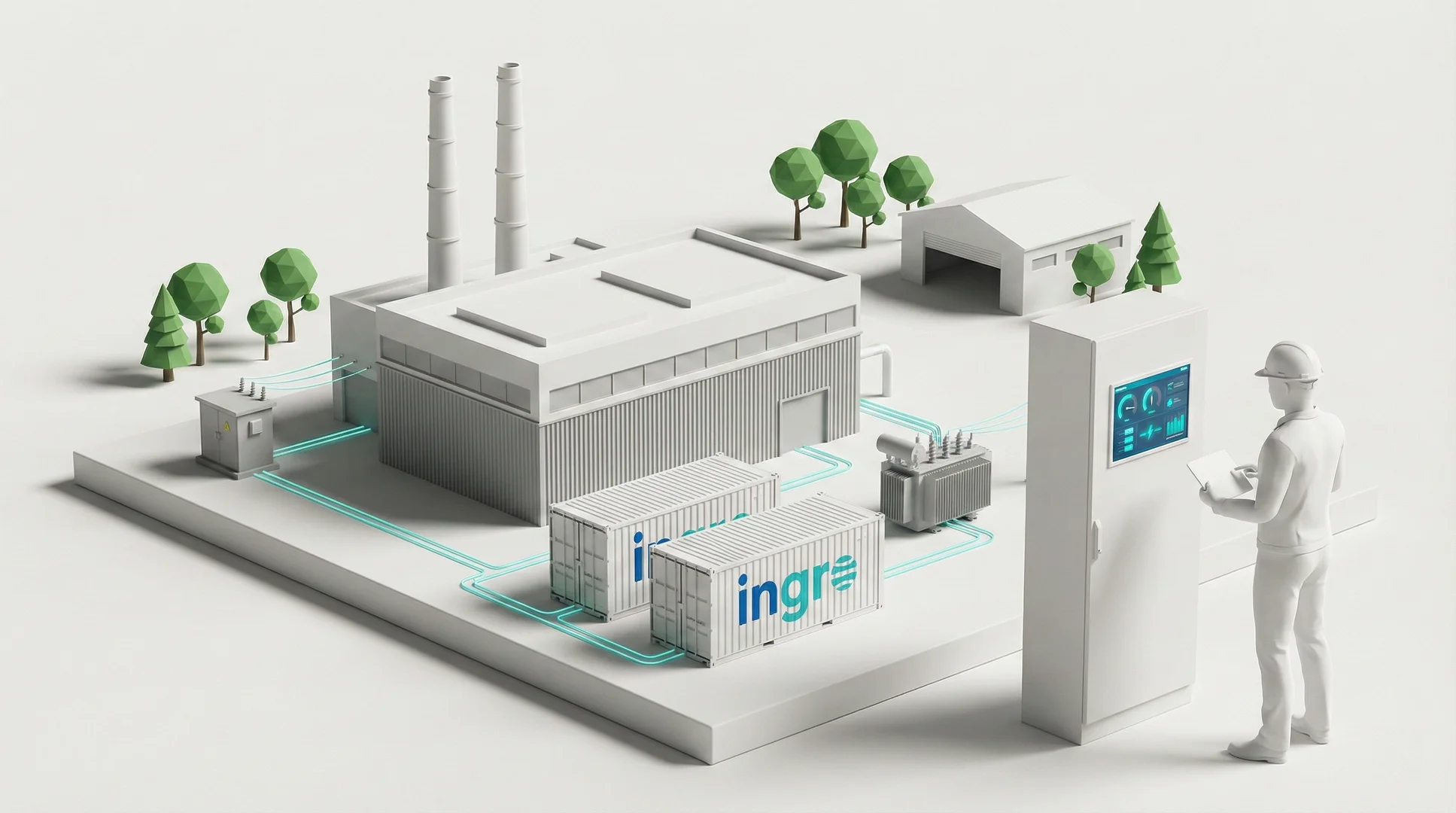
The Use-Case BookFrom a grid-plus-battery site to a plant running grid, solar, battery, and diesel together — each use case below is live in Ingro EMS today, with every dispatch decision logged.
A1Stop paying for your worst peak demand
Even if your maximum demand peaks in a single 15-minute time block in a month, your demand charge increases for the entire month. The battery covers such spikes as they happen — the meter never sees them, effectively reducing your demand charges.
Maximum Demand ShootoutDemand Charge Reduction
A2Buy power when it is cheap. Use it when it is costly.
The BESS charges during off-peak grid tariff hours and discharges during peak tariff hours. Consumption drops in exactly the time blocks where energy charges are highest, directly reducing your electricity bill.
ToD Tariff ArbitrageLoad Shifting
A3The grid goes. You keep running.
Unlike a UPS that protects a few critical loads, the entire plant is powered by the BESS during a grid outage. The battery switches to grid-forming mode — setting the voltage and frequency itself — so short outages no longer require starting the diesel generator.
Grid FormingIslandingBlack StartDG Charges Reduction
A4Serve more load without a bigger connection
The BESS charges when plant load is below your contracted meter capacity and discharges when load peaks. Plant load is optimized across the day, letting you add machine load on the same sanctioned connection — no augmentation, no waiting.
Capacity DeferralPlant Load Optimisation
A5Use your own solar without grid banking
Your rooftop or open-access solar makes power at ₹3.5–4.7 a unit against ₹6–15 from the grid. With states rapidly removing energy-banking provisions, excess solar would otherwise go to waste. The BESS stores it during solar hours and discharges it during peak tariff hours.
Self-ConsumptionDuck Curve
A6Rooftop solar that works when the grid doesn't
Most solar arrays shut down the moment the grid does. Here the battery forms a microgrid for your facility, so the rooftop plant keeps generating through the outage — the battery only covers the gap between solar output and site load.
Grid Forming with PVPV Ride-Through
A7Diesel only when it is truly needed
During an outage the BESS takes the load instantly in grid-forming mode — no DG start for short interruptions. If the outage persists, the EMS signals the diesel generator to power up and shifts load from battery to DG automatically, then back when the grid returns.
Grid FormingIslandingBlack StartDG Charges Reduction
A8The cheapest unit of energy, every second
In plants where grid, solar, BESS, and DG exist together, the problem is optimizing energy cost every second: solar at ₹3.5–4.7, grid at ₹6–15, diesel at ₹22–30 per unit. The EMS computes merit-order dispatch in real time — the battery moves energy between the rungs — so the plant always runs on the cheapest available source.
Merit Order DispatchEconomic DispatchEnergy Cost Optimisation