Ingro EMS — one energy management platform across eight kinds of site
HomeIngro EMS

Ingro EMS: One Platform, Eight Applications

An energy management system for battery storage, solar, standby generation and EV charging — designed, built and supported in India. One controller, one software build, eight configurations. Find the one that matches your site below.

What Ingro EMS is

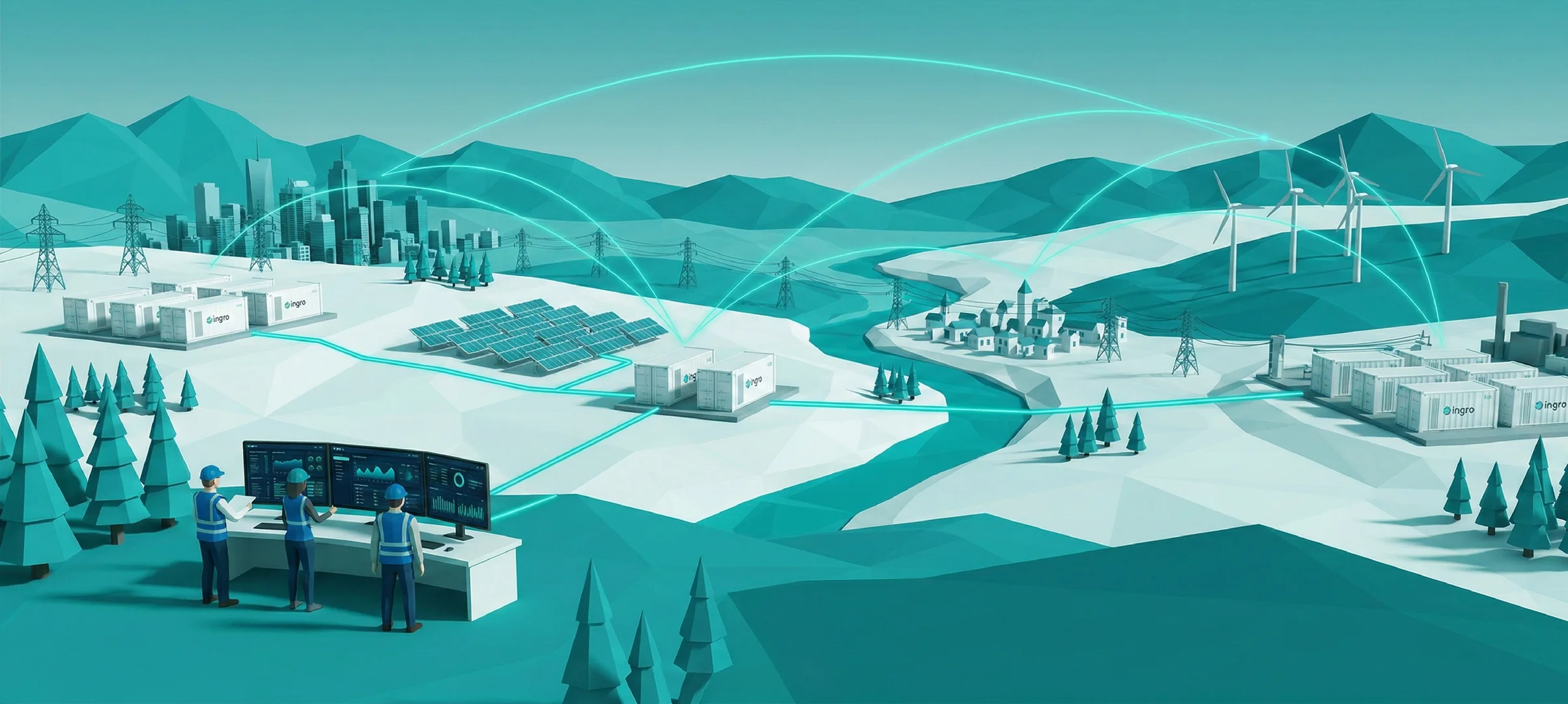
Ingro EMS is an energy management system that operates every source on a site — solar generation, battery storage, standby generation and the utility supply — as one plant against a single, configurable order of preference. The controller resolves that order once per second, issues a setpoint to each source, and records every decision with its reason.

The control logic, the operator interfaces and the reporting suite are common to every installation. What changes between an industrial site, an occupied building and an independent site is a defined set of configured parameters — the reserve floor, the demand ceiling, the tariff windows, the shed priority — not the software. That is why there are eight product codes and one platform.

Find yours

Eight Sites. One Platform.

Each product covers one kind of site. Find what you are building — the page behind it takes that configuration one at a time.

Your use case not included? Dual supplies, wind, critical process loads — configured on the same platform. Tell us about the site.

Side by side

Which Assets Each Product Runs

Ingro EMS product line: which energy assets each of the eight configurations controls
ProductSiteSolarBatteryGeneratorChargersGrid
EMS-BBattery at a factory———
EMS-CBBattery in a building———
EMS-SBSolar and a battery——
EMS-BGCutting the diesel——
EMS-MCMicro grid—
EMS-EVCharging hub—
EMS-PPCSolar plant———
EMS-GSUtility-scale storage———
The platform

What Is Supplied as Standard, and What Is Configured

One controller, one software build, three configurations — an industrial site, an occupied building, an independent site. Everything on the left arrives the same way on every site we commission; everything on the right is established during discovery and commissioning.

Supplied as standard

  • The control logic, the operating states and the order of preference
  • The operator console, the alarm handling and the mobile view
  • The historian, energy ledger and reporting suite
  • Commissioning method, handover documentation and training
  • The thirteen reports, and how every figure is derived
  • The role definitions and the command record

Configured for your site

  • Asset counts and ratings — the array, storage, generation and the connection
  • The reserve floor and the state-of-charge window
  • The demand ceiling, the tariff windows and the fuel price
  • Reconnection policy, shed priority and the generator's own limits
  • Report recipients, cadence and distribution
  • Your users, and the actions available to each of them

Runs autonomously

Site control continues with no internet connection — the controller operates the plant from the plant room.

Equipment-agnostic

Integrates any make of inverter, battery, converter or generator. A model not previously encountered is added as configuration.

Expands by licence

Adding an asset is a configuration change, not new hardware.

Specifications

Control, Measurement, Record and Interfaces

Properties of the delivered system, common to every installation.

Control

Control cycle
One second. Each cycle reads the plant, resolves the order of preference, issues setpoints and records the decision with its reason.
Interlocks
Device limits and prohibitions are re-evaluated on every cycle. A deadband governs the cycling of storage.
Operating authority
In automatic operation the controller holds authority over setpoints. Manual operation transfers that authority to the operator, under role.
Loss of supply
Confirmed by voltage hysteresis. Storage establishes the site's voltage and frequency reference, and the array continues to generate against it.
Return of supply
A stability hold precedes resynchronisation, after which the load is transferred back automatically or on operator confirmation.

Measurement and record

Metering
Each source feeder is metered. Site load is derived as the signed sum of metered flows.
Historian
One-minute resolution, to a local time-series database on site.
Energy ledger
Each site-day is closed by differencing cumulative meter counters — the same arithmetic as the utility bill.
Provenance
Every energy figure carries its basis — metered, derived or modelled — and the proportion of the period covered by data.
Retention
Raw device telemetry, months. Dispatch decisions, years. The minute rollup, longest. The daily energy ledger, retained indefinitely.
Audit
Every command is attributed and retained together with the controller's response. Alarm state is preserved across a restart.

Interfaces

Field protocols
Modbus TCP, Modbus RTU over RS485, SunSpec, dry contacts and digital I/O, and aggregator gateways.
Device integration
Register-map driven. A model not previously encountered is added as configuration.
Upstream integration
REST and WebSocket interfaces for a customer's own SCADA, corporate dashboard or portfolio system.
Reporting output
PDF and XLSX, paginated to A4, written to the filesystem and distributed on schedule.
Reporting and records

Thirteen Reports, Each Addressed to a Named Reader

Generated from the historian and the energy ledger, exported to PDF and XLSX, distributed on schedule and archived as self-contained files.

The thirteen reports issued by Ingro EMS, with cadence and intended reader
ReportCadencePrepared for
01Daily Operations BriefDailyPlant management
02Monthly Executive SummaryMonthlyOwner, finance
03Energy Accounting and Billing ReconciliationMonthlyFinance, utility
04Savings, Measurement and VerificationMonthly, annualFinance, lender, ESCO
05Solar Generation PerformanceMonthlyO&M, EPC
06Generator Operations and FuelMonthlyO&M, finance
07Supply Reliability and IslandingMonthlyPlant management, insurer
08Storage Health and WarrantyMonthly, annualO&M, lender, supplier
09Alarm Performance and SafetyMonthly, annualPlant management, HSE
10Data Quality and Assumptions RegisterMonthlyAudit
11Emissions and SustainabilityAnnualFinance, corporate reporting
12Annual Performance and Asset ReviewAnnualOwner, lender, insurer
13Dispatch and Control AuditQuarterly, on requestEngineering

Data integrity

Every figure states its basis and the proportion of the period covered by data. Modelled values are identified as modelled. Where a savings figure falls below the threshold of statistical significance, the report presents that threshold. The result is a document that stands on its own in front of a lender, an auditor or an insurer.

Each report is structured to the form the profession reading it already expects — generation performance to IEC 61724-1, savings to IPMVP, generator operations to IEEE 762, supply reliability to IEEE 1366, alarm performance to ISA-18.2, emissions to the GHG Protocol. These are the formats the reports follow; certification is issued by accredited bodies, and product listings by the equipment manufacturer.

Implementation

Five Stages, From the Site as Found to a Plant in Service

Equipment delivery is the critical path — typically around three months for a new installation. That period is used for modelling.

  1. 1

    The site is established

    What exists, what has been ordered, and the outcomes the plant is required to deliver. One schedule and one conversation.

  2. 2

    The equipment schedule is issued

    Written against those outcomes, so that the plant is capable of what has been asked of it.

  3. 3

    The plant is modelled

    Your asset counts, loads, tariff and load profile are run against a full simulation of the site before equipment ships, including adverse conditions. Behaviour is reviewed and revised at this stage.

  4. 4

    The plant is commissioned

    Wired, configured and tested against the site's own values, with the results recorded.

  5. 5

    The plant is handed over and supported

    Personnel trained, the reporting suite in service, and a defined route for support thereafter.

Scope of delivery

One Platform. One App. One Team.

1

The controller

Wired, configured and commissioned against your plant, and installed in the plant room. It is the component that operates the site.

2

The operator console

A single-line representation of the actual plant with live power on every feeder, the state of each source, the alarm register, and the endurance available at the load currently being carried.

3

The mobile view

Read-only, for management rather than operations: whether the site is sound, what it has saved, what has occurred and what is scheduled.

4

Reporting and training

The reporting suite, generated and distributed automatically, and instruction for the personnel who will operate the plant.

Common questions

The Ingro EMS Platform, Answered

What is an EMS (energy management system)?

An energy management system is the controller that decides, moment to moment, which source carries a site's load and at what power — the solar array, battery storage, standby generation or the utility supply. Ingro EMS resolves that order of preference once per second, issues a setpoint to each source, and records every decision with the reason for it.

Why are there eight Ingro EMS products instead of one?

Because eight kinds of site need eight configurations, not eight codebases. One controller and one software build run all of them; the product code identifies which assets are present — battery only, solar and battery, battery and generator, a full microgrid, a charging hub, a solar plant or tendered grid-scale storage — and which parameters are configured at commissioning.

Which Ingro EMS product suits my site?

Match the assets. Battery behind an industrial connection is EMS-B; battery in an occupied building is EMS-CB; rooftop solar with a battery is EMS-SB; battery with a diesel generator is EMS-BG; solar, battery and generator forming their own grid is EMS-MC; a charging hub behind a limited connection is EMS-EV; an exporting solar plant is EMS-PPC; and tendered standalone storage at a substation is EMS-GS.

Does Ingro EMS work with equipment we have already bought?

Yes. The platform is manufacturer-independent and register-map driven: any make of inverter, battery, converter or generator integrates over Modbus TCP, Modbus RTU over RS485, SunSpec, dry contacts and digital I/O, or aggregator gateways. A model not previously encountered is added as configuration, not as new hardware.

Does the site keep running without an internet connection?

Yes. The controller operates the plant from the plant room, so site control continues with no connectivity at all. The network connection serves reporting, forecasting and remote support — not the control loop.

Is Ingro EMS made in India?

Yes. Ingro EMS is designed, built and supported in India by Ingro Energy, and configured for Indian tariff structures — time-of-day windows, contracted maximum demand in kW or kVA, and delivered diesel price — with commissioning and support delivered by an Indian engineering team.

What is included in the delivered price?

Four elements, quoted as one item: the controller installed and commissioned against your plant, the operator console, the read-only mobile view, and the reporting suite generated and distributed automatically — together with handover documentation and training for the operating team.

How long does an installation take?

Equipment for a new installation typically requires around three months to arrive and be installed, and that period is used to model the plant against your asset counts, loads, tariff and load profile before anything ships. Commissioning, handover and training follow.
Learn

New to EMS for BESS?

Browse all guides

Four Answers, and We Scope Your Plant

We return a scope of supply, an equipment schedule and an indicative programme, written against the outcomes you set. If equipment is not yet purchased, we specify the list — or start from your bills with Ingro SIMS, our solar and BESS sizing tool.

What is on site today

Generation, storage, standby generation and the connection, as they stand today.

What is already ordered

Anything ordered or contractually committed; anything still open, we can specify.

The outcomes required

The energy bill, the fuel, continuity of production, or all three, in order of priority.

The utility connection

Remaining, being withdrawn, or never present. This determines how much of the night storage is required to own, and how the plant is sized.