What Is an EMS (Energy Management System) for BESS?
EMS Fundamentals8 min read

What Is an EMS (Energy Management System) for BESS?

The software brain that turns a battery into a safe, revenue-generating grid asset.

An energy management system (EMS) is the software intelligence that monitors, controls and optimises a battery energy storage system (BESS). It decides when the battery charges, discharges or sits idle, turning raw hardware into a safe, revenue-generating grid asset. This guide explains what an EMS for BESS does, how it differs from a BMS or SCADA, and why it shapes project returns.

What Is an EMS for BESS?

An energy management system (EMS) for BESS is the top-level software layer that coordinates every component of a battery storage plant, from cells and inverters to the grid connection point. It continuously reads data from the site, applies operating logic and dispatch schedules, and issues the commands that keep the battery running safely and profitably.

Think of the EMS as the brain of the BESS. The battery, power electronics and protection devices are the muscles; the EMS is the decision-maker that tells them what to do, when, and why. Without an EMS, a BESS is a large, expensive battery with no strategy: it cannot respond to price signals, follow a dispatch instruction, or report its status to a control centre.

A modern EMS also connects the storage asset to the outside world, to market signals, grid operators and the owner's dashboards, so a single site or an entire fleet can be operated remotely and in real time.

EMS vs BMS vs SCADA vs PCS: Who Does What

One of the most common points of confusion in BESS projects is how the EMS relates to the BMS, SCADA and the PCS. They are complementary layers, not competitors, each operating at a different level of the system.

  • BMS (Battery Management System): lives inside the battery. It protects and balances the cells and tracks state of charge (SoC), state of health (SoH), temperature and voltage. The BMS keeps the battery safe but does not decide business strategy.
  • PCS / PMS (Power Conversion System / Power Management System): the inverter layer that converts DC battery power to AC grid power and back. It executes the real (kW) and reactive (kVAr) power set-points the EMS sends, at millisecond speed.
  • SCADA (Supervisory Control and Data Acquisition): a monitoring and telemetry layer that gathers, displays and logs data and relays operator commands. Traditional SCADA visualises what is happening; it does not, by itself, optimise dispatch or run markets.
  • EMS (Energy Management System): the intelligence on top. It ingests data from the BMS, PCS and meters, decides the optimal charge and discharge schedule, and orchestrates the whole plant against price, grid and compliance objectives.

The simple rule of thumb

The BMS keeps cells safe, the PCS moves the power, SCADA shows what is happening, and the EMS decides what should happen. On many sites the EMS also absorbs SCADA-style monitoring, so the two are increasingly delivered as one platform.

Core Functions of a BESS EMS

Whatever the vendor, a capable EMS for BESS performs a consistent set of functions. These are the capabilities to look for when evaluating any platform.

  • Real-time monitoring: continuous visibility of the plant, ideally down to individual cells, inverters and meters, so operators see SoC, power flow, temperature and availability as they change.
  • Dispatch and scheduling: sending charge, discharge and idle set-points that follow a plan, whether that plan is a market schedule, a grid-operator instruction, or a self-consumption strategy behind the meter.
  • Optimisation and energy arbitrage: deciding when to charge cheap and discharge into higher prices, or to stack multiple value streams, using forecasts, tariffs and constraints to maximise revenue within safe limits.
  • Alerts and event management: multi-level alarms that flag faults, threshold breaches and abnormal behaviour early, so issues are addressed before they cause downtime or damage.
  • Regulatory and compliance reporting: automated logs and reports that evidence how the asset responded to grid signals and met its obligations, which is essential for settlement and audits.

Beyond the single site

The strongest platforms add fleet-wide analytics, comparing performance across many sites, and remote control, so operators can manage geographically dispersed assets without visiting each plant.

Cloud vs On-Premise EMS

EMS software can be deployed on-premise, running on hardware at the site, or in the cloud, running on remote servers and accessed over a network. Both approaches control the same battery, but they differ in scalability, maintenance, fleet visibility and upfront cost.

On-premise systems keep control logic physically at the plant, which some operators prefer for latency-critical loops. A cloud EMS centralises data and dispatch across an entire portfolio, pushes updates automatically, and makes fleet-wide analytics far easier, while edge devices at each site handle the fast, safety-critical control locally. Most modern platforms use a hybrid model: cloud for optimisation and oversight, edge for sub-second response.

The right choice depends on fleet size, connectivity, latency needs and internal IT capacity. Our dedicated cloud vs on-premise EMS comparison guide covers these trade-offs in detail.

Why the EMS Determines BESS ROI and Safety

The EMS has an outsized effect on whether a BESS project earns its business case. Battery cells and inverters set the physical limits of the asset, but the EMS decides how well those limits are used. Smarter dispatch, tighter arbitrage and more value streams stacked into the same battery translate directly into higher revenue over the project's life.

The EMS also shapes safety and battery longevity. By respecting SoC windows, temperature limits and cycling constraints, in coordination with the BMS, a good EMS slows degradation and reduces the risk of faults escalating. Poor control, by contrast, can overwork cells, shorten life, and erode the returns that justified the investment in the first place.

This is why the EMS, not just the battery chemistry, is often the deciding factor between a BESS that performs to plan and one that underdelivers.

EMS and India's Grid Rules: CERC, SERC and Grid Codes

In India, a BESS must operate within rules set by the Central Electricity Regulatory Commission (CERC) at the national level and the State Electricity Regulatory Commissions (SERCs) at the state level, alongside the applicable grid code. These frameworks govern how storage participates in energy and ancillary-services markets, how it responds to grid signals, and how its performance is reported and settled.

An EMS built with Indian regulation in mind can automate CERC and SERC compliance reporting, maintain the audit trail operators need, and help projects meet the conditions attached to schemes such as Viability Gap Funding (VGF). Under MNRE guidelines, a made-in-India EMS can help qualify grid-scale BESS projects for VGF, an important consideration for developers assembling a bankable project.

For projects using open access or serving commercial and industrial (C&I) buyers, the EMS is also what makes real-time scheduling, metering and settlement practical across changing state-level rules.

Ingro Cloud EMS: An EMS for BESS Built in India

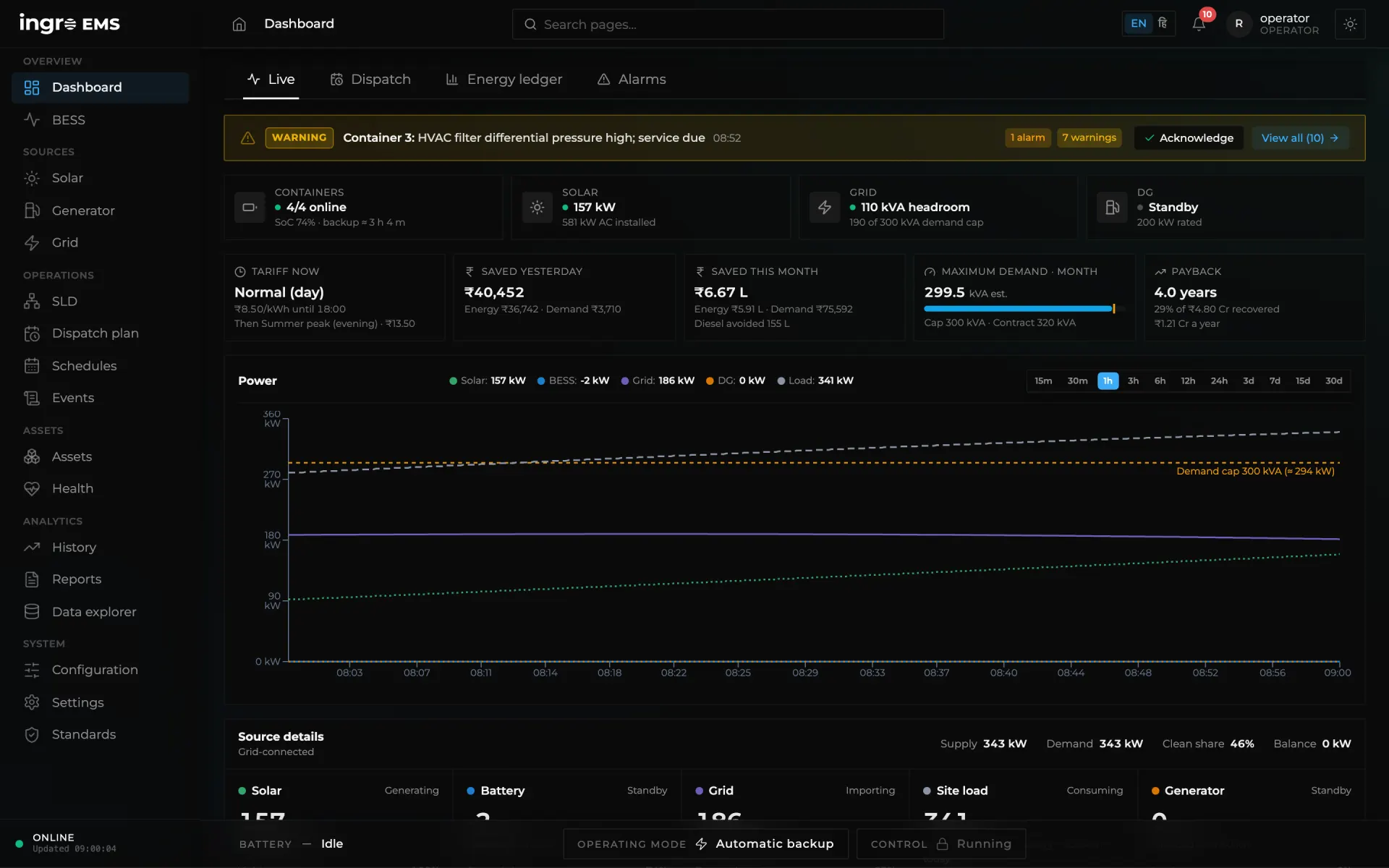
Ingro Cloud EMS is an example of a modern, cloud-based, hardware-agnostic EMS for BESS, designed and made in India. It provides real-time monitoring down to cell level, centralised and remote dispatch control, fleet-wide analytics, multi-level alerts, and automated CERC/SERC compliance reporting from a single platform.

Because it is hardware-agnostic, it connects to mixed equipment through an integrations layer using standard protocols, Modbus TCP/RTU, IEC 61850, DNP3 and OPC-UA, with edge gateways that handle protocol translation, local buffering and sub-second (to sub-10ms) control at each site. It re-optimises dispatch every five minutes and today operates one of India's oldest grid-scale BESS sites at over 99.5% availability, coordinating 124 inverters at a single site.

Within the broader Ingro platform, Cloud EMS is Pillar 1 of AI Powered BESS: it captures and controls the hardware, then feeds Battery AI for optimisation and Battery Passport for lifecycle and compliance. For teams evaluating what an EMS for BESS should deliver, it is a useful reference point for the monitoring, control and compliance capabilities discussed in this guide.

  • Real-time monitoring to cell level, plus centralised, remote dispatch control across an entire fleet.
  • Hardware-agnostic integration via Modbus, IEC 61850, DNP3 and OPC-UA, with edge gateways for sub-second control.
  • Automated CERC/SERC compliance reporting, and a made-in-India build that can support VGF eligibility under MNRE guidelines.

Key Takeaways

  • An energy management system (EMS) is the software brain of a BESS: it monitors, controls and optimises the battery so the hardware becomes a safe, revenue-generating grid asset.
  • The EMS is distinct from the BMS (cell safety), the PCS (power conversion) and SCADA (monitoring); it sits on top and decides dispatch.
  • Core EMS functions are real-time monitoring, dispatch and scheduling, optimisation and arbitrage, alerts, and compliance reporting.
  • The EMS, more than the battery chemistry, often determines BESS ROI, safety and battery life.
  • In India, an EMS should automate CERC/SERC reporting; a made-in-India EMS can help projects qualify for VGF under MNRE guidelines.
FAQ

Frequently Asked Questions

What is an EMS in a battery energy storage system?

An EMS (energy management system) is the software layer that controls a BESS. It reads data from the battery, inverters and meters, decides when to charge, discharge or hold, and issues dispatch commands, all while keeping the asset within safe limits and meeting grid and market obligations. It is the decision-making brain of the storage plant.

What is the difference between an EMS and a BMS?

A BMS (battery management system) protects the cells, balancing them and tracking state of charge, health and temperature inside the battery. An EMS sits above it, deciding the plant's overall charge and discharge strategy against price, grid and compliance goals. The BMS keeps the battery safe; the EMS decides what the battery should do.

Is an EMS the same as SCADA?

No. SCADA is primarily a monitoring and telemetry layer that displays data and relays operator commands. An EMS adds intelligence on top, optimising dispatch, running arbitrage, and orchestrating the plant against market and grid objectives. Many modern platforms combine SCADA-style monitoring and EMS control into one system, but the optimisation logic is what makes it an EMS.

Why is the EMS important for BESS ROI?

The battery sets the physical limits, but the EMS decides how well they are used. Better dispatch, tighter energy arbitrage and stacking multiple value streams into the same battery directly raise revenue, while safe cycling extends battery life. A weak EMS leaves value unused and can shorten asset life, so it often makes or breaks the business case.

Does a BESS in India need an EMS for compliance?

Effectively, yes. Operating within CERC and SERC rules and the grid code requires accurate scheduling, response to grid signals, and detailed reporting for settlement and audits. An EMS automates this compliance reporting and keeps the audit trail. A made-in-India EMS can also help grid-scale projects qualify for Viability Gap Funding under MNRE guidelines.

Keep Learning

Related Guides

See the Cloud EMS for BESS in action

Ingro Cloud EMS gives you real-time monitoring, remote dispatch, and fleet-wide control across every BESS site, from a single dashboard.