A battery energy storage system (BESS) is an integrated set of batteries, power electronics, and control software that stores electrical energy and releases it on demand. As India accelerates its shift to renewables, BESS has become the backbone of a flexible, reliable grid, letting operators shift solar and wind power to the hours when it is needed most.
Key takeaways
A battery energy storage system (BESS) stores electrical energy and discharges it on demand, integrating battery cells, a BMS, a PCS or inverter, an EMS, and thermal and safety controls.
BESS supports grid-scale reserves, C&I peak shaving, EV charging, microgrids, solar firming, and open-access energy arbitrage in India.
The EMS is the brain of a BESS: it controls dispatch, protects battery health, and automates CERC and SERC compliance, making it the biggest driver of project returns.
India's storage market is backed by CERC and SERC frameworks, MNRE schemes, and VGF support, with a made-in-India EMS helping projects qualify for funding.
Ingro Cloud EMS is a hardware-agnostic, cloud-based EMS running one of India's oldest grid-scale BESS sites at over 99.5 percent availability.
A battery energy storage system (BESS) is a rechargeable system that captures electricity from the grid or a renewable source, stores it as chemical energy in batteries, and converts it back to usable power when required. It is far more than a large battery: a BESS combines battery cells, protection electronics, power conversion, thermal control, and intelligent software into a single coordinated asset.
Most modern grid-scale and commercial systems use lithium-ion chemistries such as LFP (lithium iron phosphate) because of their safety, cycle life, and falling costs. What turns a stack of cells into a dependable storage system is the control layer that decides, second by second, when to charge, when to discharge, and how to keep every component operating safely and profitably.
02
Core Components of a BESS
A BESS is a system of systems. Each layer performs a distinct job, and the whole is only as reliable as its weakest part. The core building blocks are:
Battery cells and modulesThe electrochemical heart of the system. Cells are grouped into modules and racks to reach the required voltage and energy capacity, typically measured in megawatt-hours (MWh).
Battery Management System (BMS)Monitors voltage, current, temperature, and state of charge at the cell and module level, balancing cells and protecting them from over-charge, over-discharge, and thermal risk.
Power Conversion System (PCS) or inverterConverts direct current (DC) stored in the batteries to alternating current (AC) for the grid during discharge, and back to DC during charging.
Energy Management System (EMS)The software brain that orchestrates the whole asset, deciding how and when to dispatch power, tracking performance, and handling grid compliance.
Thermal managementCooling or heating systems that keep cells within their optimal temperature band to protect life, efficiency, and safety.
Enclosure and controlsThe container, fire-detection, protection relays, metering, and communication gear that house and safeguard the system on site.
03
How a BESS Works: The Charge and Discharge Cycle
A BESS operates on a simple principle executed with precision. During charging, electricity, often surplus solar generation during the day or cheap off-peak grid power, flows into the system, where the PCS converts it from AC to DC and stores it in the batteries as chemical energy. The BMS ensures every cell charges evenly and safely.
During discharging, the process reverses: the PCS converts stored DC back into grid-quality AC and delivers it to the load or the grid, typically during evening peaks or when renewable output drops. Not all energy survives the round trip; a well-designed lithium-ion BESS delivers a round-trip efficiency of roughly 85 to 90 percent.
Overseeing every cycle is the EMS. It reads market signals, grid conditions, and battery health, then decides the optimal charge and discharge schedule, balancing revenue, contractual obligations, and long-term battery life in real time.
Net demand across one day
Net demand (demand minus solar)Net demand with the batterySolar
Illustrative shape of an Indian high-solar day, not a forecast.
Through all four, frequency response runs on top of the schedule: the EMS keeps a band of power and charge in reserve for it.
04
Main Applications of BESS in India
Because a BESS can absorb and release power on command, it supports use cases across the entire electricity value chain. In the Indian context, the most important applications include:
Grid-scale and utility storageProviding frequency regulation, peak capacity, and reserves that help utilities and grid operators manage a renewable-heavy grid.
C&I peak shaving and demand-charge managementCommercial and industrial users store cheap power and discharge during peak periods to cut demand charges and time-of-day tariffs.
EV charging supportBuffering the grid at fast-charging hubs so that high, short bursts of demand do not require expensive upgrades to the connection.
MicrogridsForming the storage core of campus, rural, and island microgrids that must run reliably with limited or intermittent grid access.
Renewable and solar firmingSmoothing the variable output of solar and wind so that generation profiles become predictable and dispatchable.
Open access and energy arbitrageEnabling consumers and generators using open access in India to shift and trade power to periods of higher value.
05
Benefits of BESS and the India Market Context
Energy storage delivers value that generation alone cannot. It decouples the moment power is produced from the moment it is consumed, and that flexibility unlocks reliability, cost savings, and cleaner supply at the same time.
India's policy and market environment is now firmly behind storage. The Central Electricity Regulatory Commission (CERC) and state commissions (SERCs) are building the rules for storage participation, MNRE has issued dedicated schemes, and grid-scale projects can access Viability Gap Funding (VGF) support to improve their economics. Meeting evolving CERC and SERC reporting requirements is fast becoming a core operational task for every BESS owner, not an afterthought.
Grid reliabilityFast response to frequency and voltage events keeps a renewable-heavy grid stable.
Lower energy costsArbitrage, peak shaving, and demand-charge reduction improve project and consumer economics.
Renewable integrationStorage turns intermittent solar and wind into firm, dispatchable capacity.
Deferred infrastructureStrategically placed storage can postpone costly transmission and distribution upgrades.
Policy tailwindsMNRE schemes, VGF support, and evolving CERC and SERC frameworks are accelerating deployment across India.
06
Why the EMS Is the Brain of a BESS
If the battery is the muscle of a BESS, the energy management system (EMS) is its brain. Hardware determines how much energy a system can store; the EMS determines how well that energy is used. It sits above the BMS and PCS, translating business goals, grid signals, and safety limits into precise, real-time dispatch decisions.
A capable EMS monitors the fleet down to individual cells, dispatches power remotely, raises multi-level alerts before small issues become failures, and automates the compliance reporting that CERC and SERC frameworks demand. Two identical batteries can perform very differently depending on the intelligence controlling them, which is why the EMS is the single most important factor in a BESS project's lifetime returns and reliability. To go deeper, see our dedicated guide to what an EMS for BESS is.
The cycle repeats automatically. Control response is specified per project — sub-millisecond, 4 ms, 10 ms or 20 ms — to match the grid code, the connection agreement or the client's own requirement.
07
How Ingro Cloud EMS Powers Modern BESS Projects
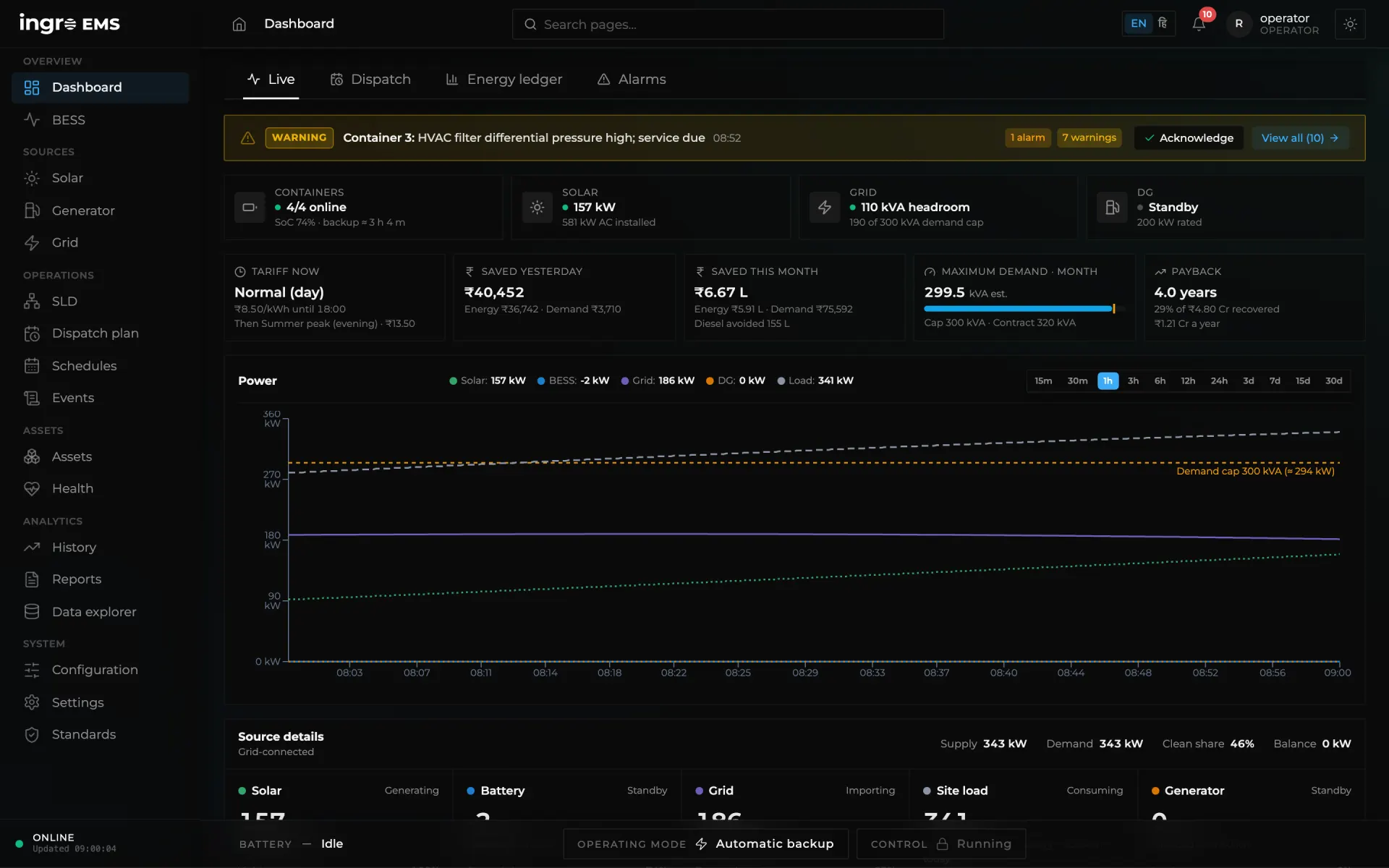
Ingro Cloud EMS is a cloud-based, hardware-agnostic energy management system built in India specifically for BESS. It provides real-time monitoring down to the cell level, centralised and remote dispatch control, fleet-wide analytics, multi-level alerts, and automated CERC and SERC compliance reporting, giving owners a single, intelligent control layer across every asset.
Because it is hardware-agnostic, Cloud EMS connects to virtually any battery, BMS, or inverter through open protocols, Modbus TCP and RTU, IEC 61850, DNP3, and OPC-UA, with edge gateways that handle protocol translation, local buffering, and sub-second to sub-10-millisecond edge control. This proven platform operates one of India's oldest grid-scale BESS sites at over 99.5 percent availability, coordinates 124 inverters at a single site, and re-optimises dispatch every five minutes.
As a made-in-India EMS, Cloud EMS can also help grid-scale projects qualify for Viability Gap Funding (VGF) under MNRE guidelines. It is a module of the Ingro EMS platform: it feeds Ingro Brain (Battery AI) for advanced optimisation and Battery Passport for lifecycle and compliance tracking, while the Integrations layer connects the underlying hardware. Together they turn a battery installation into an intelligent, revenue-optimised asset.
A controller installed in your plant room, a console on site and on your phone, and reports your finance team can use. Supplied on its own for your battery, or as a complete battery system.
Ingro EMS Controller, wired and commissioned on site
Operator console, mobile app and 13 reports
Add Cloud EMS, Ingro Brain or Battery Passport when you need them
A BESS, or battery energy storage system, is a rechargeable system that stores electricity in batteries and releases it when needed. It combines battery cells, power electronics, thermal management, and control software so that power produced at one time can be used at another, improving reliability and cutting costs.
During charging, a BESS takes in electricity, converts it from AC to DC through the inverter, and stores it in batteries as chemical energy. During discharging, it converts that stored DC back to grid-quality AC and delivers it to the load. An EMS decides the optimal timing based on grid conditions, prices, and battery health.
The EMS is the brain because it turns battery capacity into useful, profitable output. Sitting above the BMS and inverter, it monitors the system down to cell level, makes real-time dispatch decisions, raises alerts, and automates compliance reporting. Two identical batteries perform very differently depending on the intelligence of the EMS controlling them.
A BESS has six core components: battery cells and modules that store energy, a battery management system (BMS) that protects them, a power conversion system (PCS) or inverter that converts between DC and AC, an energy management system (EMS) that controls dispatch, thermal management, and the enclosure with safety and control gear.
In India, BESS is used for grid-scale frequency regulation and reserves, commercial and industrial peak shaving and demand-charge reduction, EV charging support, microgrids, solar and wind firming, and open-access energy arbitrage. Policy support from CERC, SERCs, MNRE, and VGF schemes is accelerating adoption across these applications.
Yes. Beyond data sovereignty and local support, a made-in-India EMS such as Ingro Cloud EMS can help grid-scale projects qualify for Viability Gap Funding (VGF) under MNRE guidelines. It also automates the CERC and SERC compliance reporting that Indian regulators increasingly require from storage operators.
Ingro EMS is designed, built and supported in India, for C&I sites and grid-scale BESS. Ingro EMS is deployed on site (offline), in the cloud, or as a hybrid of the two. In on-site and hybrid deployments, site control continues with no internet connection.