EMS-B — Battery storage control for industrial sites.
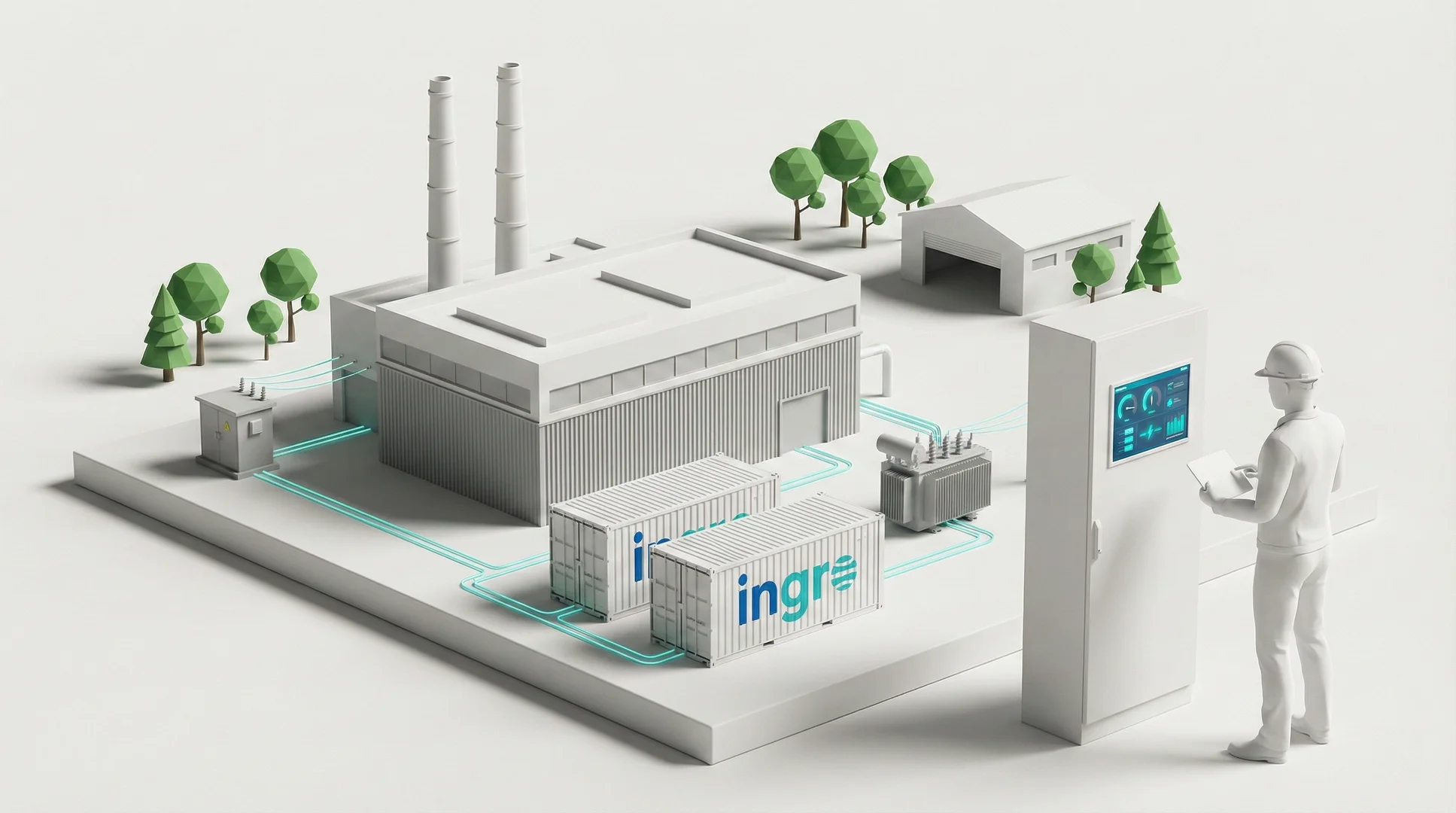
EMS-B · Battery at a factory

EMS for Industrial Battery Storage

Battery storage control for industrial sites. The controller holds billed maximum demand below a limit you configure, charges the battery in low-tariff windows and discharges it in peak windows. When the supply fails it transfers the site to the battery without interruption, and hands the load back under control when the supply returns.

What EMS-B is

Ingro EMS-B is an energy management system for battery storage at industrial sites. It controls the battery system and the grid connection point, dispatching against the tariff and a set demand limit, and carries the site through supply interruptions.

The controller holds billed maximum demand below a limit you configure, charges the battery in low-tariff windows and discharges it in peak windows. When the supply fails it transfers the site to the battery without interruption, and hands the load back under control when the supply returns.

SolarBatteryGeneratorChargersGrid

Battery + supply · no solar, no generator

What EMS-B Controls

The assets on the site, and the controller that decides between them.

The plant

the load, and the bill

The battery

cabinets, or containers

Ingro EMS

the controller

The supply

its demand charge

A data centre or a metro depot is this same package with a larger reserve held back. Nothing else changes.

What it does for the business

The Outcomes EMS-B Delivers

Demand held below a configured limit — the billed maximum demand never registers above it.

Charged in low-tariff windows and discharged in peak windows, configured to your tariff structure.

Seamless transfer to battery on supply failure, and a controlled return when the supply is restored.

Additional load carried on the existing connection — the battery supplies short peaks above the sanctioned limit.

EMS-B in three lines

  • Peak shaving to a set demand limit
  • Time-of-use charging
  • Seamless backup through outages

Where this configuration runs

FactoryWarehouseCold storageData centreMetro depot
Industrial plant solutions
Common questions

EMS-B, Answered

How does an EMS reduce the maximum demand charge?

The EMS meters the site's import continuously and discharges the battery whenever load approaches the demand ceiling you have configured, so the recorded maximum demand never registers above that figure. The charge levied against contracted capacity is then set by the ceiling you chose, not by the site's worst fifteen minutes of the month.

Can a battery add load to a connection that is already at its sanctioned limit?

Yes. EMS-B supplies short peaks above the sanctioned limit from the battery rather than from the grid, so additional plant can run on the existing connection without applying for a sanctioned-load enhancement.

Does EMS-B need solar or a generator on site?

No. EMS-B is the battery-and-supply configuration — it coordinates the battery system and the grid connection point only. If the site has solar, a generator or EV chargers, the same platform is configured as EMS-SB, EMS-BG or EMS-EV instead.

Scope of delivery

Four Elements, Quoted as One Item

Every configuration is delivered the same way: the controller installed and commissioned, the app, a monthly report pack for finance, lenders and auditors, and training for the operating team — all included in the delivered price.

1

The controller

Wired, configured and commissioned against your plant, and installed in the plant room. It is the component that operates the site.

2

The operator console

A single-line representation of the actual plant with live power on every feeder, the state of each source, the alarm register, and the endurance available at the load currently being carried.

3

The mobile view

Read-only, for management rather than operations: whether the site is sound, what it has saved, what has occurred and what is scheduled.

4

Reporting and training

The reporting suite, generated and distributed automatically, and instruction for the personnel who will operate the plant.

Runs autonomously

Site control continues with no internet connection — the controller operates the plant from the plant room.

Equipment-agnostic

Integrates any make of inverter, battery, converter or generator. A model not previously encountered is added as configuration.

Expands by licence

Adding an asset is a configuration change, not new hardware.
Not your site?

The Same Platform, Configured Differently

Four Answers, and We Scope Your Plant

We return a scope of supply, an equipment schedule and an indicative programme, written against the outcomes you set.

What is on site today

Generation, storage, standby generation and the connection, as they stand today.

What is already ordered

Anything ordered or contractually committed; anything still open, we can specify.

The outcomes required

The energy bill, the fuel, continuity of production, or all three, in order of priority.

The utility connection

Remaining, being withdrawn, or never present. This determines how much of the night storage is required to own, and how the plant is sized.