
Combined control of rooftop solar and battery storage. The array and the battery are dispatched together rather than separately, so generation is used where it is worth most — on the site's own load, then in storage, and only then exported at the feed-in rate. On a daytime outage the site runs on solar and storage, with the array recharging the battery through the event.
Ingro EMS-SB is an energy management system that controls rooftop solar and battery storage as a single plant: on-site generation is consumed first, surplus is directed to storage in preference to export, and demand limiting is maintained on low-yield days.
The array and the battery are dispatched together rather than separately, so generation is used where it is worth most — on the site's own load, then in storage, and only then exported at the feed-in rate. On a daytime outage the site runs on solar and storage, with the array recharging the battery through the event.
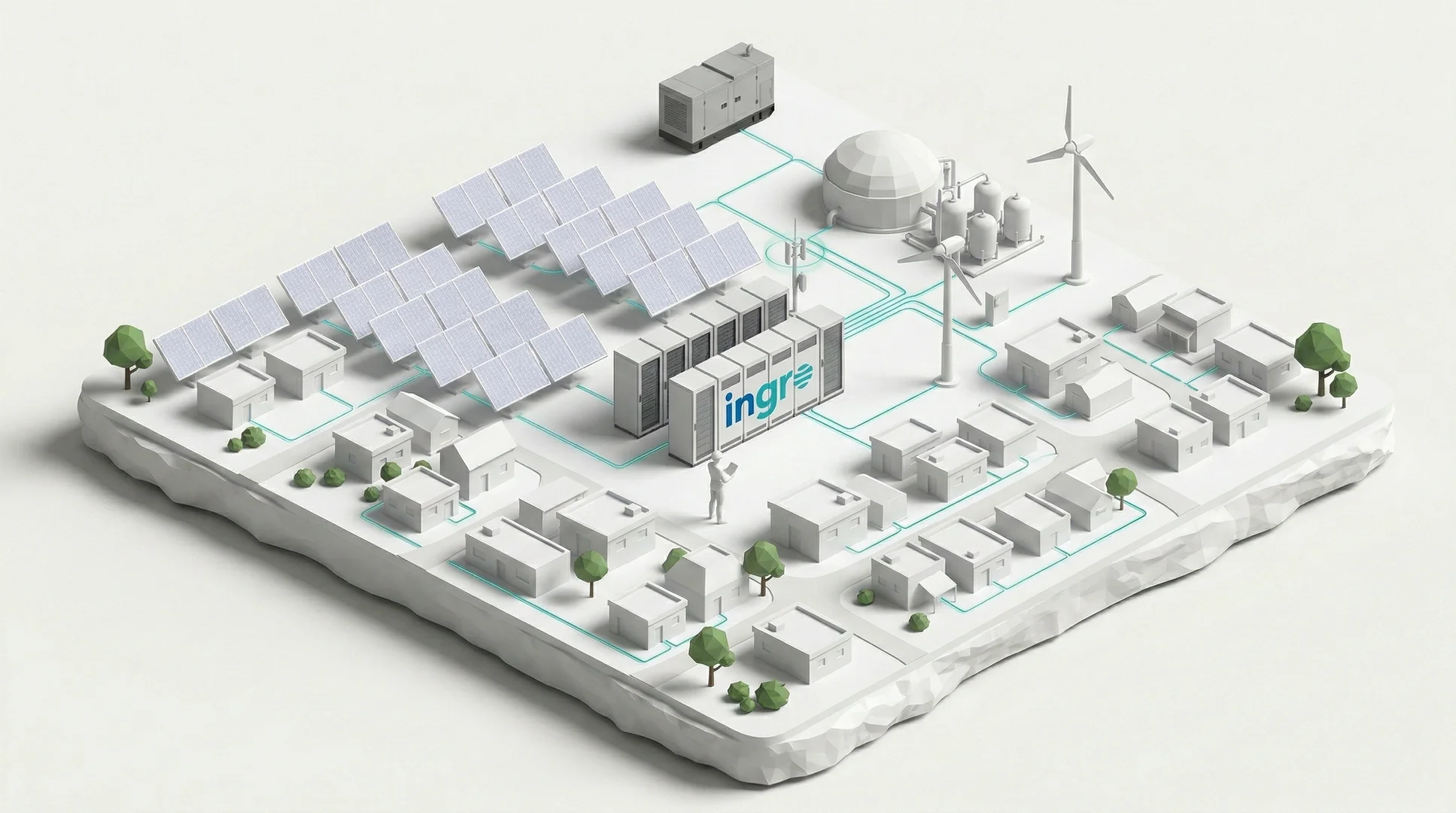
Solar + battery + supply
The assets on the site, and the controller that decides between them.
Your building
the roof, put to work
The array
generation, first in the order
The battery
sized to your peak
Ingro EMS
the controller
The supply
the balance
Four battery units and ten panels, or forty and a thousand. The counts are yours; the product code is the same.
Generation consumed on site first, with surplus directed to storage rather than exported at the feed-in rate.
Demand limiting maintained on low-yield days, with the battery covering what the array cannot.
Daytime outages carried on solar and storage, with the array recharging the battery through the outage.
Consolidated monthly reporting of generation, self-consumption and savings.
Because the two are priced differently. Exported units are settled at the feed-in or net-metering rate, while a unit held in storage and used during the evening peak displaces a unit you would otherwise have bought at the peak tariff. EMS-SB directs surplus to storage in preference to export whenever that comparison favours storing it.
The site keeps running. Storage assumes the load at the instant supply is lost and establishes the site's voltage and frequency reference, and the array continues to generate against that reference — so solar keeps recharging the battery through the outage rather than shutting down with the grid.
Usually not. The platform is manufacturer-independent and integrates over Modbus TCP/RTU, SunSpec and comparable interfaces; inverters that accept a remote active-power limit qualify, which covers effectively all current models. Compatibility is confirmed against your equipment list during discovery.
Every configuration is delivered the same way: the controller installed and commissioned, the app, a monthly report pack for finance, lenders and auditors, and training for the operating team — all included in the delivered price.
Wired, configured and commissioned against your plant, and installed in the plant room. It is the component that operates the site.
A single-line representation of the actual plant with live power on every feeder, the state of each source, the alarm register, and the endurance available at the load currently being carried.
Read-only, for management rather than operations: whether the site is sound, what it has saved, what has occurred and what is scheduled.
The reporting suite, generated and distributed automatically, and instruction for the personnel who will operate the plant.
Site control continues with no internet connection — the controller operates the plant from the plant room.
Integrates any make of inverter, battery, converter or generator. A model not previously encountered is added as configuration.
Adding an asset is a configuration change, not new hardware.
We return a scope of supply, an equipment schedule and an indicative programme, written against the outcomes you set.
Generation, storage, standby generation and the connection, as they stand today.
Anything ordered or contractually committed; anything still open, we can specify.
The energy bill, the fuel, continuity of production, or all three, in order of priority.
Remaining, being withdrawn, or never present. This determines how much of the night storage is required to own, and how the plant is sized.