EMS-EV — Charging-hub control behind a limited grid connection.
EMS-EV · Charging hub

EMS for EV Charging Hubs

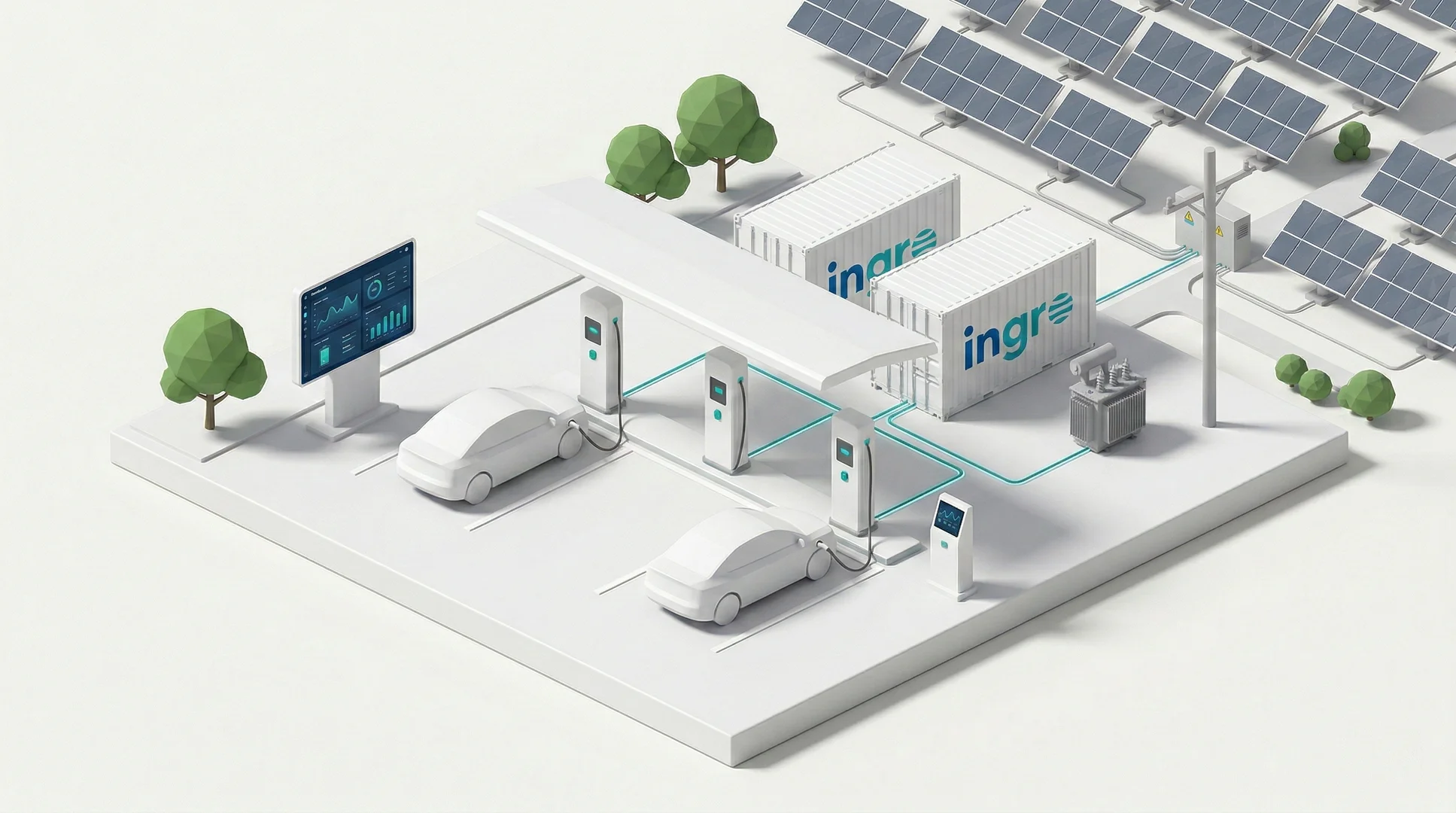
Charging-hub control behind a limited grid connection. Vehicles are charged from canopy solar first, reducing energy drawn from the connection. When several vehicles plug in at once, the battery supplies the coincident peak so that demand stays inside the connection limit — which means more charger capacity on the connection you already hold, without applying for a sanctioned-load enhancement.

What EMS-EV is

Ingro EMS-EV is an energy management system for EV charging hubs operating behind a limited grid connection. It coordinates chargers, battery storage and canopy solar against the connection limit, and accounts for energy per charger.

Vehicles are charged from canopy solar first, reducing energy drawn from the connection. When several vehicles plug in at once, the battery supplies the coincident peak so that demand stays inside the connection limit — which means more charger capacity on the connection you already hold, without applying for a sanctioned-load enhancement.

SolarBatteryGeneratorChargersGrid

Chargers + battery + solar + supply

What EMS-EV Controls

The assets on the site, and the controller that decides between them.

The canopy

shade that earns

The chargers

cars, buses, fleets

The battery

for the rush

Ingro EMS

the controller

The supply

its connection limit

The same package runs a bus depot, a forklift bay and a highway forecourt — including forecourts with no grid connection at all.

What it does for the business

The Outcomes EMS-EV Delivers

Vehicles charged from canopy solar first, reducing energy drawn from the connection.

Coincident plug-in peaks supplied by the battery, keeping demand within the connection limit.

Higher charger capacity on the existing connection, without a sanctioned-load enhancement.

Energy accounting per charger for billing and utilisation analysis.

EMS-EV in three lines

  • More chargers on the existing connection
  • Plug-in peaks absorbed by the battery
  • Billing split per charger

Where this configuration runs

Bus depotFleet yardHighway forecourtForklift bayMall parking
Electric mobility solutions
Common questions

EMS-EV, Answered

How do you add EV chargers when the grid connection is already at its limit?

By putting a battery behind the chargers and a controller in front of both. EMS-EV supplies coincident plug-in peaks from storage rather than the grid, so the connection never sees them — which allows more charger capacity on the existing sanctioned load instead of an enhancement application and the wait that comes with it.

Can an EV charging hub run without a grid connection?

Yes. A forecourt with canopy solar, storage and no connection at all is the same package configured differently — the order of preference closes up where the utility supply would have sat, and the site runs on generation and storage.

Does the EMS bill per charger?

It accounts per charger. Each charger's energy is metered and recorded for billing and utilisation analysis, so revenue and throughput can be attributed to individual units rather than to the site as a whole.

Scope of delivery

Four Elements, Quoted as One Item

Every configuration is delivered the same way: the controller installed and commissioned, the app, a monthly report pack for finance, lenders and auditors, and training for the operating team — all included in the delivered price.

1

The controller

Wired, configured and commissioned against your plant, and installed in the plant room. It is the component that operates the site.

2

The operator console

A single-line representation of the actual plant with live power on every feeder, the state of each source, the alarm register, and the endurance available at the load currently being carried.

3

The mobile view

Read-only, for management rather than operations: whether the site is sound, what it has saved, what has occurred and what is scheduled.

4

Reporting and training

The reporting suite, generated and distributed automatically, and instruction for the personnel who will operate the plant.

Runs autonomously

Site control continues with no internet connection — the controller operates the plant from the plant room.

Equipment-agnostic

Integrates any make of inverter, battery, converter or generator. A model not previously encountered is added as configuration.

Expands by licence

Adding an asset is a configuration change, not new hardware.
Not your site?

The Same Platform, Configured Differently

Four Answers, and We Scope Your Plant

We return a scope of supply, an equipment schedule and an indicative programme, written against the outcomes you set.

What is on site today

Generation, storage, standby generation and the connection, as they stand today.

What is already ordered

Anything ordered or contractually committed; anything still open, we can specify.

The outcomes required

The energy bill, the fuel, continuity of production, or all three, in order of priority.

The utility connection

Remaining, being withdrawn, or never present. This determines how much of the night storage is required to own, and how the plant is sized.