
Microgrid control for off-grid and weak-grid sites. Once per second the controller reads the plant, resolves the least-cost compliant means of carrying the present load, issues a setpoint to each source and records the decision with its reason. Solar is consumed first, storage covers the hours that cost most and answers every interruption, the utility supply carries the balance within its demand ceiling, and standby generation is engaged only when demand exceeds what storage can deliver.
Ingro EMS-MC is a microgrid energy management system for off-grid and weak-grid sites. It forms and holds the site's own grid, operating solar generation, battery storage, standby generation and the utility supply as one plant against a single, configurable order of preference.
Once per second the controller reads the plant, resolves the least-cost compliant means of carrying the present load, issues a setpoint to each source and records the decision with its reason. Solar is consumed first, storage covers the hours that cost most and answers every interruption, the utility supply carries the balance within its demand ceiling, and standby generation is engaged only when demand exceeds what storage can deliver.
Solar + battery + generator, supply optional
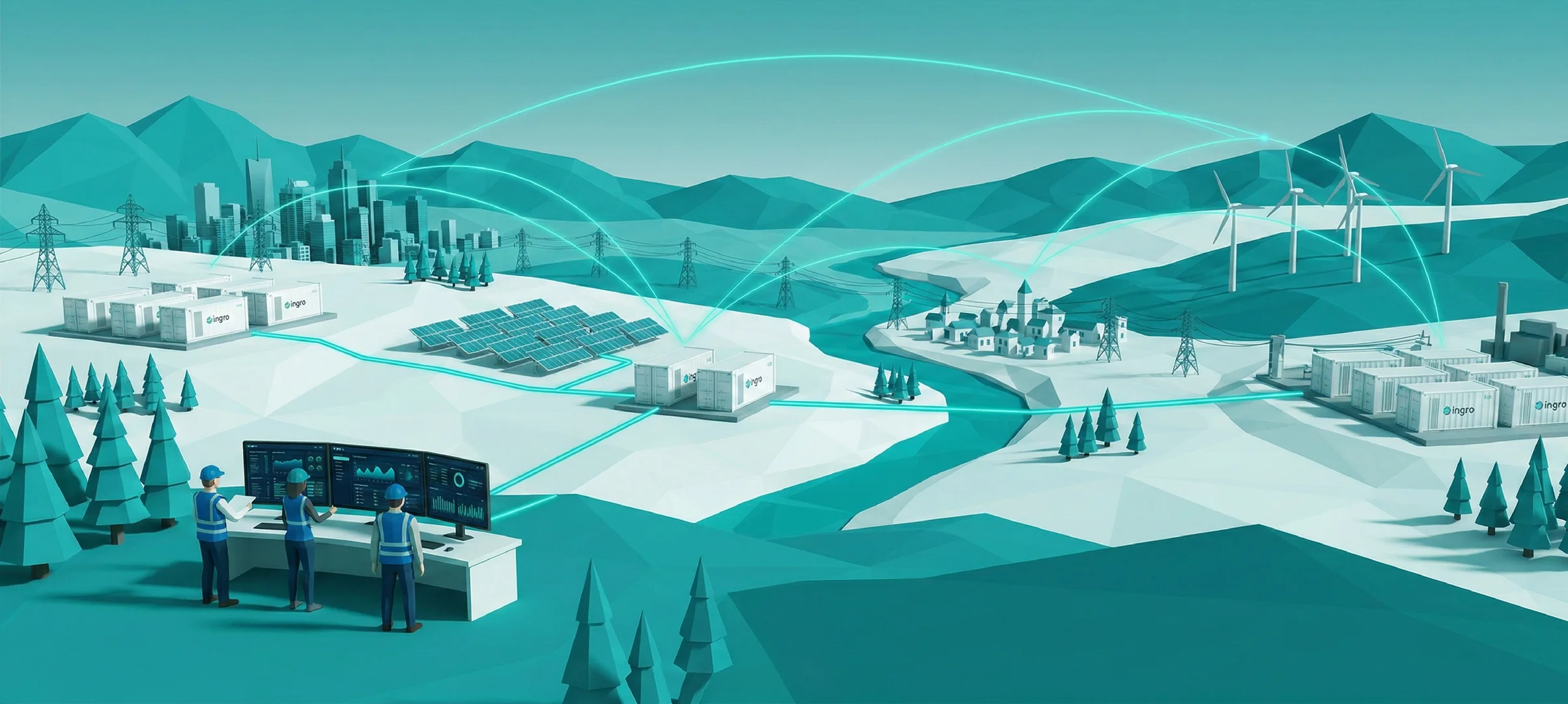
The assets on the site, and the controller that decides between them.
The site
a mine, a resort, a village
Solar
first in the order
The battery
for the night
Generator
last resort
Ingro EMS
the controller
This is the fullest configuration we build. Every other product in the line is this one with something taken out.
Solar and battery carry the base operation, with the generator held as reserve.
The full site supported with no utility supply — continuous operation, not short-term ride-through.
Load shedding in a defined priority order, applied only to circuits you nominate.
A single cost-per-unit figure for the site, reported monthly with diesel included.
A microgrid EMS is the controller that forms and holds a site's own grid when there is no utility supply behind it, and operates every source on the site — solar, storage, standby generation and the connection where one exists — against a single order of preference. Ingro EMS-MC resolves that order once per second and issues a setpoint to each source.
By marginal cost, subject to continuity. Solar generation is consumed first and its surplus stored in preference to export; battery storage covers the most expensive hours and is the first response to any loss of supply; the utility supply carries the balance within its demand ceiling and cheapest tariff windows; standby generation is engaged only when demand exceeds what storage can deliver. The order is the supplied default and is configurable.
Yes — that is the independent-supply case, for mines, estates, resorts, plantations and remote installations where the connection is being withdrawn or was never made. Generation and storage carry the base operation, standby generation is held in reserve, and the order of preference simply closes up where the utility supply would have sat.
Loss of supply is confirmed by voltage hysteresis; storage then establishes the site's voltage and frequency reference and the array continues to generate against it. On return, a stability hold precedes resynchronisation, after which the load is transferred back automatically or on operator confirmation, according to the reconnection policy you configure.
Yes. The controller operates the plant from the plant room, not from the cloud. Connectivity serves reporting, forecasting and remote support; site control continues without it.
Every configuration is delivered the same way: the controller installed and commissioned, the app, a monthly report pack for finance, lenders and auditors, and training for the operating team — all included in the delivered price.
Wired, configured and commissioned against your plant, and installed in the plant room. It is the component that operates the site.
A single-line representation of the actual plant with live power on every feeder, the state of each source, the alarm register, and the endurance available at the load currently being carried.
Read-only, for management rather than operations: whether the site is sound, what it has saved, what has occurred and what is scheduled.
The reporting suite, generated and distributed automatically, and instruction for the personnel who will operate the plant.
Site control continues with no internet connection — the controller operates the plant from the plant room.
Integrates any make of inverter, battery, converter or generator. A model not previously encountered is added as configuration.
Adding an asset is a configuration change, not new hardware.
We return a scope of supply, an equipment schedule and an indicative programme, written against the outcomes you set.
Generation, storage, standby generation and the connection, as they stand today.
Anything ordered or contractually committed; anything still open, we can specify.
The energy bill, the fuel, continuity of production, or all three, in order of priority.
Remaining, being withdrawn, or never present. This determines how much of the night storage is required to own, and how the plant is sized.