An energy management system decides when a battery charges, discharges and waits. Most of the conditions that age a battery, heat, charge level, cycle depth and charging speed, are consequences of those decisions. A dispatch strategy that treats cycling as free will earn the most revenue on paper and wear the battery out fastest. One that counts the cost of wear can earn more over the battery's life. This guide explains degradation-aware dispatch, what the research shows, and the practical levers an EMS uses to extend battery life.
Key takeaways
Every cycle uses up battery life; ignoring that cost overstates revenue and wears the battery out early.
In one market study, dispatch that treated cycling as free earned the most revenue but lost money once wear was costed.
An Oxford experiment found degradation-aware control raised revenue by 20% while cutting degradation by 30%.
The cost of a cycle depends on depth, rate, temperature and state of health, and changes over time.
An EMS controls the levers: depth, charge timing, rate, temperature, rest level and warranty limits.
The aim is not to use the battery less, but to spend its life where it earns the most.
Each time a battery cycles, it uses up a little of its life. That wear is a real cost, as real as the electricity bought to charge it, even though it shows up years later as lost capacity or an earlier replacement. A dispatch algorithm that ignores it will cycle whenever there is any price difference at all.
Sandia's energy storage handbook notes that one action being considered across the industry is to factor the cost of battery degradation into the optimisation algorithms that decide how batteries respond to the grid. The research on why is striking.
02
What the Research Shows
Several studies have compared dispatch that ignores degradation with dispatch that prices it in.
Revenue up, profit downIn a year-long simulation of a 20 MW battery in New England electricity markets, published in IEEE Transactions on Power Systems, dispatch that treated cycling as free produced the most revenue, but lost money in every market once battery wear was costed, with battery life falling to between 1.1 and 2.9 years. A depth-aware ageing cost turned it profitable and kept battery life at around 8 to 10 years.
Value overstatedAn Argonne National Laboratory study of arbitrage on US market prices found that ignoring degradation overstated the battery's value, with revenue reduced by 12% to 46% once degradation was accounted for, and that adding a cycling penalty to the optimiser improved lifetime profitability.
More revenue and less wearResearchers at the University of Oxford cycled real cells for a year on trading profiles and found that using a physics-based degradation model in the optimiser increased revenue by 20% while decreasing degradation by 30%, compared with existing methods.
Lifespan protectedA 2025 Pacific Northwest National Laboratory study found that leaving out the life-loss model cut expected battery lifespan by 45% in its case study.
Depth matters in the cost
The New England study also showed why a flat cost per megawatt-hour is not good enough. A flat ageing cost overestimates the wear of shallow cycles and leaves the battery idle unless price swings are very large. A cost that depends on cycle depth matched an after-the-fact count of the real cycles almost exactly.
03
Value vs Wear: How the Decision Works
In practice, a degradation-aware EMS compares two things for every possible cycle: what it earns, from a tariff spread, a market price difference, a demand charge avoided or diesel not burned; and what it costs in battery life, which depends on depth, rate, temperature and the battery's current state of health. If the value doesn't cover the wear, the best move is to hold, or to run a shallower cycle that catches most of the value for much less wear.
Try it below: change the spread and the cell conditions and see when a full cycle, a partial cycle or holding wins. Researchers at Carnegie Mellon have shown formally that this marginal cost of degradation changes over time, with the battery's state of health, which is why it has to be recalculated rather than set once.
NarrowWide
Cell conditions
Heat raises the wear cost of the same cycle.
Value earned vs battery life used
Partial cycleEMS picks this
Earns
Wears
Full cycle
Earns
Wears
Decision: Partial cycle
The best hours are worth it, the extremes aren't. A shallower cycle catches most of the value for much less wear.
Relative bars, not prices. A real EMS makes this call for every interval, using the site's tariffs or market prices, a degradation model for its own cells, and the limits in the warranty.
04
The Levers an EMS Controls
Beyond the cycle-or-not decision, an EMS shapes how every cycle happens.
Cycle depthA working state-of-charge window, with the extremes used only when they pay.
Charge timingCharging just in time for the discharge, so the battery doesn't sit full for hours.
Charge rateSpreading charging over the hours available rather than rushing it.
TemperaturePre-cooling ahead of hot hours, moving heavy work away from peak heat, and slowing charge when cells are cold.
Rest levelLeaving the battery at a moderate state of charge during long idle periods.
Warranty limitsKeeping throughput, cycles per day, temperature and state of charge inside the warranty's conditions.
Thermal management in the model
An NREL study of a grid-connected battery found that thermal management, holding cells between 20 and 30 degrees, extended modelled life from 4.9 to 7 years, and to 10 years when combined with a shallower daily cycle. Temperature and depth are levers that work together.
Illustrative. The just-in-time schedule reaches its target shortly before the evening peak and works a slightly narrower window. When a day needs the full range, the EMS can still use it; the point is to pay that wear only when the energy is worth it.
05
It Doesn't Mean Using the Battery Less
Degradation-aware dispatch is sometimes misread as babying the battery. It isn't. A battery that sits idle earns nothing and still ages on the calendar. The goal is to spend battery life where it earns the most: run hard on the days with wide spreads, high demand charges or grid calls, and ease off on the days when the margin is thin.
The concept of economic end of life captures this. Researchers at Carnegie Mellon proposed retiring storage when it can no longer earn a positive net benefit, and showed this can come well before the physical end-of-life threshold if the battery is worked carelessly. Good dispatch pushes economic end of life later.
06
What It Needs to Work
Degradation-aware dispatch is only as good as its degradation model. It needs to know how this battery ages, not how an average cell ages in a lab: its chemistry, its current state of health, how it responds to heat on this site, and how close it is to its warranty limits. That is why the dispatch engine and the battery analytics have to work together.
Ingro Brain + Ingro EMS
How Ingro EMS Weighs Value Against Wear
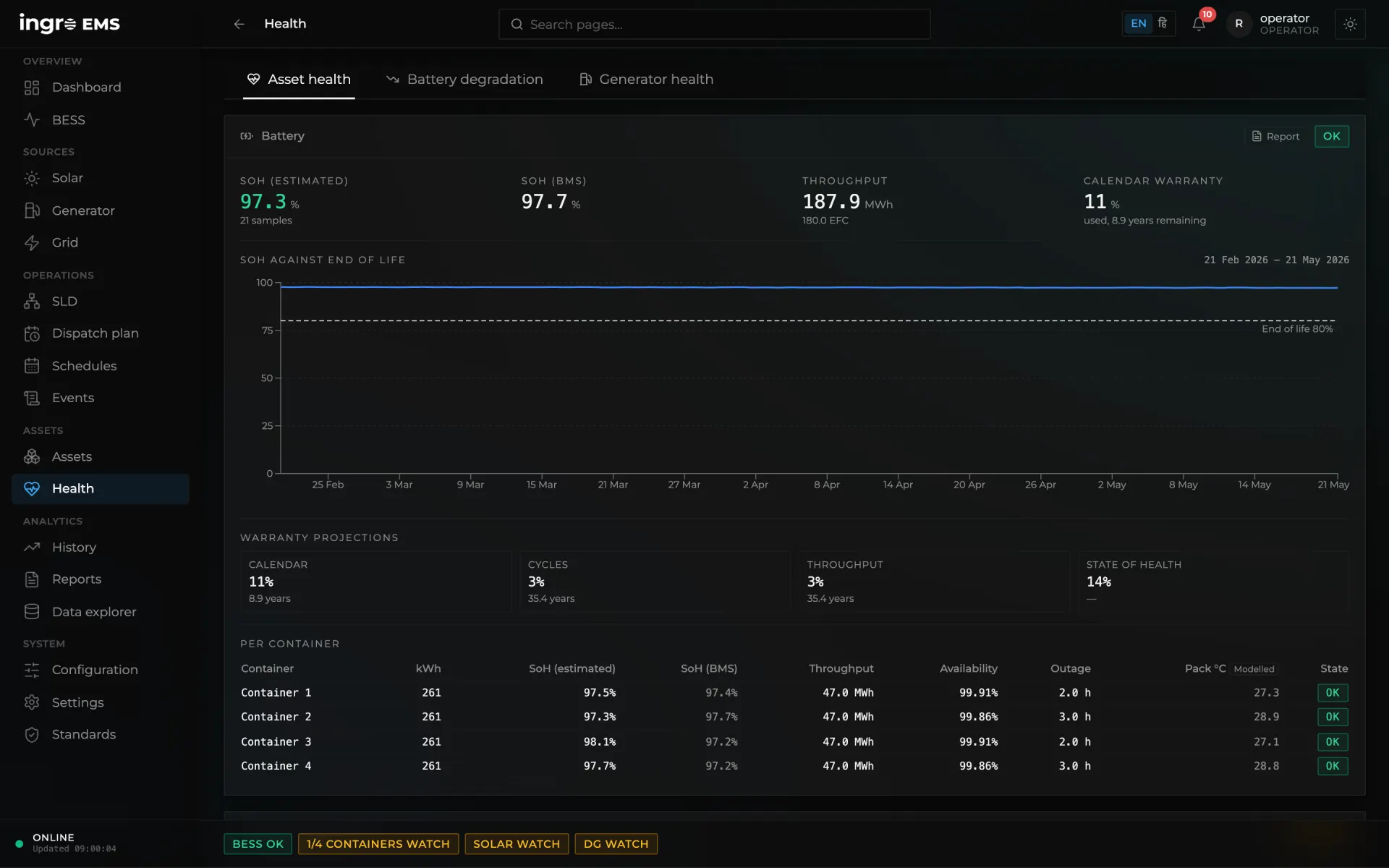
Ingro EMS weighs every cycle's value against the battery life it costs before committing the battery, and shapes how each cycle runs: depth, timing, rate and temperature. Ingro Brain supplies the cost side, estimating how each operating choice will age this particular battery, learned from the site's own data and from batteries of the same chemistry across every site Ingro runs.
The result is a battery that works hard when it pays and eases off when it doesn't, stays inside its warranty conditions, and keeps the reserve and dispatch obligations the site depends on.
Value vs wearEach cycle is checked against its cost in battery life.
Shaped cyclesDepth, timing, rate and temperature planned together.
Warranty-awareThroughput, cycle, temperature and charge limits respected.
Learning modelWear estimates improve with every site and every season.
Degradation-aware dispatch means the EMS counts the cost of battery wear when deciding whether and how to cycle. It compares the value of a cycle with the battery life it uses up, which depends on depth, rate and temperature, and holds or runs a gentler cycle when the value doesn't cover the wear.
Not over the battery's life. Dispatch that ignores wear can earn more in the short term but shortens the battery's useful life and can lose money overall. Spending battery life on the most valuable cycles typically earns more in total.
Yes. Most of the conditions that age a battery are operating decisions the EMS makes. Research has shown degradation-aware control can reduce degradation while increasing revenue, and that thermal management and shallower daily cycles extended modelled battery life substantially in an NREL study.
A degradation model for the specific battery: its chemistry, its current state of health, how it responds to temperature, depth and rate, and its warranty limits. The better the model reflects real field data, the better the dispatch decisions.