Battery health centre

Battery health: how batteries age, and how to make yours last

Every battery loses capacity over time. How fast depends on heat, on how it is charged and how hard it is worked, and much of that is decided by the software running it. These guides explain the science in plain language, and how Ingro Brain and Ingro EMS put it to work on every site.

ingroCoolingHEALTHOn track
Why it matters

Why battery health is a business number

Battery health decides how much energy you can still sell, store or shift, whether the warranty holds, and how safely the system runs.

1

Capacity is what you paid for

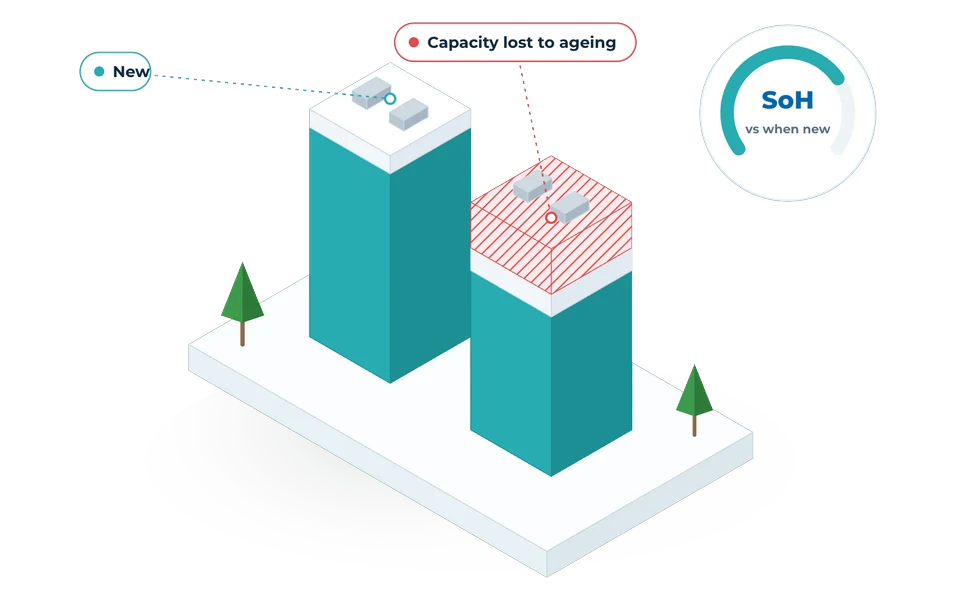
A battery is bought by the kilowatt-hour. Every kilowatt-hour lost to ageing is one you paid for and can no longer use, so the rate of fade feeds straight into the return on the project.

2

Warranties come with conditions

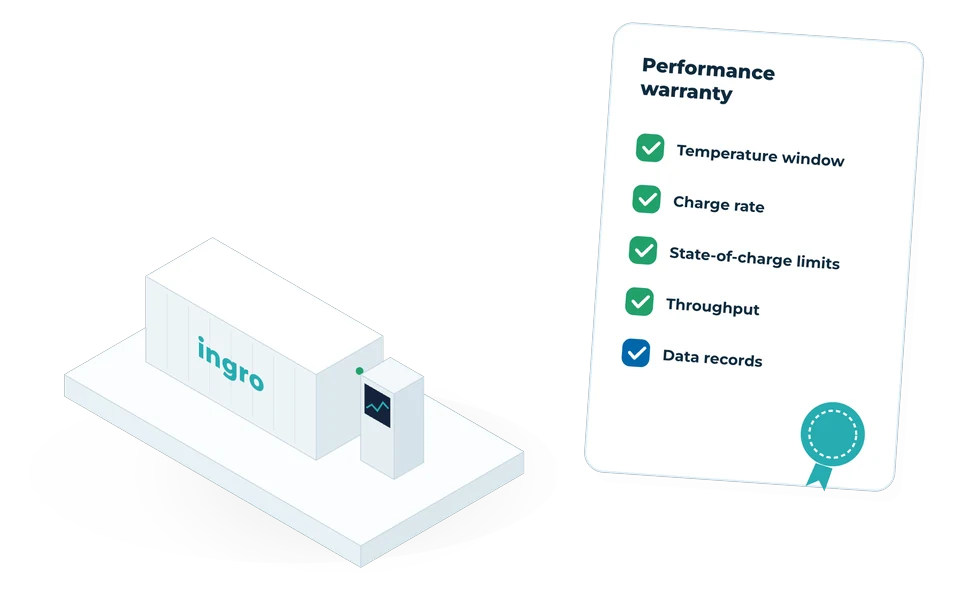
Capacity guarantees typically hold only if the battery stays inside agreed limits on temperature, cycling and charge level, and the owner can show the operating records to prove it.

3

Safety follows health

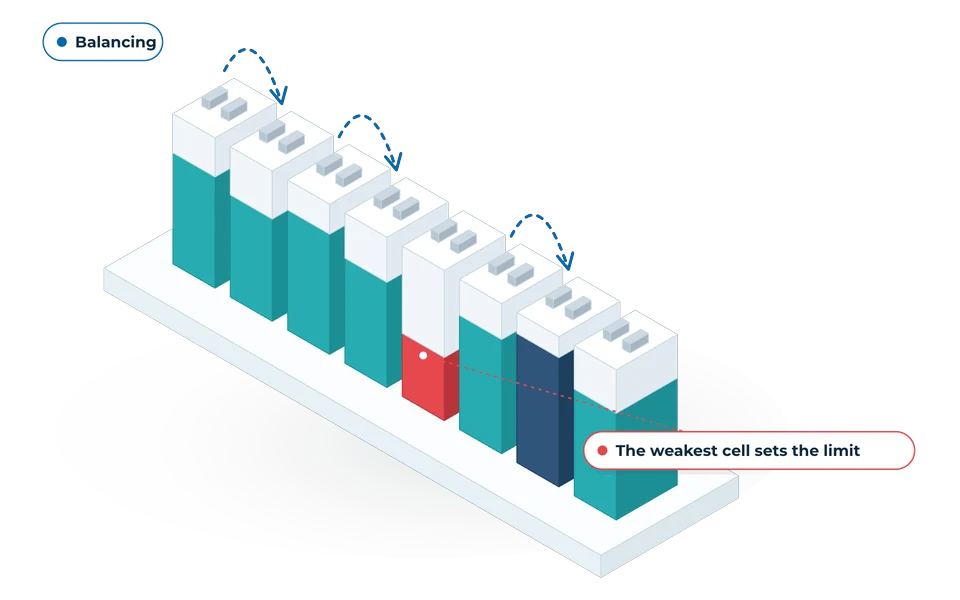
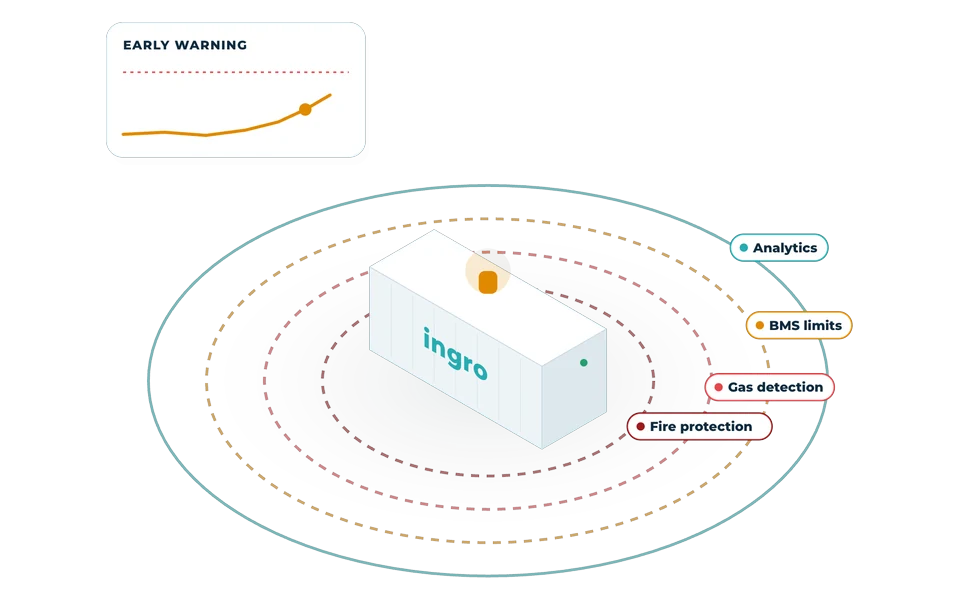
A cell that starts to drift from its neighbours is the one to watch. Catching that drift early turns a possible incident into a planned repair.

How batteries age

Every battery fades. The shape of the fade is what you can change.

A battery's state of health is how much it can still do compared with when it was new: the energy it holds and the power it can deliver. It falls quickly at first, then slowly for most of its life, and late in life it can fall away fast, a change engineers call the knee.

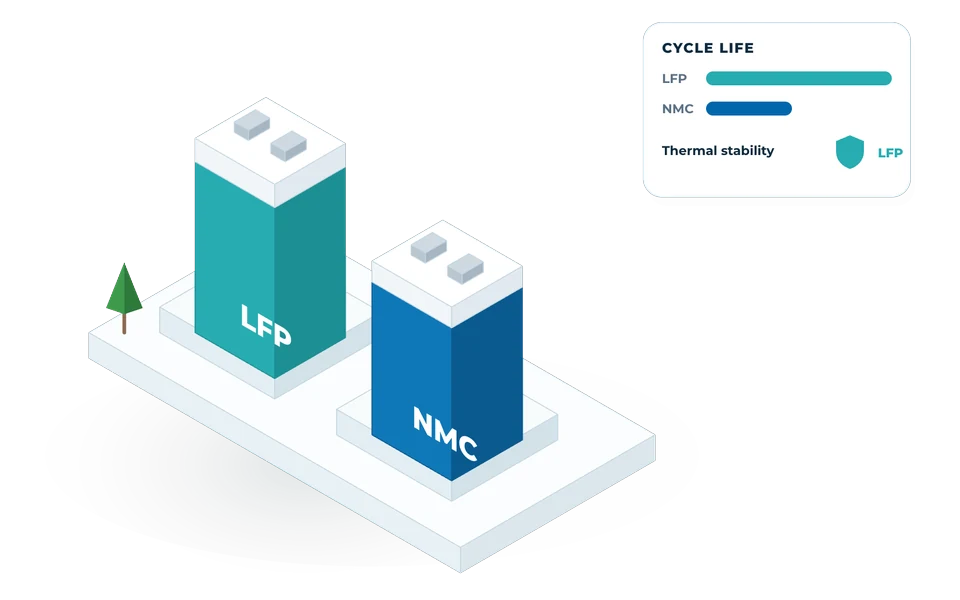
The chemistry sets the starting point. Temperature, charge level, cycling depth and charging speed set the slope, and those are exactly what an energy management system controls.

Early fadeLong, steady wearKnee: ageing speeds upEnd-of-life threshold (set in the warranty)NewState of healthTime in service →Knee pointMore useful life from the same cellsWorked harshlyHealth-aware control
Illustrative shapes, not measured data. Real curves depend on the chemistry, the cell design, the climate and how the battery is used, which is why the useful number is your own battery's trend, tracked over time.
Inside the cell

Four ways a cell wears out

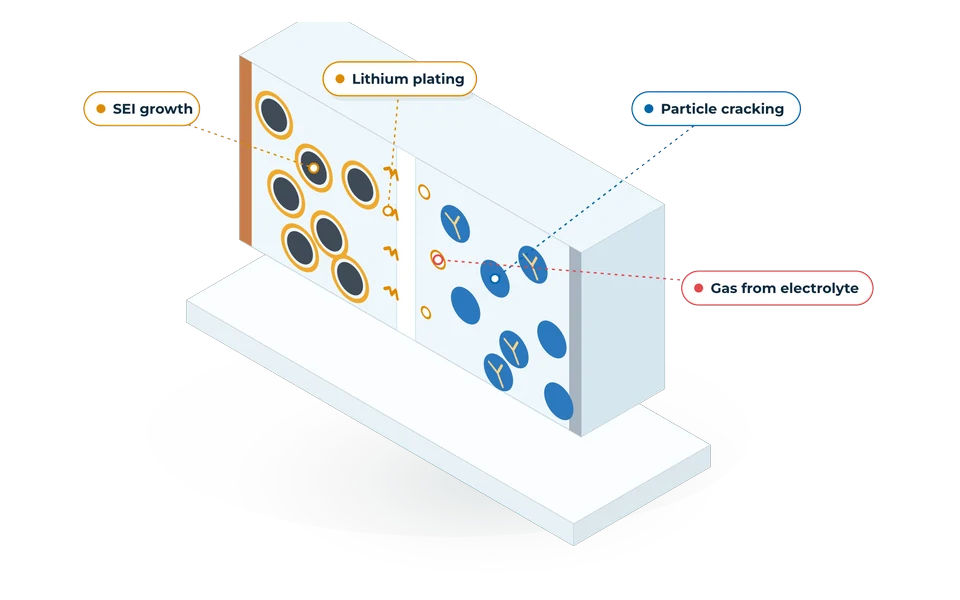
Inside every lithium-ion cell, a handful of side reactions slowly use up the lithium and the electrode material that store energy. Some run all the time, even when the battery is idle; others happen only when it is worked hard, charged in the cold or held hot and full.

Knowing which mechanism a condition drives is what lets control software avoid it.

Anode (graphite)SeparatorCathode (LFP or NMC)CuAlLithium ions move through the electrolyte on every charge and discharge

On the anode particles

What drives it
Time, heat, and resting at a high state of charge. It never fully stops, even when the battery is idle.
What it costs you
Each layer of the film traps lithium that can no longer carry charge (loss of lithium inventory), and a thicker film raises resistance.
What control can do
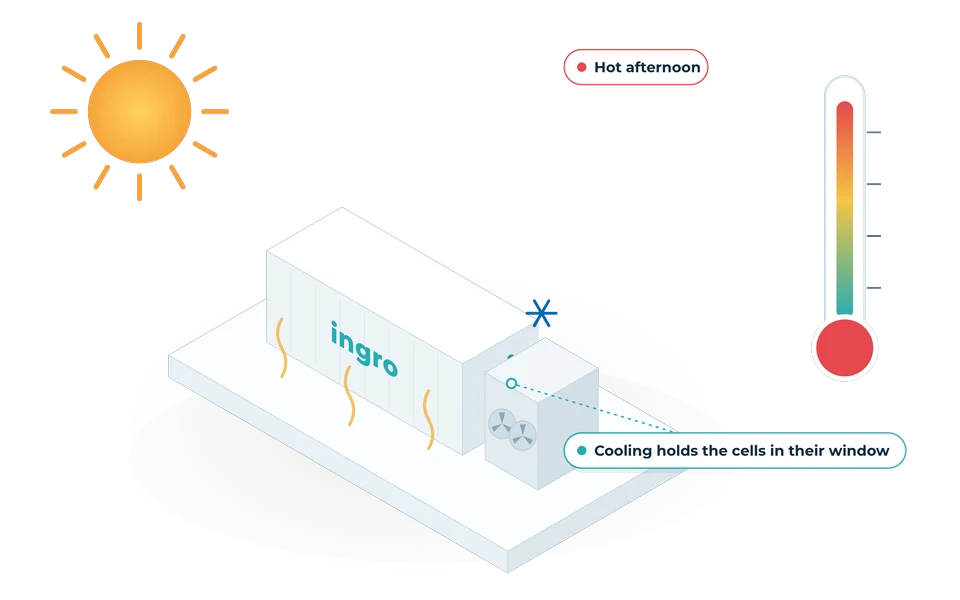
Keep cells cool and avoid parking the battery full for long.
A simplified drawing, not to scale. Real cells age through several of these at once, and which one leads depends on the chemistry and how the cell is used.
What wears batteries out

Try it: what is wearing this battery out?

Four operating conditions do most of the damage: cell temperature, the charge level the battery rests at, how deep each cycle goes, and how fast it is charged and discharged.

Set them in the explorer and see which ageing mechanisms they drive, and what a health-aware EMS would change.

Set the operating conditions

Cell temperature

Where it rests

Cycle depth

Charge speed (C-rate)

Overall wear

Gentle

This battery is ageing about as slowly as its chemistry allows.

What it drives inside the cell

  • SEI growthA film on the anode thickens and locks away lithium for good.
  • Lithium platingLithium coats the anode as metal instead of slotting into it.
  • Particle crackingElectrode particles swell and shrink until they fracture.
  • Electrolyte breakdownThe electrolyte slowly decomposes and can form gas.

What a health-aware EMS changes

Nothing urgent. It keeps watching cell temperature, spread and resistance so it notices if that changes.

Directional, not a lifetime prediction. How much each condition matters depends on the chemistry and the cell design; the cell datasheet and warranty set the actual limits.
Ingro Brain

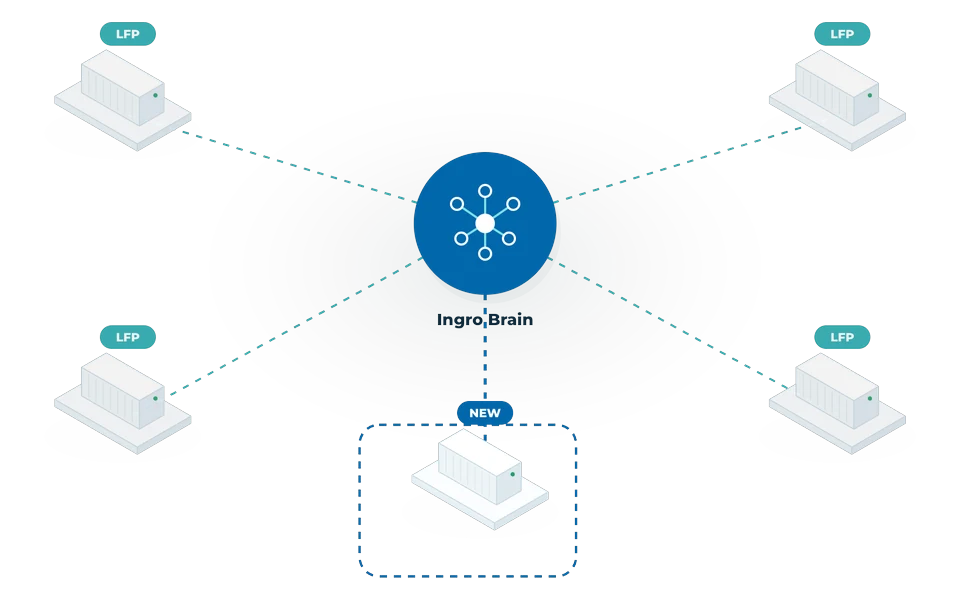
Your battery starts with what the fleet already knows

Ingro Brain runs AI models on each site's own data and learns across every site we operate. A battery commissioned today starts from what batteries of the same chemistry, in similar heat, have already shown, then learns its own cells.

Your new battery

Chemistry
Climate

Sites already running

  • LFPSolar parkSolar shifting
  • LFPSteel plantPeak shaving
  • LFPPort warehouseBackup + ToD
  • NMCHospitalBackup power
  • LFPGrid substationArbitrage
  • NMCEV charging hubPeak shaving
  • LFPTextile millDiesel offset
  • LFPHill microgridOff-grid
  • NMCData centreUPS support

Same chemistry and climateSame chemistry

Shared modelIngro Brain

Learns from every LFP site, weighted to hot & dry sites like yours:

  • How this chemistry ages in this kind of heat
  • Which operating habits wear its cells fastest
  • What the early signs of a failing cell look like

Your site

LFP battery, hot & dry

  1. 1Day one: starts from what similar sites have already taught the model, not from a blank page.
  2. 2Every day after: its own data tunes the model to its own cells, loads and weather.
  3. 3And back: what it learns improves the model for the next site.
Matched on chemistry and climate
Illustrative: the sites shown are examples, not a list of real deployments. Lab tests age cells under fixed conditions; a fleet shows how the same chemistry ages under real Indian heat, tariffs and duty cycles.

Field data, not just lab data

Lab tests age cells under fixed, controlled conditions, and published research shows lab results don't transfer cleanly to real use. A fleet shows how the same chemistry ages under real heat, tariffs and duty cycles.

A head start for new sites

A brand-new battery has no history of its own. Studies of pooled and shared battery data show models trained on many similar batteries predict better for each new one than models built from a single battery.

Every site improves the next

What one site learns about a chemistry, a climate or a failure pattern goes back into the shared model. Older sites matter most: they have already shown what late life looks like.
Health-aware dispatch

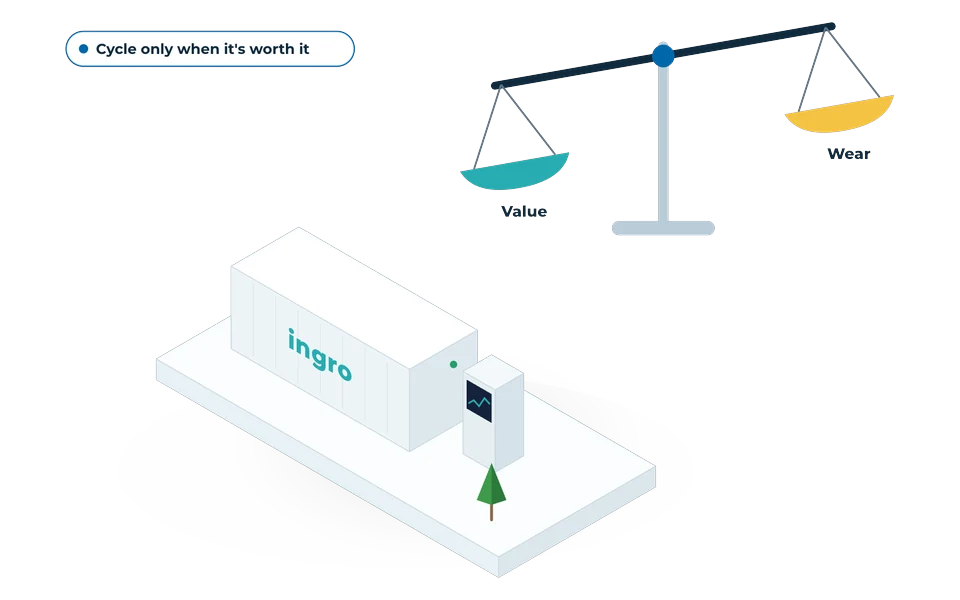
Every cycle has a cost. The EMS checks it's worth paying.

Each cycle earns something, the price or tariff spread it captures, and costs something, the slice of battery life it uses up. That cost is higher on a hot day and for a deep, fast cycle.

Ingro EMS weighs the two before it commits the battery. When the spread doesn't pay for the wear, it holds or runs a gentler cycle, and the battery keeps that life for a day when it does.

NarrowWide

Cell conditions

Heat raises the wear cost of the same cycle.

Value earned vs battery life used

  • Partial cycleEMS picks this

    Earns
    Wears
  • Full cycle

    Earns
    Wears

Decision: Partial cycle

The best hours are worth it, the extremes aren't. A shallower cycle catches most of the value for much less wear.

Relative bars, not prices. A real EMS makes this call for every interval, using the site's tariffs or market prices, a degradation model for its own cells, and the limits in the warranty.
Product + service

How Ingro protects battery health

Software that understands the battery, and the team that installs, runs and supports it.

The guides

Battery health, step by step

Start with how batteries age, then what wears them out, then how to keep them healthy.

FAQ

Battery health, answered

What is battery state of health (SoH)?

State of health compares what a battery can do now with what it could do when new, usually as the share of its original capacity that remains, and sometimes also how much its internal resistance has grown. A new battery starts at 100%, and the figure falls as the battery ages.

What makes a lithium-ion battery age faster?

High temperature, resting at a high state of charge, deep cycles, high charge and discharge rates, and charging when cells are cold. Most batteries age from several of these at once, and the right operating strategy reduces each of them.

Does a battery age even when it is not being used?

Yes. Calendar ageing continues while a battery sits idle, and it runs faster when the battery is warm and kept full. That is why a stationary battery's resting temperature and charge level matter as much as how it is cycled.

How does an EMS extend battery life?

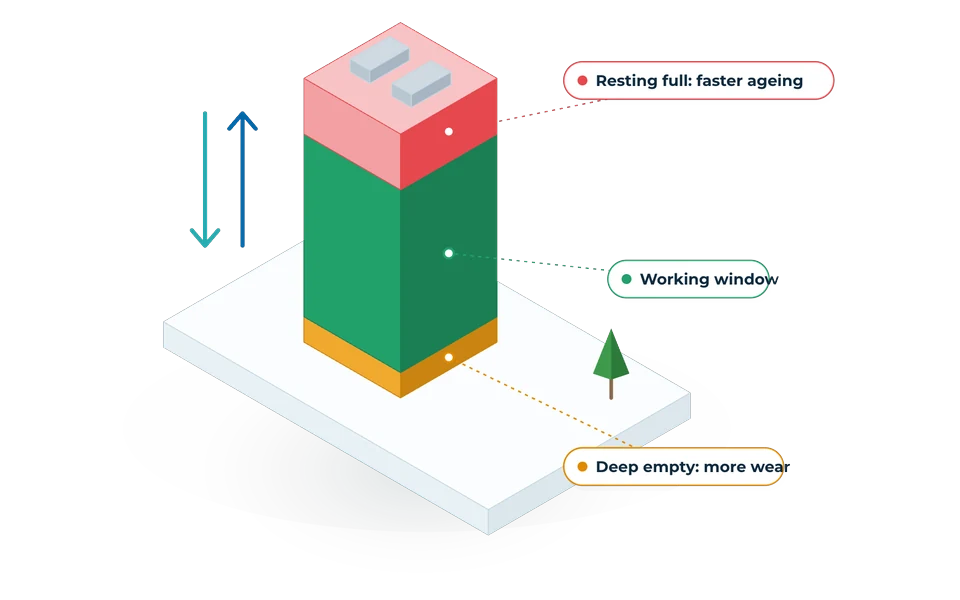
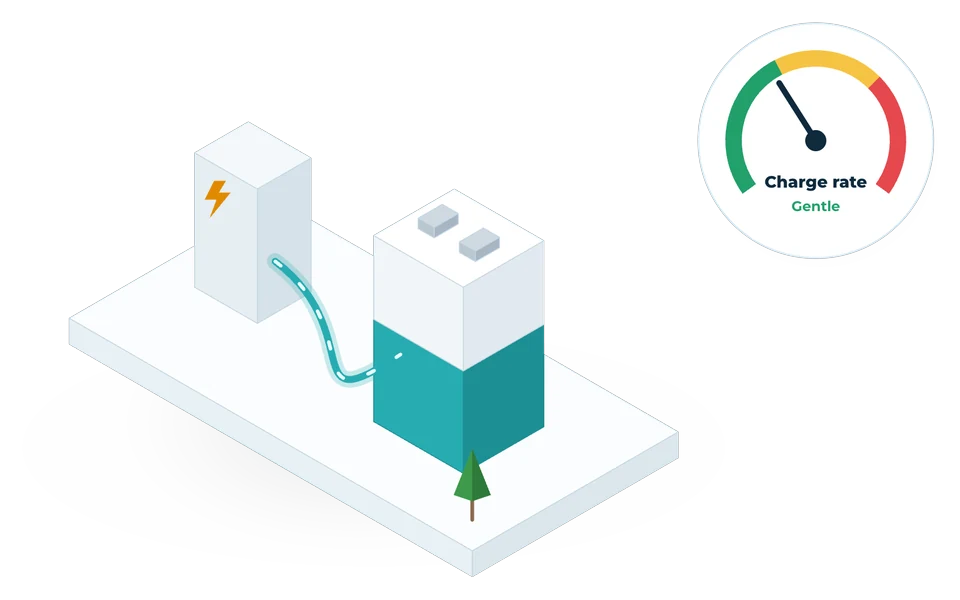
By choosing how the battery is used: keeping cells inside their temperature window, avoiding long periods at full charge, using a working state-of-charge window, spreading charging out instead of rushing it, and skipping cycles whose value does not cover the wear they cause.

What does Ingro Brain learn from other sites?

Ingro Brain trains AI models on operating data from the sites Ingro runs. It learns how each chemistry ages under different climates and duty cycles, and what the early signs of a failing cell look like. A new battery starts from what similar batteries have already shown, and its own data then tunes the model to its cells.

Can Ingro improve the health of a battery that is already installed?

Ingro can connect its EMS and Ingro Brain to existing battery systems through a smart retrofit. Lost capacity cannot be restored, but health-aware control and early warning can slow further ageing and catch failing cells sooner.

Sources

  1. 1.Lithium ion battery degradation: what you need to know Edge et al., Physical Chemistry Chemical Physics, 2021
  2. 2.DOE Energy Storage Handbook, Chapter 3: Lithium-Ion Batteries Sandia National Laboratories, 2021
  3. 3.Degradation of Commercial Lithium-Ion Cells as a Function of Chemistry and Cycling Conditions Preger et al., Journal of The Electrochemical Society, 2020
  4. 4.Review: Knees in Lithium-Ion Battery Aging Trajectories Attia et al., Journal of The Electrochemical Society, 2022
  5. 5.Calendar Aging of Lithium-Ion Batteries: I. Impact of the Graphite Anode on Capacity Fade Keil et al., Journal of The Electrochemical Society, 2016
  6. 6.Factoring the Cycle Aging Cost of Batteries Participating in Electricity Markets Xu et al., IEEE Transactions on Power Systems, 2018
  7. 7.Unlocking extra value from grid batteries using advanced models Reniers, Mulder & Howey, Journal of Power Sources, 2021
  8. 8.Predicting battery end of life from solar off-grid system field data using machine learning Aitio & Howey, Joule, 2021
  9. 9.Battery lifetime prediction across diverse ageing conditions with inter-cell deep learning Zhang et al., Nature Machine Intelligence, 2025
  10. 10.Insights from EPRI's BESS Failure Incident Database: Analysis of Failure Root Cause EPRI, TWAICE and PNNL, 2024
  11. 11.Energy Storage Financing: Performance Impacts on Project Financing Sandia National Laboratories, 2018
  12. 12.Annual Climate Summary 2024 India Meteorological Department, 2025

Buying a battery, or worried about one you already run?

We can review how your battery is run today, or plan a new one around its health from the first day. Ingro Brain and Ingro EMS come with the engineers who install and support them.