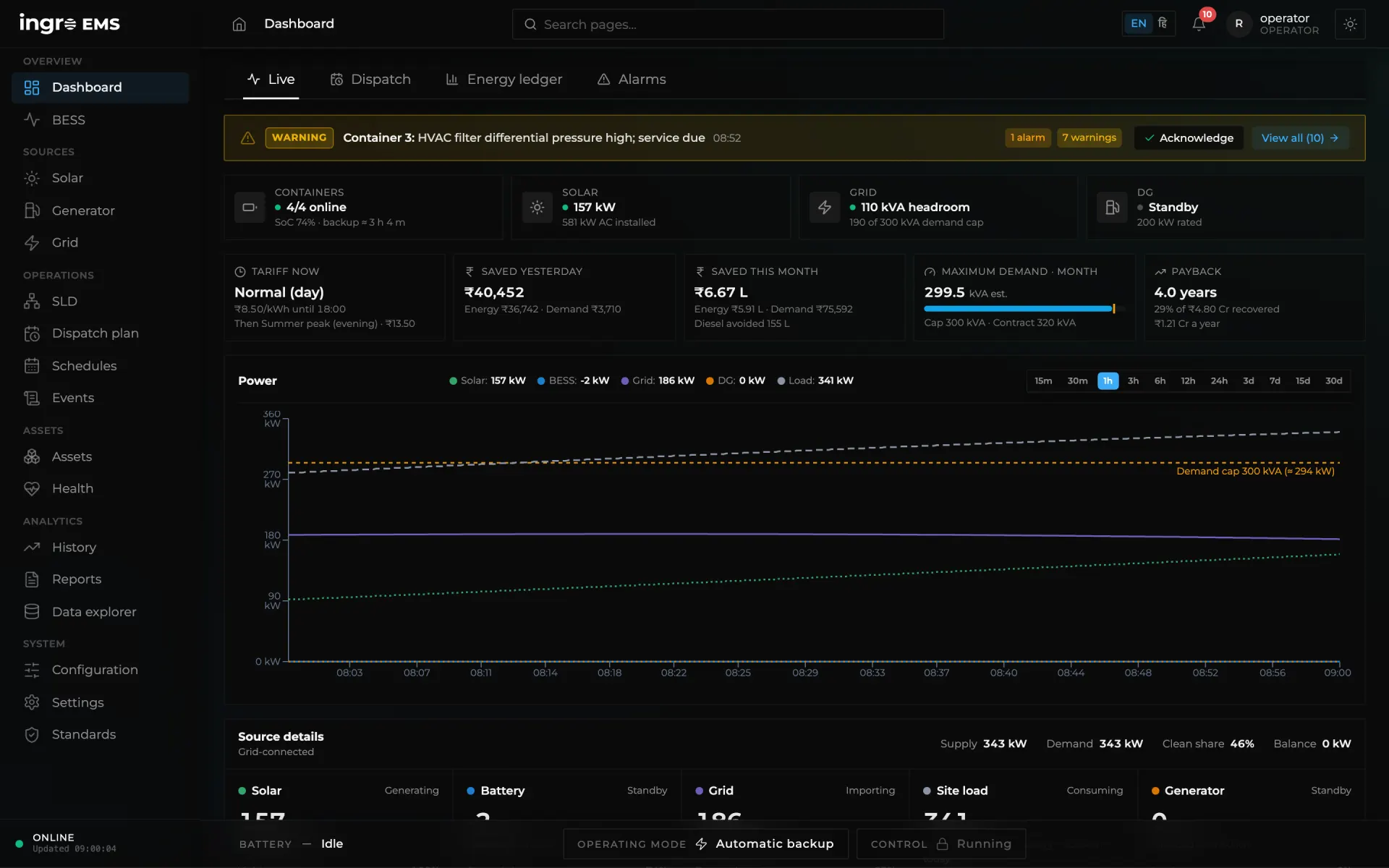
SCADA vs EMS for BESS is one of the most common points of confusion in battery storage projects. Both systems sit at the heart of how a battery energy storage system (BESS) is monitored and controlled, yet they answer very different questions. This guide defines each layer, compares them side by side, and helps you decide whether your project needs one, the other, or both.
Key takeaways
SCADA is the monitoring and supervisory layer (telemetry, HMI, alarms, operator commands, historian); an EMS is the decision layer (optimisation, dispatch scheduling, market and grid response, compliance).
The simplest test: SCADA answers what is happening; an EMS answers what the battery should do next, and why.
Almost every grid-scale and C&I BESS needs both capabilities; the real choice is two integrated systems versus one unified platform.
In India, utilities and SLDCs often mandate a SCADA link over DNP3 or IEC 61850 to the load-dispatch centre, while the EMS is what makes the asset commercially and CERC/SERC compliant.
Modern platforms such as Ingro Cloud EMS fold SCADA-grade monitoring into the EMS, so one system handles both visibility and optimisation.
SCADA stands for Supervisory Control and Data Acquisition. In a BESS, SCADA is the operational visibility and command layer. It continuously acquires telemetry from every device on site, presents that data to operators on a human-machine interface (HMI), raises alarms when values breach limits, and lets operators issue manual supervisory commands such as start, stop or a setpoint change.
SCADA is fundamentally about the present moment: what is happening across the plant right now, and what a human operator can do about it. A historian stores the raw time-series for trending, audits and post-event forensics, but SCADA itself does not calculate the most profitable or most grid-optimal action.
Telemetry acquisitionPolling voltages, currents, temperatures, state of charge (SoC), breaker status and inverter states from field devices.
VisualisationSingle-line diagrams, mimic screens and live dashboards on an HMI for control-room operators.
Alarms and eventsThreshold-based alerts and sequence-of-events logging so faults are noticed and traced.
Operator commandsManual supervisory control such as opening or closing breakers, issuing setpoints and acknowledging trips.
HistorianTime-series storage of raw measurements for trending, compliance audits and post-event analysis.
02
What Is an EMS in a BESS Context?
An energy management system (EMS) is the decision-making and optimisation layer. Where SCADA reports state, the EMS decides what the battery should do next and why: when to charge, when to discharge, at what power, and against which technical or commercial objective. It converts forecasts, prices, grid signals and constraints into dispatch schedules and setpoints.
The EMS is the brain that closes the loop between market or grid conditions and battery action. It runs optimisation against objectives such as energy arbitrage, peak shaving, frequency response and ancillary services, renewable firming, and demand-charge management, always inside the battery's SoC, C-rate, thermal and cycle-life constraints.
Optimisation and dispatch schedulingComputing charge and discharge plans against price, forecast and constraint inputs.
Market and grid responseBidding into or responding to energy markets, ancillary-service signals and utility instructions.
Arbitrage and value stackingSequencing multiple revenue streams within battery and warranty limits.
Compliance and reportingEnforcing grid-code limits and generating regulatory reports such as CERC and SERC filings in India.
03
SCADA vs EMS: A Side-by-Side Comparison
The clearest way to understand SCADA vs EMS is by purpose. SCADA exists to monitor and supervise; an EMS exists to decide and optimise. Everything else, intelligence, scope, data and users, follows from that distinction.
PurposeSCADA monitors and supervises; the EMS decides and optimises.
Core questionSCADA answers what is happening right now; the EMS answers what the battery should do next, and why.
IntelligenceSCADA is rule- and threshold-based with manual operator control; the EMS uses optimisation algorithms, forecasting and increasingly AI.
ScopeSCADA is typically single-site and equipment-focused; the EMS spans the site plus fleets, markets and grid interfaces.
DataSCADA delivers raw telemetry and alarms; the EMS delivers an actionable dispatch strategy and schedules.
Time horizonSCADA is near-instantaneous and reactive; the EMS plans ahead across seconds, hours and days.
Primary userSCADA serves control-room operators; the EMS serves asset managers, traders and optimisation engineers.
04
The Layered BESS Control Stack: BMS, PCS, SCADA and EMS
SCADA and EMS do not work in isolation. They sit at the top of a layered control stack (BMS to PCS to SCADA to EMS), where each layer abstracts the one below it. Commands flow down the stack and telemetry flows up.
The BMS and PCS handle device-level safety and power conversion; this article focuses on the SCADA and EMS layers above them. Commands flow down (EMS to SCADA to PCS to battery) while measurements flow up (BMS to PCS to SCADA to EMS).
BMS (Battery Management System)Protects cells and modules through balancing, SoC and SoH estimation, and thermal and safety limits. Fastest layer, closest to the cells.
PCS (Power Conversion System)The bidirectional inverter that converts DC battery power to AC grid power and executes real and reactive power setpoints.
SCADAAggregates BMS and PCS data across the site, visualises it, and passes operator or EMS commands down to the PCS.
EMSSits on top, setting the objectives and dispatch schedule that SCADA and the PCS then execute.
Grid operator, tariff, market signalsarrive at the EMS
SCADA
Sees and recordsSupervisory control and data acquisition
“What is happening on the site, and what happened?”
Telemetry up, operator commands down
EMS
DecidesEnergy management system
“Should the battery charge, discharge or wait, and at what power?”
Charge and discharge setpoints (kW, kVAr)
PCS
ConvertsPower conversion system
“How do I turn this setpoint into AC power, safely?”
State of charge, limits and alarms, back to the EMS
BMS
ProtectsBattery management system
“Are the cells inside their safe limits right now?”
Four layers, four jobs. The EMS is the only one that weighs the tariff, the grid and the battery's limits together, so it is the layer that decides what the battery does.
05
Where SCADA and EMS Overlap, and Where the Boundary Blurs
In practice the line between SCADA and EMS is not sharp. Both consume the same telemetry, both can issue setpoints, and both depend on reliable protocol connectivity. Modern platforms increasingly fold SCADA-style monitoring into the EMS, so a single system both shows the operator what is happening and decides what to do next.
The blur is deepest around real-time control. Fast, closed-loop functions such as frequency response and setpoint tracking may be implemented at the edge and appear in both a SCADA description and an EMS description. What matters is not the label but the responsibility: is the function acquiring, visualising and alarming (SCADA-like), or forecasting, optimising and scheduling (EMS-like)? Many functions legitimately do both.
Shared telemetryBoth rely on the same measurements from the BMS and PCS.
Shared protocolsBoth speak Modbus, DNP3, IEC 61850 and OPC-UA.
Shared control pathBoth can push setpoints down to the PCS.
Converging productsUnified platforms present one HMI and one optimisation engine, removing a separate SCADA silo.
06
Do You Need Both? SCADA, EMS and the India Utility Angle
Functionally, almost every grid-scale or C&I BESS needs both capabilities. You cannot safely operate a battery without supervisory monitoring, and you cannot extract its full value without optimisation. The real question is not SCADA or EMS, but whether you buy them as two integrated systems or as one unified platform.
In India the choice is shaped by utility and regulatory requirements. State load-dispatch centres (SLDCs) frequently mandate a SCADA or telemetry link, typically over DNP3 or IEC 61850, so the grid operator can see and, where required, control the asset. Grid-scale projects must also meet CERC and SERC obligations and provide compliance reporting. A SCADA-grade interface to the load-dispatch centre is therefore often non-negotiable, while the EMS is what makes the asset commercially viable.
You want one HMI and one data model instead of stitching separate SCADA and EMS vendors together.
You operate a fleet and need centralised, remote dispatch and analytics across sites.
You need automated CERC and SERC compliance reporting rather than manual data exports.
You want optimisation and monitoring to share the same real-time telemetry with no integration gap.
07
How Ingro Cloud EMS Unifies SCADA-Grade Monitoring and EMS Optimisation
Ingro Cloud EMS is a cloud-based, hardware-agnostic energy management system for BESS, made in India, that combines SCADA-style real-time monitoring with EMS optimisation and control in a single platform. Instead of running a separate SCADA silo alongside a separate EMS, operators get one system for both visibility and decisions.
The platform is proven at scale: Ingro operates one of India's oldest grid-scale BESS sites at 99.5% availability, coordinates 124 inverters at a single site, and re-optimises dispatch every five minutes. Cloud EMS is a module of the Ingro EMS platform, feeding Battery AI and the Battery Passport, with an Integrations layer that connects the underlying hardware.
Real-time monitoring down to cell level, with multi-level alerts, the SCADA-grade visibility layer.
Centralised, remote dispatch control and fleet-wide analytics, the EMS optimisation layer.
Automated CERC and SERC compliance reporting built in.
Broad protocol support, Modbus TCP/RTU, IEC 61850, DNP3 and OPC-UA, with edge gateways for protocol translation, local buffering and sub-second (to sub-10ms) edge control.
A controller installed in your plant room, a console on site and on your phone, and reports your finance team can use. Supplied on its own for your battery, or as a complete battery system.
Ingro EMS Controller, wired and commissioned on site
Operator console, mobile app and 13 reports
Add Cloud EMS, Ingro Brain or Battery Passport when you need them
SCADA (Supervisory Control and Data Acquisition) monitors and supervises: it collects telemetry, visualises it on an HMI, raises alarms and lets operators issue commands. An EMS (energy management system) decides and optimises: it schedules charging and discharging to meet commercial and grid objectives. SCADA reports state; the EMS turns that data into strategy.
Functionally, yes. You cannot safely operate a battery without supervisory monitoring, and you cannot capture its full value without optimisation. The practical decision is whether to buy separate SCADA and EMS systems or a unified platform that delivers both from one data model and one interface.
State load-dispatch centres (SLDCs) need real-time visibility and, often, control of grid-connected assets for stability and dispatch. They typically mandate a SCADA or telemetry link over DNP3 or IEC 61850 to the load-dispatch centre. This requirement is separate from, and complementary to, the EMS that optimises the battery commercially.
Not by removing the function, but by absorbing it. Modern EMS platforms increasingly include SCADA-grade monitoring, real-time telemetry, dashboards and alarms, so you no longer need a standalone SCADA system. You still need supervisory monitoring; you simply get it inside the EMS rather than as a separate product.
From the cells up: the BMS protects the battery, the PCS converts DC to AC power, SCADA aggregates and visualises site data, and the EMS sits on top setting objectives and dispatch. Commands flow down (EMS to SCADA to PCS) while telemetry flows up (BMS to PCS to SCADA to EMS).
The common industrial protocols are Modbus TCP/RTU, IEC 61850, DNP3 and OPC-UA. Modbus is widespread for device-level data, IEC 61850 and DNP3 are typical for utility and substation interfaces, and OPC-UA suits higher-level integration. Edge gateways handle protocol translation and local buffering between the field and the platform.
Ingro EMS is designed, built and supported in India, for C&I sites and grid-scale BESS. Ingro EMS is deployed on site (offline), in the cloud, or as a hybrid of the two. In on-site and hybrid deployments, site control continues with no internet connection.