Every lithium-ion battery slowly loses its ability to store and deliver energy. State of health (SoH) is the number that tracks that loss: how much the battery can still do compared with when it was new. This guide explains what SoH means, how it differs from state of charge (SoC), how engineers measure it, what end of life actually means in warranties and Indian tender contracts, and why it is the number that decides what a battery is worth.
Key takeaways
SoC is how full the battery is now; SoH is how much it can still hold and deliver compared with when it was new.
SoH is estimated, not read: from capacity tests, resistance, coulomb counting, voltage curves or data models.
End of life is a convention: 80% in most lab work, 70% to 80% in grid modelling, and a year-by-year floor in Indian tender contracts.
Capacity usually fades steadily for most of a battery's life, then can speed up at a knee point.
Identical cells can age differently, so track each battery's own trend rather than assume a lifetime.
Continuous SoH estimation from operating data avoids taking the battery offline and gives early warning.
State of charge (SoC) is how full the battery is right now, as a share of what it can currently hold. It goes up and down every day. Sandia National Laboratories' energy storage handbook notes that, for lithium-ion and lead-acid batteries, SoC cannot be measured directly; it is estimated from voltage and current, with temperature and battery age also feeding into the estimate.
State of health (SoH) is how the battery compares with itself when new. Sandia defines it as the present health divided by the initial health, with usable energy or capacity the most common yardstick. A battery at 90% SoH holds about 90% of the energy it held on day one. SoC tells you how much fuel is in the tank; SoH tells you how big the tank still is.
A quick example
A 1 MWh battery at 90% SoH can hold about 900 kWh when full. At 50% SoC, it holds about half of that, around 450 kWh, not 500. Every energy calculation, from tomorrow's dispatch to next year's revenue, depends on knowing the real size of the tank.
02
How State of Health Is Measured
No sensor reads SoH directly. It is worked out in one of a few ways, each with a trade-off between accuracy and effort. A 2024 review in Energy Conversion and Economics describes capacity-based SoH as the most representative measure, though measuring capacity takes time, and resistance-based SoH as quick to measure with a current pulse but less accurate.
Capacity testA full, controlled charge and discharge that measures how much energy the battery delivers. The most accurate method, but it takes the battery out of service.
Resistance measurementA short current pulse shows how much the voltage sags. Resistance rises as cells age, which reduces the power they can deliver.
Coulomb countingAdding up the current flowing in and out over time. Simple, but small sensor errors accumulate, so it needs regular recalibration.
Voltage-curve diagnosticsComparing how the voltage curve changes over time can separate lost lithium from lost electrode material, showing why capacity is falling.
Model and data-driven estimationSoftware that infers SoH continuously from everyday voltage, current and temperature data.
How labs do it
Laboratories measure health with reference performance tests: a slow full capacity test and a pulse test for resistance and power, run when the battery is new and then at intervals. Sandia's performance testing handbook notes that field systems run equivalent system-level tests to estimate SoH as performance degrades.
03
What Counts as End of Life?
You will often hear that a battery reaches end of life at 80% of its original capacity. That threshold is real, but it is a convention, set by whoever is writing the rule, and different rules use different numbers.
Laboratory researchCycle life is usually counted until a cell falls to 80% of its nominal capacity.
Grid storage modellingAn NREL paper notes end of life is typically defined at 70% to 80% of beginning-of-life capacity.
Electric vehicle regulationUN Global Technical Regulation No. 22 requires cars to keep at least 80% of certified battery energy for 5 years or 100,000 km, and 70% up to 8 years or 160,000 km.
Cell datasheetsOne manufacturer's LFP storage cell specification rates cycle life to 70% state of health, and sets a separate stop-using limit at 60% capacity or doubled internal resistance.
Indian grid tendersThe standard battery energy storage purchase agreement used by SECI with GRIDCO lets minimum dispatchable capacity step down 2.5 percentage points a year, to 80% after year 8 and 62.5% after year 15, with the developer responsible for any augmentation needed to stay above it.
Watch the scale
Most dashboards show SoH as remaining capacity divided by original capacity, so a battery at its 80% threshold reads 80% SoH. Sandia's handbook also describes a second scale on which 80% of rated capacity counts as 0% SoH. When you compare reports or contracts, check which scale is being used.
04
How SoH Changes Over a Battery's Life
State of health does not fall in a straight line. A new cell's first charge forms a protective film on the anode that consumes some lithium, but that loss is already priced in: Sandia notes the rated capacity of a lithium-ion cell is always net of this initial loss. After that, capacity typically falls slowly and steadily for most of the battery's working life. Sandia's handbook says that for most cycling conditions ageing is roughly linear down to 80% capacity, and for some conditions down to 60%.
Late in life, many batteries hit a knee: the point where capacity loss suddenly speeds up. A 2022 review of knees in lithium-ion ageing, written by researchers across several universities and national labs, found knees typically occur at or before end of life, can be triggered by fast charging, cold or high voltage, and can even appear in storage when cells are kept hot and full. It also found that nominally identical cells, used identically, can show different knee behaviour.
Why that matters
Because identical cells can age differently, and because the knee is hard to see coming from capacity alone, a fixed lifetime assumption is not enough. The useful number is each battery's own SoH trend, tracked over time and ideally at cell or module level.
Illustrative shapes, not measured data. Real curves depend on the chemistry, the cell design, the climate and how the battery is used, which is why the useful number is your own battery's trend, tracked over time.
05
Why SoH Matters to a BESS Owner
State of health is not an engineering curiosity. For anyone who owns or finances a battery, it drives most of the numbers that matter.
Revenue and savingsA battery sells, shifts or stores energy by the kilowatt-hour. Lower SoH means fewer kilowatt-hours to work with every day.
Contract obligationsIndian tender contracts set minimum dispatchable capacity year by year, and also require availability and round-trip efficiency targets, so SoH has to be tracked to stay compliant.
Warranty claimsCapacity guarantees are written as a share of rated capacity after a set time or throughput. Proving a shortfall needs a trustworthy SoH record.
Augmentation planningThe SoH trend tells you when to add capacity, and how much.
Safety and resaleCells whose health drifts away from their neighbours deserve attention, and buyers of used batteries price them on their health history.
06
Tracking SoH Without Taking the Battery Offline
Capacity tests are accurate but disruptive. In a multi-year study of 21 home storage systems published in Nature Energy in 2024, researchers at RWTH Aachen found each manual capacity test took about two days, and showed that a method using only operating data could match the periodic tests. That is the direction the industry is moving: estimate SoH continuously from the voltage, current and temperature the battery already records, and use occasional capacity tests to check the estimate.
Done well, continuous tracking gives an owner three things a once-a-year test cannot: a trend line instead of a snapshot, early warning when one part of the battery starts ageing faster than the rest, and a record that stands up when a warranty or contract question arises.
Ingro Brain + Ingro EMS
How Ingro Tracks State of Health
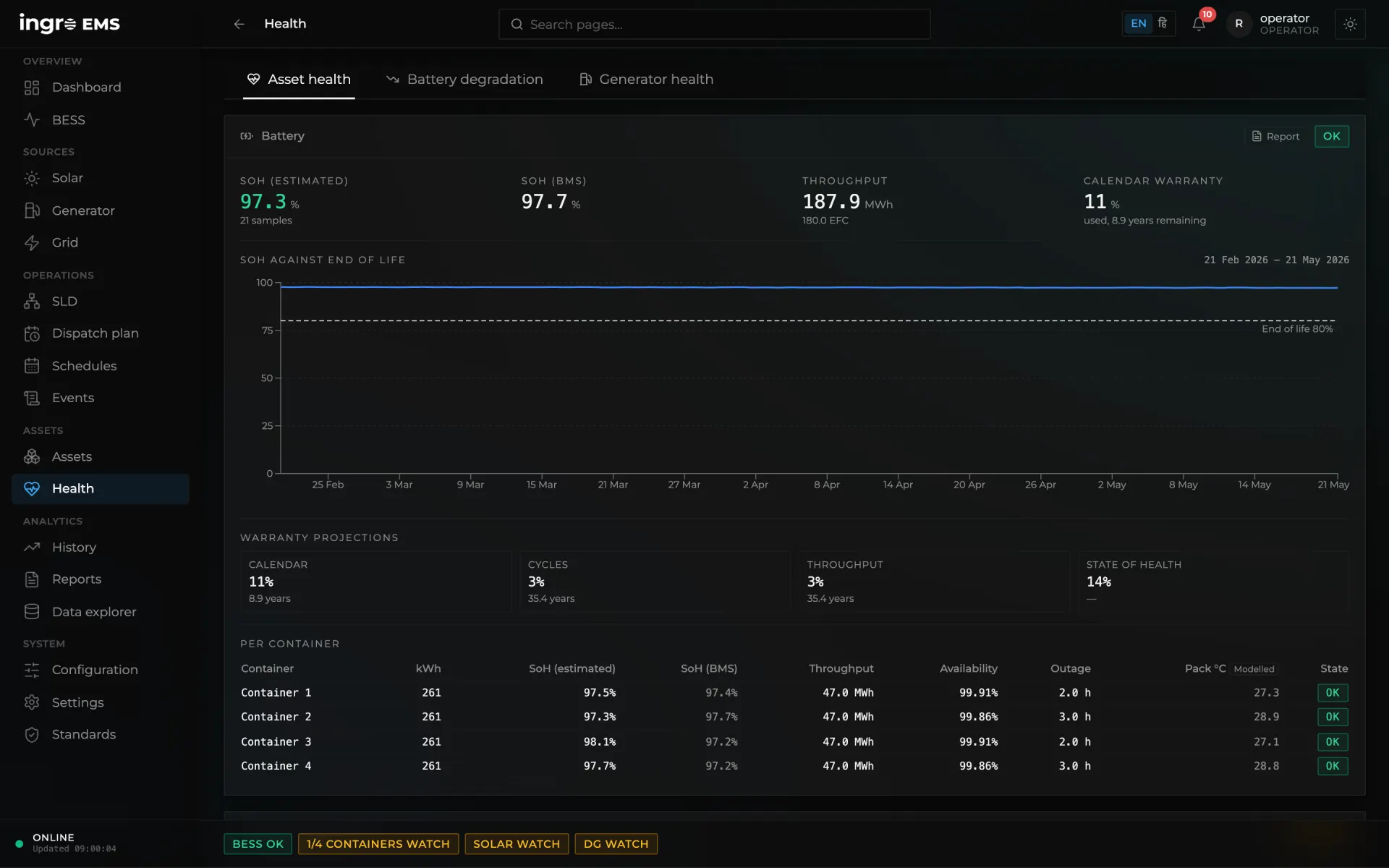
Ingro Brain estimates state of health continuously from each site's own operating data, down to the level of detail the battery management system provides, so owners see a trend rather than a once-a-year snapshot. Because Ingro Brain learns across every site Ingro runs, a new battery's estimates start from what batteries of the same chemistry, in similar conditions, have already shown, and its own data then tunes them.
Those estimates are put to work: Ingro EMS uses them when it decides how hard to work the battery, and the same record supports warranty, contract and augmentation decisions.
Continuous estimatesNo need to take the battery offline to know where it stands.
Module and cell viewSpot the parts of the battery ageing faster than the rest.
Fleet baselineNew batteries benefit from the history of similar batteries from day one.
One recordThe same health history serves dispatch, maintenance, warranty and the Battery Passport.
A new battery starts at 100%. What counts as good depends on age and use: the key questions are whether SoH is falling at the rate the warranty and business case assumed, and whether any modules are falling faster than the rest. Many warranties and contracts set a floor, often between 60% and 80% depending on the application and the year.
No. 80% is a common end-of-life convention, especially in laboratory research and many warranties, because below it performance becomes less predictable. A battery at 80% still works; it simply holds less energy, and late in life it can lose capacity faster. Indian tender contracts, for example, set capacity floors that go well below 80% over a 15-year term.
Lost capacity cannot be restored in a lithium-ion battery. What you can change is the rate of loss from here on, by managing temperature, charge levels, cycle depth and charging speed, and by catching modules that are ageing abnormally before they hold back the rest.
State of charge (SoC) is how full the battery is right now and changes every day. State of health (SoH) is how much the battery can hold and deliver compared with when it was new, and falls slowly over years. A battery at 100% SoC but 85% SoH is full, but holds only 85% of its original energy.
The most common method divides the capacity the battery can deliver today by its original rated capacity. Some systems also track the rise in internal resistance. In practice, SoH is estimated continuously from voltage, current and temperature data and checked periodically against a full capacity test.