Cloud EMS vs Local EMS for BESS: Benefits Compared
EMS Deep-Dive8 min read

Cloud EMS vs Local EMS for BESS: Benefits Compared

A balanced, India-aware comparison of cloud and on-premise energy management systems for battery storage, and why hybrid edge plus cloud is the modern answer.

Cloud EMS vs local EMS is the first architecture decision most BESS developers face, and it shapes cost, uptime and how quickly a fleet can scale. This guide compares cloud and on-premise EMS for BESS across the dimensions that matter in India, then explains why a hybrid edge-and-cloud design increasingly settles the debate.

What Cloud EMS and Local (On-Premise) EMS Actually Mean

An energy management system (EMS) is the software brain of a battery energy storage system. It reads data from the battery management system, inverters and meters, decides how the asset should charge, discharge or sit idle, and enforces safety and grid-compliance limits. Where that software runs, on a server in the field or in the cloud, is what separates the two architectures.

Cloud EMS defined

A cloud EMS hosts the optimisation, analytics and dispatch logic on remote servers, reachable over the internet. Operators log in through a browser, monitor every site from one dashboard, and receive updates centrally. A cloud EMS is typically hardware-agnostic, so it can manage batteries and inverters from different vendors across many locations.

Local / on-premise (offline) EMS defined

A local or on-premise EMS runs entirely on hardware installed at the site, an industrial PC or controller inside the container or control room. It works without an internet connection, keeps all data on site, and controls the battery directly. Its scope is usually limited to the single asset it is wired into.

Cloud EMS vs Local EMS: A Dimension-by-Dimension Comparison

Neither architecture is universally better; each dimension carries a trade-off. The comparison below weighs cloud EMS against local EMS on the factors that most affect a BESS project's economics and operations.

  • Remote access and multi-site management: A cloud EMS lets one team monitor and dispatch an entire fleet from anywhere, essential when sites are spread across states. A local EMS needs a person, VPN or SCADA link per site, which does not scale gracefully.
  • Scalability: Adding a site to a cloud EMS is largely a configuration exercise. Growing a local-EMS estate means replicating servers, integrations and staff at every location.
  • Software updates and cybersecurity patching: Cloud platforms push new features, optimisation models and security patches centrally and continuously. On-premise systems often depend on manual, site-by-site upgrades that lag behind, a real cyber-risk for grid-connected assets.
  • Analytics and AI capability: Aggregating data from many batteries in the cloud enables fleet-wide benchmarking, degradation modelling and AI-driven dispatch that a single isolated controller cannot match. Local EMS analytics are confined to one asset's history.
  • Cost model (capex vs opex): Cloud EMS shifts spend towards a predictable subscription (opex) with little on-site IT. Local EMS front-loads capital for servers and integration, plus ongoing maintenance, which some balance sheets and tender structures still prefer.
  • Data security and sovereignty: On-premise keeps data physically on site, which suits air-gapped or highly sensitive installations. Cloud EMS concentrates security expertise and encryption centrally, but raises questions on where data resides, a live concern under India's evolving data-protection rules.
  • Latency and real-time control: Safety-critical actions such as fault trips and fast frequency response need millisecond response that a round-trip to the cloud cannot guarantee. Local control has the edge here, which is exactly why pure-cloud control is unsuitable for these functions.
  • Offline resilience and connectivity dependence: A naive cloud EMS stops controlling when the link drops. A local EMS is immune to that failure but blind to the wider fleet. This single trade-off is what pushes serious deployments towards a hybrid design.

Where Local / On-Premise EMS Still Holds an Edge

A balanced comparison has to concede where on-premise wins. For sub-second, safety-critical control loops, local hardware responds without any network round-trip, so protection and fast-response functions belong close to the battery.

Air-gapped security is the other genuine advantage. Defence, certain industrial and some critical-infrastructure sites may be mandated to keep control systems physically disconnected from public networks, and a fully local EMS satisfies that requirement cleanly. In these cases the loss of remote analytics is an accepted trade-off.

"Cloud EMS Fails When the Internet Drops": Answering the Objection

This is the most common and most reasonable objection, especially in India where remote BESS sites can face intermittent connectivity. If dispatch logic lived only in the cloud, a dropped link would indeed leave the battery uncontrolled, an unacceptable risk.

The objection is valid against pure-cloud designs, but it does not apply to a properly engineered hybrid. The fix is to put safety and control at the edge, on site, and use the cloud for what it does best: optimisation, fleet oversight and updates. When connectivity returns, the edge and cloud re-synchronise. Modern platforms are built exactly this way, which is why the internet-drops concern is really an argument for hybrid architecture, not against cloud.

The Hybrid Edge + Cloud Model: The Modern Answer

The hybrid edge-and-cloud model resolves the trade-off rather than choosing a side. An edge gateway or controller at each site handles protocol translation and time-critical control locally, while the cloud layer handles optimisation, analytics and multi-site management.

  • Edge does the fast, safety-critical work: sub-second dispatch, protection limits and local buffering of data so nothing is lost during an outage.
  • Cloud does the heavy thinking: fleet-wide analytics, AI-driven optimisation, remote dispatch and automated compliance reporting.
  • Local failover keeps the asset controlled if the link drops; the site reconnects and back-fills data automatically when connectivity is restored.

Why hybrid beats either extreme

This design gives you the millisecond response and offline resilience of on-premise, plus the scalability, updates and intelligence of the cloud, which is why it has become the default for serious grid-scale and C&I deployments in markets like India, where connectivity, MNRE-backed VGF economics and regulatory reporting all pull in different directions.

How Ingro Cloud EMS Keeps Control Local and Optimisation Central

Ingro Cloud EMS is a cloud-based, hardware-agnostic EMS built on exactly this hybrid edge-and-cloud architecture. Its edge gateways speak Modbus TCP/RTU, IEC 61850, DNP3 and OPC-UA, handling protocol translation to whatever battery, BMS or inverter is on site, with sub-second, down to sub-10ms, edge control for time-critical actions.

Crucially, the edge gateways perform local buffering and local failover: if connectivity to the cloud drops, control continues on site and no operational data is lost, then everything re-synchronises once the link is back. This is how the platform answers the what-if-the-internet-fails objection in practice rather than in theory.

On top of that edge foundation, the cloud layer delivers real-time monitoring down to cell level, centralised and remote dispatch, fleet-wide analytics, multi-level alerts and automated CERC/SERC compliance reporting. Ingro operates one of India's oldest grid-scale BESS sites at 99.5%-plus availability, manages 124 inverters at a single site, and re-optimises dispatch every five minutes.

Cloud EMS is Pillar 1 of Ingro's AI Powered BESS platform: it feeds Battery AI and the Battery Passport, while the Integrations layer connects the underlying hardware. Made in India in New Delhi, it is designed around Indian connectivity realities and regulatory reporting from the outset.

The Verdict: Hybrid Edge + Cloud Wins for BESS in India

For a single air-gapped asset with strict isolation rules, a purely local EMS remains defensible. For almost every other case, multi-site fleets, C&I portfolios, and utility-scale projects that must scale, stay patched and report to regulators, a hybrid edge-and-cloud EMS is the stronger choice.

It keeps safety-critical control local so the battery never depends on the internet to stay safe, while the cloud delivers the analytics, AI and fleet-wide view that pure on-premise systems structurally cannot. In the cloud EMS vs local EMS debate, the modern answer is not either/or, it is both, layered correctly.

Key Takeaways

  • Cloud EMS wins on remote multi-site management, scalability, continuous updates, fleet analytics and opex-friendly cost; local EMS wins on millisecond latency and air-gapped isolation.
  • The cloud-fails-when-the-internet-drops objection is valid only against pure-cloud designs, not against hybrid architectures with local control.
  • A hybrid edge-and-cloud EMS runs safety-critical control at the edge and optimisation, analytics and compliance in the cloud.
  • Ingro Cloud EMS uses edge gateways with local buffering and failover, so control continues and no data is lost if connectivity drops.
  • For multi-site BESS fleets in India, hybrid edge-and-cloud is the balanced, future-proof default.
FAQ

Frequently Asked Questions

What is the difference between a cloud EMS and a local EMS for BESS?

A cloud EMS runs optimisation, analytics and dispatch on remote servers accessed over the internet, giving multi-site control and continuous updates. A local or on-premise EMS runs on hardware at the site, works offline and controls only that asset. Hybrid designs combine local edge control with cloud intelligence to get the benefits of both.

Does a cloud EMS stop working if the internet connection fails?

A pure-cloud EMS would lose control during an outage, but a properly designed hybrid EMS does not. Edge gateways at the site keep controlling the battery locally, buffer data during the outage, and re-synchronise with the cloud once connectivity returns, so operations continue safely without data loss.

Is on-premise EMS more secure than cloud EMS?

On-premise EMS suits air-gapped sites that must stay physically disconnected, which is a genuine security advantage. However, cloud platforms centralise encryption, monitoring and security patching, often closing vulnerabilities faster than manual site-by-site updates. The right choice depends on isolation requirements and data-sovereignty rules.

Which is cheaper, cloud EMS or on-premise EMS?

Cloud EMS typically shifts spend to a predictable subscription (opex) with minimal on-site IT, while on-premise EMS front-loads capital for servers, integration and ongoing maintenance. Cloud is usually more cost-effective across a multi-site fleet; a single isolated asset may favour local depending on tender and financing structures.

What is a hybrid edge and cloud EMS?

A hybrid edge-and-cloud EMS puts time-critical, safety-related control on an edge gateway at the site and runs optimisation, fleet analytics, remote dispatch and compliance reporting in the cloud. It combines the sub-second response and offline resilience of local systems with the scalability and intelligence of the cloud.

Can a cloud EMS handle CERC and SERC compliance reporting?

Yes. A cloud EMS can automate CERC and SERC compliance reporting by continuously collecting operational data across the fleet and generating the required reports centrally. Ingro Cloud EMS includes automated CERC/SERC reporting alongside real-time monitoring to cell level, fleet-wide analytics and multi-level alerts.

Keep Learning

Related Guides

See the Cloud EMS for BESS in action

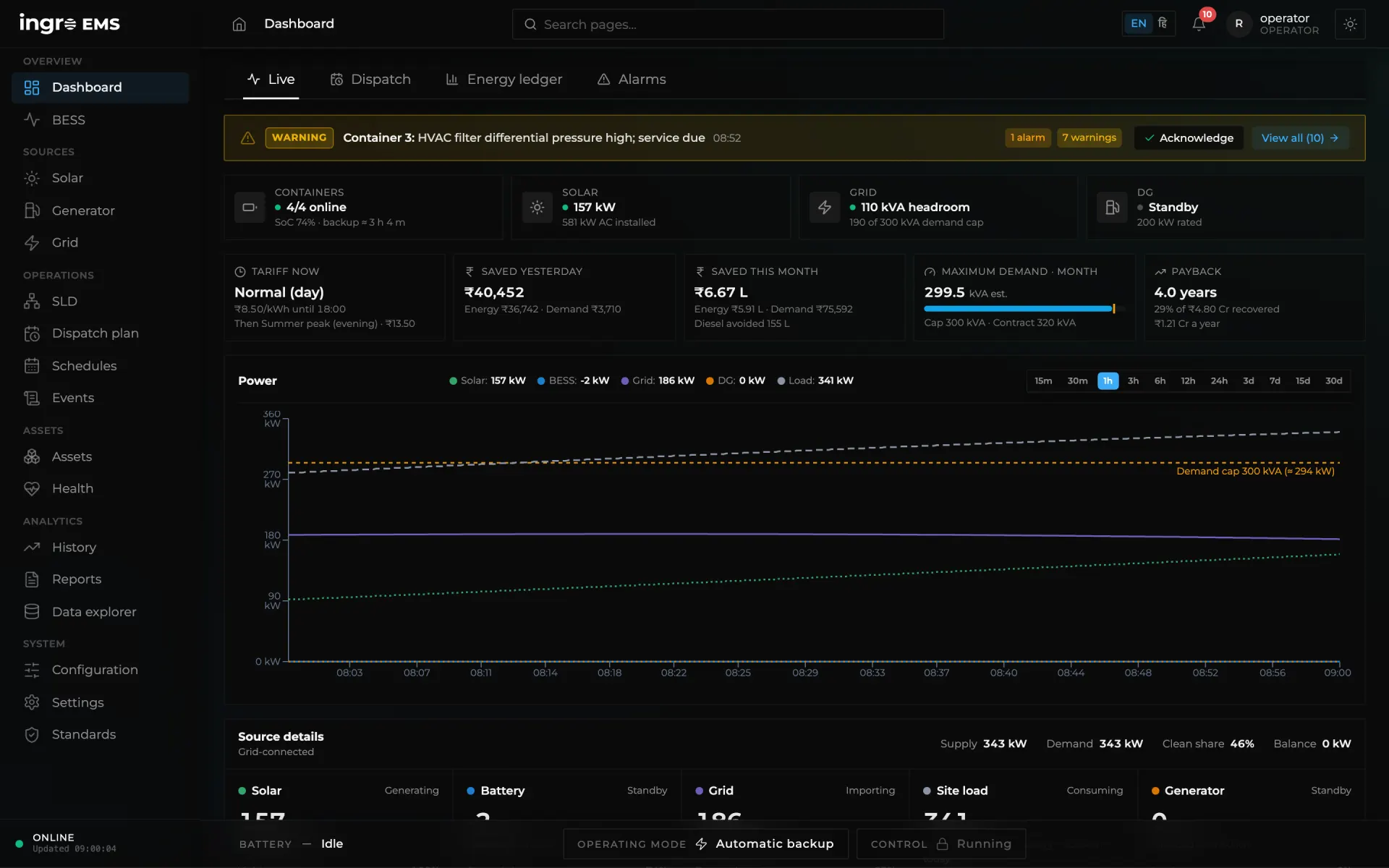
Ingro Cloud EMS gives you real-time monitoring, remote dispatch, and fleet-wide control across every BESS site, from a single dashboard.