No sensor reads a battery's state of health directly. It has to be inferred, either by taking the battery offline for a capacity test or by modelling it from the voltage, current and temperature the system already records. Machine learning has made that second route far more capable, and the research is clear on what makes it work: data from many batteries, operating in real conditions. This guide explains how AI battery health prediction works, where the evidence is strong, where it isn't, and why a fleet learns faster than a single site.
Key takeaways
State of health can't be read off a sensor; it is inferred from voltage, current and temperature, or measured with a capacity test.
Machine learning can predict battery life early: a 2019 Nature Energy study predicted cycle life from the first 100 cycles.
Lab results don't transfer cleanly to the field; real heat, duty cycles and rest periods change how batteries age.
Models learn faster across many batteries: field and lab studies show pooled and shared data improve prediction for each site.
Older batteries of the same chemistry are the most valuable teachers, because they have already shown late-life behaviour.
Good analytics reports uncertainty and is judged by the relevance of its training data, not one headline accuracy figure.
State of health (SoH) is usually defined as the capacity a battery can still deliver compared with when it was new, sometimes alongside how much its internal resistance has grown. The trouble is that neither number appears on a display. The battery management system reports voltage, current and temperature; capacity has to be worked out.
The direct way is a capacity test: charge fully, discharge fully at a controlled rate, and measure the energy. It is accurate, but it takes the battery out of service and costs time. In a multi-year study of 21 home storage systems in Germany, researchers at RWTH Aachen found each manual capacity test took about two days, so their 60 tests added up to roughly 120 days of work. For a battery earning money every day, that is a real cost.
The alternative is to estimate health continuously from normal operating data. That is where machine learning comes in.
02
What the Models Learn From
Most published battery health models use only the signals a BMS already records: voltage, current and temperature. Researchers at Oxford built end-of-life predictions for more than a thousand field batteries from exactly those three signals, with no extra sensors. Other approaches add impedance measurements or look at how voltage settles when the battery rests after charging.
The landmark result came in 2019. A team from Stanford, MIT and the Toyota Research Institute, publishing in Nature Energy, cycled 124 commercial LFP cells and showed that a model could predict each cell's cycle life from its first 100 cycles, before any capacity loss was visible, with a 9.1% test error. The signal was hidden in small changes to the shape of the discharge voltage curve.
Capacity estimationInferring how much energy the battery can still hold from partial charge and discharge curves, without a full test.
Resistance trackingWatching how much the voltage sags under load, which rises as cells age and as connections degrade.
Remaining useful lifeProjecting the health trend forward to estimate when the battery will reach the end-of-life threshold in its warranty.
Anomaly detectionFlagging cells, modules or racks whose behaviour no longer matches their neighbours or the model's expectation.
03
Lab Data vs Field Data
Most of the early breakthroughs used laboratory cells cycled under fixed, controlled conditions. Real batteries live differently, and the research now shows how much that matters.
A 2026 review from the Technical University of Munich compared almost 2,600 stress-factor combinations from 201 published ageing studies with real vehicle data, and concluded that lab stress levels are far harsher and far less varied than real use, which raises concerns about how well accelerated lab results transfer. A 2024 Nature Energy study from Stanford found that cells cycled with realistic, varying discharge profiles delivered up to 38% more equivalent full cycles than identical cells discharged at constant current, the standard lab method.
Field data has its own effects that labs never see. In a year of real electric-vehicle data analysed in Joule, seasonal temperature moved the battery's health indicators more than ageing did, leading the authors to warn that health algorithms not built on realistic data are likely to be inaccurate in the field. An analysis of three years of data from 300 electric vehicles found that the dominant ageing mechanism varied from vehicle to vehicle, and called for training data that covers a wider range of scenarios.
What this means in India
Much of the published field data comes from European vehicles and homes, at average battery temperatures far below an Indian summer. A model trained on that data has never seen a container at the end of a 45 degree afternoon. The only way to learn how a chemistry ages in Indian heat, on Indian tariffs and duty cycles, is to collect that data from batteries running here.
04
Why a Fleet Learns Faster Than a Single Site
One battery, on its own, rarely produces enough data to train a reliable lifetime model, especially early in its life. A 2020 perspective on battery digital twins in the journal Energy and AI made the point directly: individual units may not collect enough data for a statistically meaningful model, but aggregated together they can improve it.
The field evidence agrees. In the Oxford study of 1,027 solar-connected batteries, the approach that worked combined a population-wide health model with a battery-specific indicator. It predicted end of life eight weeks in advance with 73% balanced accuracy, and the authors noted that more accurate models could be built from population data, particularly if many operators shared their operating data.
Other work points the same way. A model published in Nature Machine Intelligence in 2025 compares each new cell with a database of cells that have already aged, and cut prediction error by more than 40% on average compared with learning from single cells in isolation. In a federated learning study from the Technical University of Munich, data owners who joined a shared ageing model reduced their own prediction error from about 7% to about 1%.
One finding is especially relevant to buyers. A transfer learning study presented at the PHM Society European Conference found that, when moving a health forecasting model to a new battery type, data from a few old batteries was worth more than data from many new ones. The oldest batteries of a chemistry are the ones that have already shown what late life looks like.
Your new battery
Chemistry
Climate
Sites already running
LFPSolar parkSolar shifting
LFPSteel plantPeak shaving
LFPPort warehouseBackup + ToD
NMCHospitalBackup power
LFPGrid substationArbitrage
NMCEV charging hubPeak shaving
LFPTextile millDiesel offset
LFPHill microgridOff-grid
NMCData centreUPS support
Same chemistry and climateSame chemistry
Shared modelIngro Brain
Learns from every LFP site, weighted to hot & dry sites like yours:
How this chemistry ages in this kind of heat
Which operating habits wear its cells fastest
What the early signs of a failing cell look like
Your site
LFP battery, hot & dry
1Day one: starts from what similar sites have already taught the model, not from a blank page.
2Every day after: its own data tunes the model to its own cells, loads and weather.
3And back: what it learns improves the model for the next site.
Matched on chemistry and climate
Illustrative: the sites shown are examples, not a list of real deployments. Lab tests age cells under fixed conditions; a fleet shows how the same chemistry ages under real Indian heat, tariffs and duty cycles.
05
What AI Can and Can't Promise
Honest battery analytics comes with caveats, and the research is explicit about them.
Accuracy depends on how varied the use isA 2024 study that cycled 225 cells across a wide range of rates and depths reported lifetime prediction errors of about 15% to 22%, well above the headline figures from tightly controlled lab datasets.
Models can look better than they areA 2023 Joule analysis showed that some lab models partly predict the test protocol rather than the cell, and lose accuracy on cells cycled identically.
Predictions need uncertainty attachedA 2024 review of probabilistic machine learning for batteries argued that health and lifetime predictions with large errors and no warnings are unacceptable, because most battery datasets are small.
Detection reduces risk, it doesn't remove itA 2023 Nature Communications study of 347 electric vehicles found its fault detector cut expected accident and inspection costs, but at the cost-optimal setting it still caught only about half of the faulty vehicles.
The practical takeaway
Treat an AI health estimate as a well-informed reading with a margin around it, check it against capacity tests when they happen, and judge a provider by how much relevant field data its models have learned from, not by a single accuracy figure.
06
From Prediction to Action
A health estimate is only useful if it changes what happens on site. In a well-run battery, it feeds four decisions.
DispatchThe EMS uses a degradation model to decide whether a cycle earns more than the battery life it uses up.
MaintenanceDrifting cells, modules or cooling problems become planned work orders instead of emergency call-outs.
WarrantyA continuous health record shows where the battery stands against its capacity guarantee, long before a claim.
PlanningThe health trend tells the owner when augmentation will be needed and how much capacity to add.
Ingro Brain + Ingro EMS
How Ingro Brain Learns Battery Health
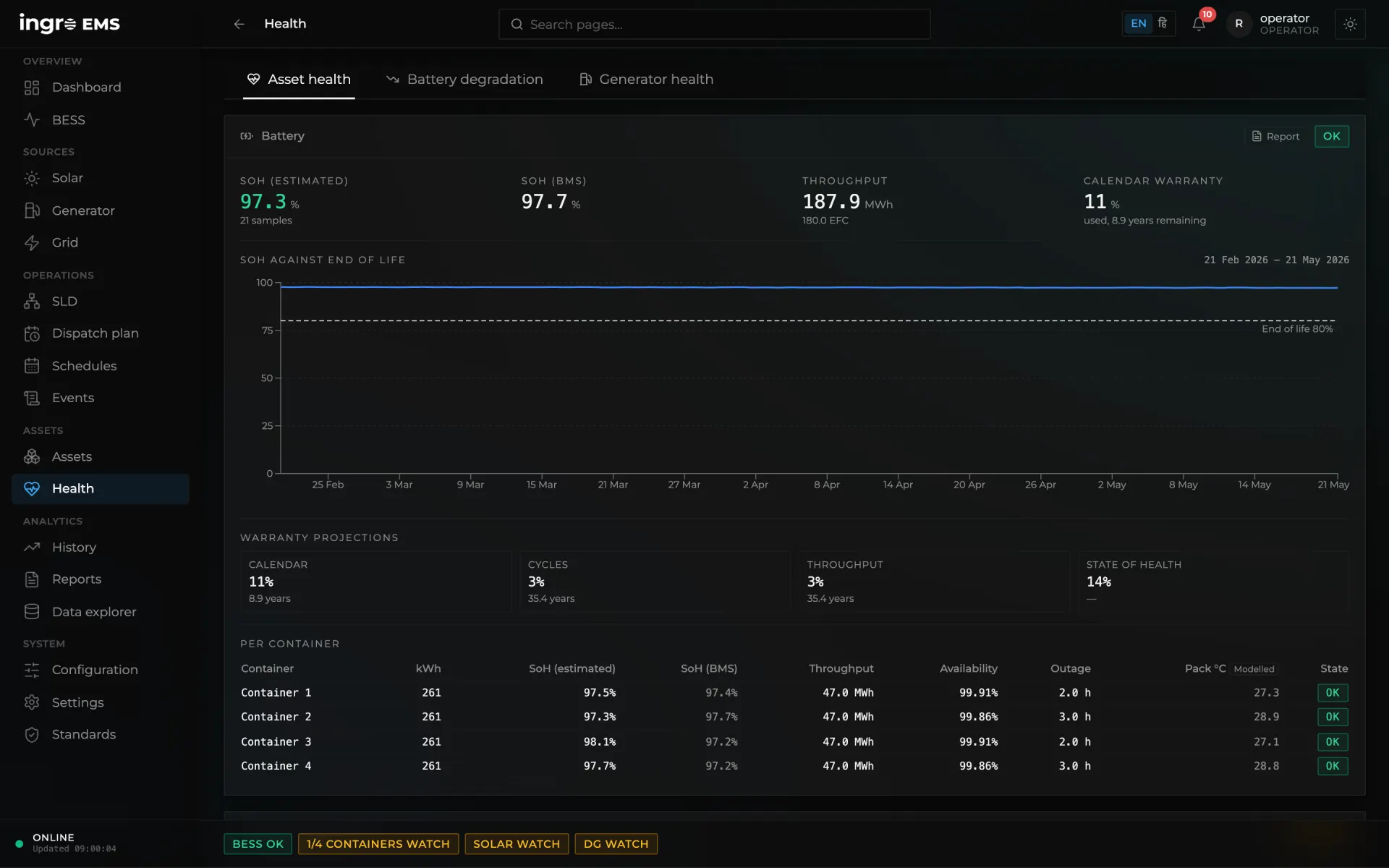
Ingro Brain runs AI models on each site's own operating data, and learns across every site Ingro operates. That means a battery commissioned today does not start from a blank page: it starts from what batteries of the same chemistry, under similar heat and duty cycles, have already shown, including sites that are further into their lives. From the first day, its own data then tunes the model to its own cells.
The output is not a dashboard number for its own sake. Health estimates feed straight into how Ingro EMS runs the battery, and into the alerts and reports the owner and the Ingro team act on.
Site modelsTrained on the battery's own voltage, current and temperature data, cell by cell where the BMS allows.
Fleet learningKnowledge shared across sites with the same chemistry and similar climates, so new sites start ahead.
Into dispatchIngro EMS weighs each cycle's value against the wear Ingro Brain expects it to cause.
Into maintenanceDrifting cells and abnormal trends become planned work for the Ingro service team.
AI can estimate how a battery's health is trending and flag cells that behave abnormally, often well before a limit trips. Research shows useful early warnings, for example end-of-life predictions eight weeks ahead in a study of 1,027 field batteries, but no model catches every fault, so predictions work alongside the BMS, gas detection and fire protection rather than replacing them.
A new battery has no history of its own, and a single site produces too little data early on to train a reliable model. Models trained on batteries of the same chemistry under similar conditions give a new site a sensible starting point, and studies on pooled, transfer and federated learning show this reduces prediction error compared with learning from one battery alone.
Not on its own. Published research shows lab stress tests differ sharply from real use, and that temperature strongly shapes field health indicators. Indian sites run hotter than most of the conditions in published datasets, so field data from batteries operating in India is needed to model them well.
Mostly the data a battery management system already records: voltage, current and temperature at cell, module or rack level, logged continuously. Some methods also use impedance measurements or rest-period voltage. Clean, continuous data matters more than exotic sensors.
It depends on the data and conditions. Lab studies report errors of around 1% or less for capacity estimation on well-characterised cells, while lifetime predictions under varied, realistic use have shown errors of roughly 15% to 22%. A trustworthy system reports its uncertainty and is periodically checked against measured capacity.