A battery energy storage system does not simply work until it stops. As its capacity fades, owners face a series of decisions: add capacity to keep meeting the contract, keep running at lower capacity, repurpose the cells for gentler work, or retire and recycle them. Each decision depends on knowing the battery's real state of health and its history. This guide explains augmentation, economic and physical end of life, second life, India's recycling rules and the battery passport.
Key takeaways
Augmentation adds capacity over a project's life to keep meeting its guarantee; in Indian tenders it is the developer's cost.
Deferring augmentation saves money, but only with an accurate picture of which modules are fading and how fast.
Economic end of life, when a battery stops earning its keep, can come well before physical end of life.
Second-life use depends on a trustworthy health history, for price and for safety.
India's Battery Waste Management Rules put recycling responsibility on producers, with material recovery targets.
The EU battery passport requires lifelong state-of-health and usage records for industrial batteries from 2027.
Augmentation is the additional storage equipment added over a system's life to maintain the capability agreed under its performance guarantee, as a Sandia National Laboratories financing report defines it. An augmentation plan usually combines some initial oversizing with later additions or replacements.
Indian tenders make augmentation the developer's responsibility. NHPC's standalone battery tender requires the developer to make periodic replacements or replenishments at its own cost to meet the annual guaranteed ratings, and counts the outage time for that work against the availability target. NREL's cost baseline for utility-scale storage likewise builds augmentation into fixed operating costs, so the plant delivers its rated capacity throughout an assumed 15-year life.
Timing and mixing old with new
Because battery prices tend to fall, Sandia notes the cost-minimising strategy is to push as much augmentation as possible into the future. It also notes that adding new modules to a common inverter beside old ones makes balancing them more difficult, while adding them at the AC side with a new inverter keeps them separate at a slightly higher capital cost. Both decisions depend on an accurate, current picture of which modules are weakest and how fast the battery is fading.
02
Physical End of Life vs Economic End of Life
Physical end of life is a capacity threshold, often 70% to 80% of the original, set by a warranty or a contract. Economic end of life is different. Researchers at Carnegie Mellon University proposed retiring storage when it can no longer earn a positive net benefit in its intended application, and showed in a case study that economic end of life can arrive significantly earlier than physical end of life.
For an owner, the useful question is not whether the battery has crossed 80%, but whether it still earns more than it costs to run, and whether a different use would earn more.
03
Second Life: Reuse in Gentler Duty
A battery retired from demanding duty may still have years of use in a less demanding one. An NREL study of electric-vehicle batteries found second-life use could potentially exceed ten years under favourable conditions, and that repurposing costs fall sharply when the buyer has the battery's diagnostic history.
That history is the sticking point. A 2026 white paper from the National Laboratory of the Rockies (formerly NREL) notes that repurposers typically lack access to the original battery management system, and so may not know the history of the cells, including temperature extremes, overcharge and undercharge. It also cites a study finding that aged cells could have thermal runaway onset temperatures more than 50 degrees lower than new cells, which is why a used battery's record matters for safety as well as price.
04
Recycling Rules in India
India's Battery Waste Management Rules, notified in August 2022, are based on extended producer responsibility: producers, including importers, are responsible for collecting and recycling or refurbishing waste batteries, and disposal in landfill or by incineration is prohibited. The rules set minimum material recovery targets for industrial batteries of 55% for 2024-25 and 60% from 2025-26, and the Central Pollution Control Board issues EPR certificates through an online portal based on recycled or refurbished quantities. The rules have since been amended, so check the current targets for a specific project.
05
The Battery Passport
The EU Battery Regulation is setting the template for battery records worldwide. Since August 2024, the battery management system of stationary storage sold in the EU must hold up-to-date data on state of health and expected lifetime, readable by the buyer or a third party acting for them, for purposes including assessing residual value and repurposing. The required parameters include remaining capacity, energy throughput, deep discharge events and time spent in extreme temperatures.
From February 2027, each industrial battery over 2 kWh placed on the EU market needs a battery passport: an electronic record that includes its state of health, its status as original, repurposed, re-used, remanufactured or waste, and data from its use, such as charge and discharge cycles, negative events and periodically recorded temperature and state of charge. For Indian manufacturers and exporters, and increasingly for Indian buyers, a trustworthy lifelong record is becoming part of what a battery is.
06
Why the Record Starts on Day One
Every late-life decision, when to augment, whether to keep running, what a second-life buyer will pay, whether a used battery is safe, depends on data that can only be collected while the battery is working. Acceptance tests set the baseline; years of operating data show how it has been used and how it has aged. A battery whose history was never recorded is worth less at every stage.
Commission
Operate
Augment
Second life
Recycle
Operate
Years of daily work. Health-aware control slows the fade; monitoring tracks it cell by cell.
The health record
Throughput, temperature history, state-of-charge habits and health estimates, logged continuously.
Ingro Brain + Ingro EMS
How Ingro Supports the Whole Life
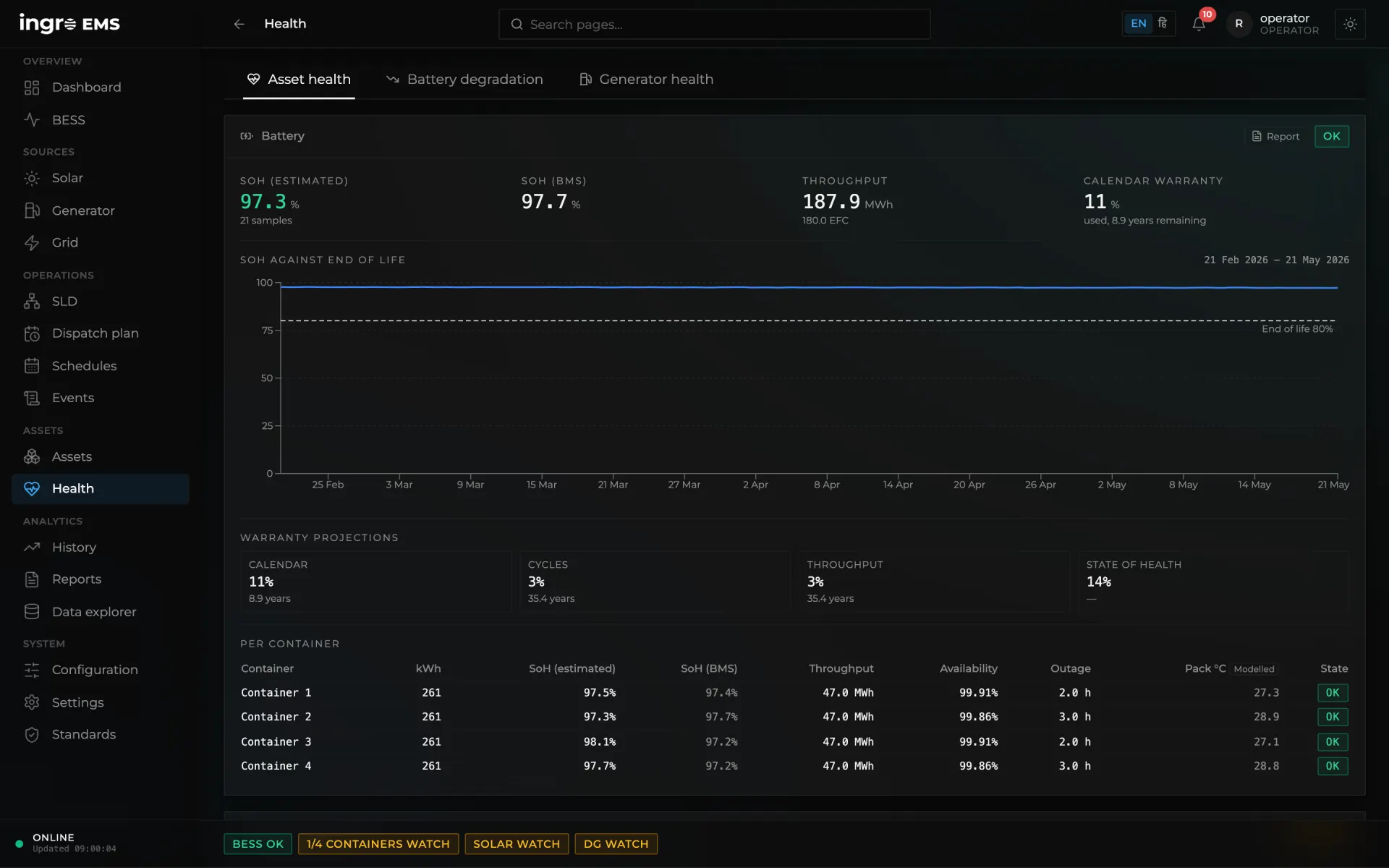
Ingro Brain builds each battery's health record from its first day: baseline, state-of-health trend, temperature history, cycles and events, module by module. That record tells an owner when augmentation will be needed and which modules to replace, and it carries straight into Ingro's Battery Passport for warranty claims, resale, second life and recycling.
Because Ingro Brain learns across every site Ingro runs, its view of how a chemistry ages late in life improves as older sites move through those stages, knowledge that helps every newer battery plan its own.
Augmentation planningHealth trends and weakest-module lists that show when and where to add capacity.
Economic viewThe value a battery earns tracked against what it costs to run.
Lifelong recordThe data a second-life buyer, insurer or recycler needs.
Battery PassportThe same record, structured for compliance and transfer.
Augmentation is adding battery capacity during a project's life so it keeps meeting its capacity guarantee as the original cells fade. It usually combines some initial oversizing with later additions or replacements, timed to balance cost against contract obligations.
Often, for less demanding applications, if their state of health and operating history are known. Without that history, buyers face uncertainty about remaining life and safety, and research shows aged cells can have lower thermal runaway onset temperatures than new ones.
They can be augmented and kept running, repurposed for gentler second-life duty if their health and history support it, or retired and recycled. In India, the Battery Waste Management Rules make producers responsible for collection and recycling, and prohibit landfill and incineration.
A battery passport is a digital record of a battery's identity, materials, state of health and usage history. Under the EU Battery Regulation, industrial batteries over 2 kWh placed on the EU market need one from February 2027.