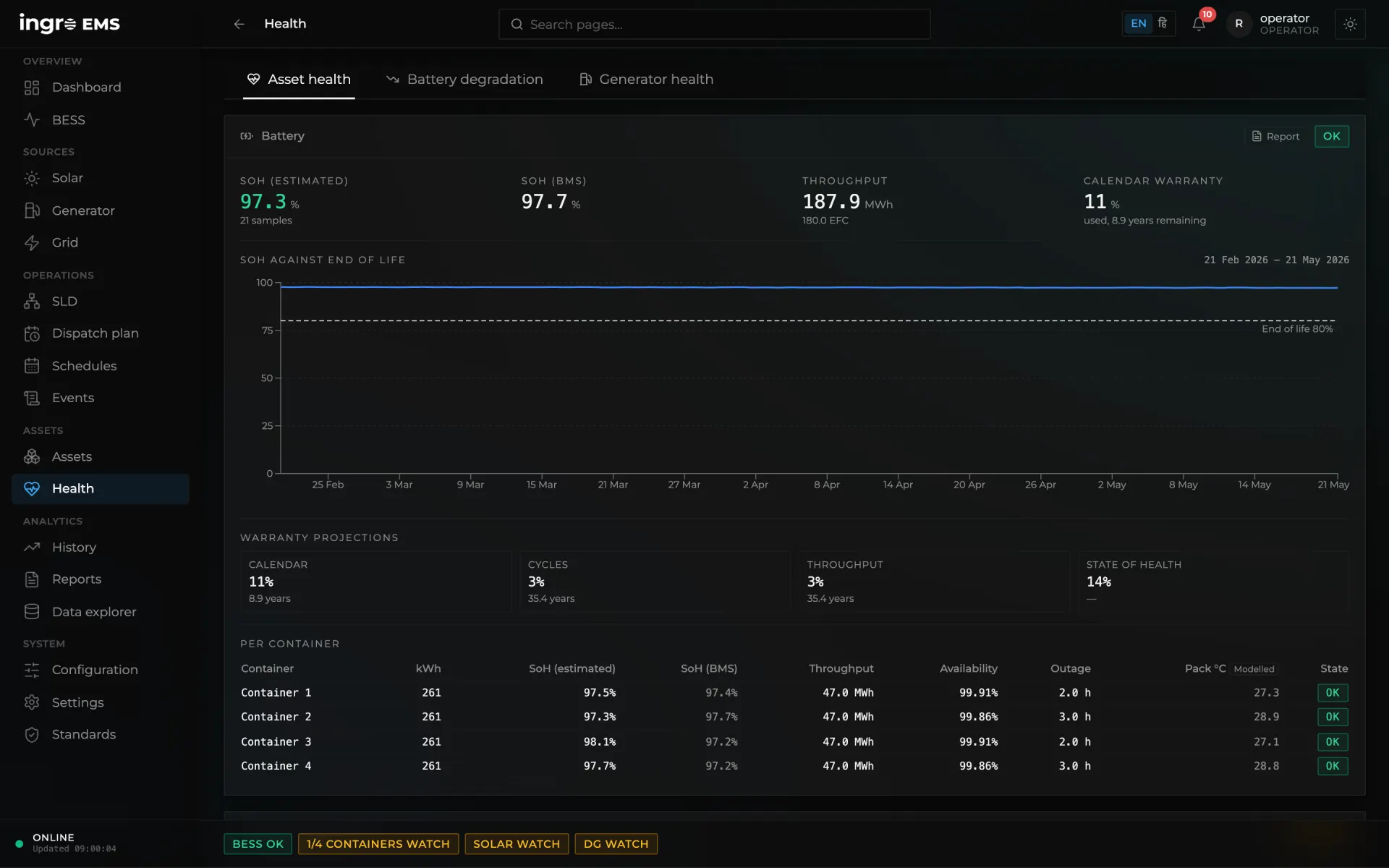
Every battery degrades, so every serious battery contract says how much degradation is acceptable. Manufacturer warranties guarantee a share of capacity after a set time or throughput, under stated operating conditions. Indian tender contracts go further, setting a minimum dispatchable capacity for every year of the contract, with penalties if it is not met. This guide explains how these guarantees are structured, the conditions that can void them, and why continuous operating data is what keeps a battery owner covered.
Key takeaways
Warranties cover defects and performance; performance warranties guarantee capacity or throughput.
Capacity guarantees are year-by-year schedules, often ending around 70% at 10 years for C&I and home products.
Indian tenders set a minimum dispatchable capacity each year, falling 2.5 points a year, with augmentation at the developer's cost.
Tenders also require monthly availability and round-trip efficiency, annual energy tests and OEM performance guarantees.
Operating outside temperature, rate, state-of-charge or cycle limits can void a warranty.
Continuous operating data is the evidence that keeps an owner covered, and is increasingly required.
A Sandia National Laboratories report on energy storage financing explains that warranty coverage is typically focused on two areas: manufacturing defects and performance. A defect warranty covers equipment that fails, but does not reimburse the economic loss from downtime. A performance warranty covers how well the battery keeps working over time, and is centred either on energy capacity or on energy throughput.
A capacity warranty guarantees at least a stated share of rated energy capacity for a number of years or cycles, stepping down every few years or in a straight line each year. A throughput warranty guarantees a total amount of energy delivered over the battery's life, while it is operated under normal conditions.
02
What a Capacity Schedule Looks Like
Capacity guarantees are written as a year-by-year schedule. One published commercial and industrial battery warranty, for example, steps state of health down from 100% to 70% at year 10, assuming charge and discharge at 0.5C, 90% depth of discharge, a resting state of charge no higher than 50% and one cycle per day, with state of health measured at the DC terminals.
Home storage warranties are framed the same way. Tesla's Powerwall warranty guarantees 70% of rated capacity at 10 years in the USA, and 80% at 10 years in several European countries. Many warranties are also capped by throughput: one home battery warranty guarantees 60% of usable energy for ten years or until a minimum energy throughput is reached, whichever comes first.
03
Indian Tenders: Degradation Written Into the Contract
Indian grid-scale tenders put degradation at the centre of the contract. NHPC's 500 MW / 1,000 MWh standalone battery tender under the Viability Gap Funding scheme sets the minimum dispatchable capacity at the end of each contract year, falling 2.5 percentage points a year from 97.5% in year 1 to 70% in year 12. SECI's standard purchase agreement template with GRIDCO uses the same 2.5-point annual step over 15 years, ending at 62.5%.
The obligations do not stop there. The NHPC tender requires 2 operational cycles a day, minimum availability of 95% measured monthly with liquidated damages for shortfalls, and an AC-to-AC round-trip efficiency of at least 85%, also measured monthly, with penalties below that. The developer must replace or replenish capacity at its own cost to meet the annual guaranteed ratings, submit an available-energy test to IEC 62933-2-1 every year, and procure performance guarantees from the battery manufacturer that state life expectancy for the application's discharge profile.
Draft national standards
The Central Electricity Authority's draft technical standards for BESS propose performance guarantees of at least 90% output after 5 years, 80% after 10 and 70% after 15, and require the BMS to monitor state of health, among other parameters, at module, rack and container level. Check the final notified version before relying on these figures.
04
The Conditions That Can Void a Warranty
Performance warranties assume the battery is operated within agreed conditions. Sandia's financing report notes that throughput warranties can include temperature, charge and discharge rates and state-of-charge range, and warns that varying market roles may unintentionally force a system out of compliance with its warranty, a direct risk for lenders. In a 2019 industry roundtable published by Norton Rose Fulbright, practitioners described vendors requiring the operator to maintain temperature and state of charge within limits or void the warranty.
TemperatureCell or ambient temperature outside the agreed window, often with specific exclusions for extreme heat or cold.
Charge and discharge ratePower above the rated C-rate.
State of chargeResting too long near full or near empty, where the warranty restricts it.
Cycles and throughputMore cycles per day, or more total energy, than the guarantee assumes.
Registration and installationWarranties that must be registered within a set period, or installed by approved parties.
DataMissing or incomplete operating records.
Warranty conditions
Tracked every day, not checked at claim time
1 to watch
Time resting near full or near empty, where the warranty restricts it.
Illustrative. The conditions and limits differ by manufacturer and contract; the point is to know where you stand on each of them before a claim, not after.
05
Data Is the Evidence
A capacity claim is a dispute about numbers, and the party with the better records usually wins. The Norton Rose Fulbright roundtable described battery vendors requiring a very specific list of data, typically logged at 15-minute intervals, including maximum current and minimum and maximum state of charge. Sandia's financing report recommends monitoring and performance testing that track round-trip efficiency, standby losses and state-of-charge excursions, because this produces useful information about capacity degradation.
The EU Battery Regulation goes further: since August 2024, the battery management system of stationary storage sold in the EU must hold up-to-date data on state of health and expected lifetime, including energy throughput, deep discharge events and time spent in extreme temperatures. India's tender contracts and draft standards point in the same direction: continuous, trustworthy operating data is becoming a requirement, not a nice-to-have.
06
Augmentation: Planning for Degradation
Augmentation means adding battery capacity over a project's life to keep meeting its guarantee. Sandia's report explains that an augmentation schedule typically combines some initial oversizing with later additions or replacements, and that because battery prices tend to fall, the cost-minimising strategy is to defer as much augmentation as possible. NREL's cost baseline assumes augmentation is built into fixed operating costs, so the plant keeps delivering its rated capacity throughout a 15-year life.
Deferring augmentation safely depends on knowing the battery's real state of health and how fast it is falling. Too early wastes money; too late breaches the contract. See the next guide in this series for how augmentation, second life and end of life work.
Ingro Brain + Ingro EMS
How Ingro Keeps You Covered
Ingro EMS runs the battery inside its warranty and contract conditions as part of every dispatch decision: temperature, rate, state-of-charge limits, cycles and throughput. Ingro Brain tracks state of health continuously, so an owner knows where the battery stands against its capacity schedule long before an annual test or a claim.
The operating record that results is the evidence a warranty claim, a tender compliance report or a lender's review needs, and it feeds augmentation planning and the Battery Passport.
Conditions enforcedWarranty and contract limits built into dispatch.
Schedule trackingState of health compared with the guaranteed capacity, year by year.
EvidenceContinuous logs of temperature, rate, state of charge and throughput.
PlanningHealth trends that show when augmentation will be needed.
A performance warranty guarantees that the battery keeps a stated share of its rated capacity for a set number of years or cycles, or delivers a stated total energy throughput, provided it is operated within agreed conditions on temperature, charge and discharge rate, state of charge and cycling.
Common grounds include operating outside the agreed temperature window, exceeding the rated charge or discharge rate, keeping the battery at restricted states of charge, exceeding cycle or throughput limits, missing registration, and incomplete operating data.
Recent tenders, such as NHPC's 500 MW / 1,000 MWh VGF tender, set a minimum dispatchable capacity that falls 2.5 percentage points a year, from 97.5% after year 1 to 70% after year 12. SECI's standard agreement template uses the same step over 15 years. The developer must augment capacity at its own cost to stay above the floor.
Augmentation is adding battery capacity during a project's life so it keeps meeting its capacity guarantee as the original cells degrade. It is usually planned from the start, combining some initial oversizing with later additions.