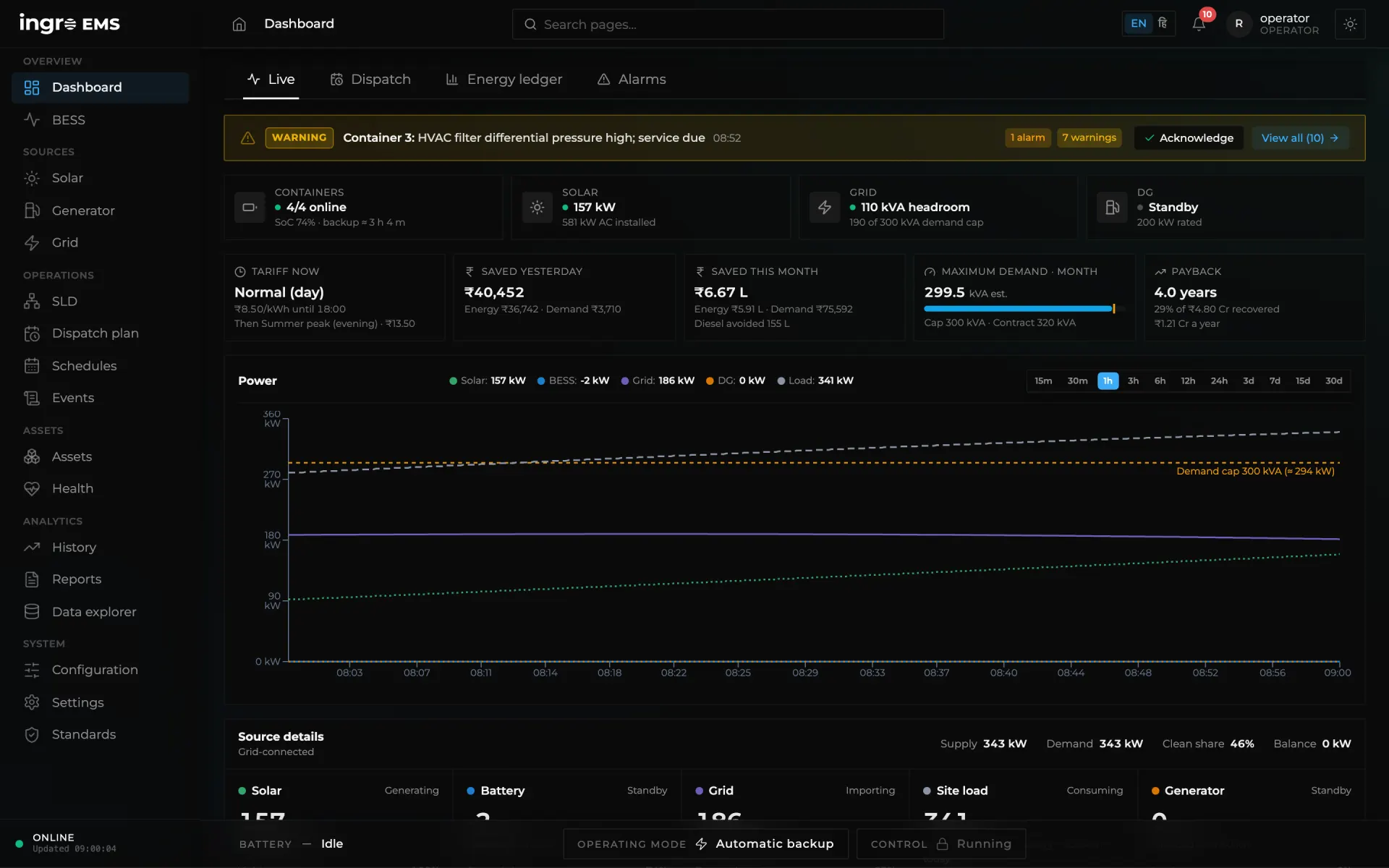
Managing multiple BESS sites with tools built for a single facility quickly breaks down. A fleet EMS replaces fragmented dashboards, spreadsheets and site visits with one cloud platform that monitors, dispatches and benchmarks every battery asset in real time, so a growing portfolio does not demand a proportionally growing operations team.
Key takeaways
Running multiple BESS facilities with single-site tools creates data islands, avoidable truck rolls and no true portfolio view.
A fleet cloud EMS unifies real-time monitoring, aggregated and per-site dispatch, cross-site benchmarking, role-based access and SLA tracking in one platform.
Centralisation and automation let a lean central team scale from one site to many without growing headcount linearly.
In India, a fleet EMS must reconcile multi-state SERC and CERC rules, ABT metering and open access across the portfolio.
Ingro Cloud EMS delivers hardware-agnostic fleet management, proven at 99.5% availability, as a module of the Ingro EMS platform.
The Operational Challenges of Running Multiple BESS Facilities
A single BESS site is manageable with the OEM's local controller, an on-site SCADA screen and periodic manual reports. Add a second site in another state, a third with a different battery vendor, and a fourth under a separate PPA, and the operating model stops scaling. Each site becomes an island of data, and the portfolio view that owners, lenders and off-takers actually need never materialises.
Fragmented toolingEvery OEM ships its own controller and portal, so operators juggle multiple logins, data formats and alarm conventions with no common view.
Truck rolls and site visitsWithout remote visibility, routine checks, firmware updates and fault diagnosis all require sending an engineer to a remote substation.
Inconsistent dataSoC, SoH, availability and throughput are calculated differently by each vendor, making cross-site comparison and honest reporting almost impossible.
No portfolio viewManagement cannot see aggregated capacity, revenue or SLA compliance in one place, so decisions rely on stale, manually compiled spreadsheets.
Compliance across sitesCERC and SERC scheduling, metering and reporting obligations multiply with every state and every off-take contract, each with its own formats and deadlines.
Headcount that scales linearlyEvery new site seems to need its own operators and site engineers, eroding the economics of a growing fleet.
02
What a Fleet Cloud EMS Does: One Pane of Glass for Every Site
A fleet cloud EMS is a hardware-agnostic layer that sits above every site's local controllers and normalises their data into one model. Instead of managing sites, operators manage a portfolio: they see every facility, string and cell in a single interface, dispatch across the fleet or drill into one asset, and let the platform handle the protocol translation underneath.
Real-time multi-site monitoringLive telemetry from every site, pack and cell in one dashboard, with a common data model across mixed OEM hardware.
Aggregated and per-site dispatchSend a portfolio-wide schedule or override a single site manually, with sub-second edge control where market or grid conditions demand it.
Cross-site benchmarkingRank sites on availability, round-trip efficiency, degradation and revenue to surface under-performers early.
Role-based accessOperators, engineers and management each get the views and controls appropriate to their role, across the whole fleet.
SLA and uptime trackingAutomated availability accounting against contractual guarantees, with the evidence trail lenders and off-takers expect.
Remote diagnosticsAnomaly detection and remote troubleshooting resolve most issues without a truck roll, and turn the rest into a targeted, parts-ready visit.
One dashboard for the whole fleet, with drill-down from the portfolio to a site, a container and a rack.
03
Portfolio-Level Revenue Optimisation and Standardisation
Managing sites individually leaves money on the table. A fleet EMS optimises dispatch against each site's tariff, PPA and market opportunity while respecting portfolio-level constraints, so charge and discharge decisions reflect the whole book rather than one asset in isolation. Standardisation is the quieter benefit: one configuration model, one alarm taxonomy and one reporting template applied everywhere.
Optimise the portfolio, not just the asset
When several sites can serve the same energy or ancillary obligation, the EMS can allocate the call to the site with the lowest marginal cost, the healthiest cells or the most available headroom, extending asset life while meeting the commitment. Ingro Cloud EMS re-optimises dispatch every five minutes, keeping decisions aligned with changing prices and state of charge.
Standardise once, apply everywhere
A new site inherits proven templates for control logic, safety limits, roles and reports instead of being commissioned from scratch. That consistency is what makes benchmarking meaningful, shortens onboarding, and lets a lean central team operate many sites the same way.
04
Scaling From One Site to a Fleet Without Growing Headcount Linearly
The core promise of multi-site BESS management is operational leverage. Because monitoring, dispatch, diagnostics and reporting are centralised and automated, a central operations team can run tens of sites with roughly the same staff it took to run a few. Exceptions, not routine checks, drive human attention.
Centralised monitoring means one control room watches the whole fleet, with alarms escalating only the sites that need a human.
Remote diagnostics cut truck rolls, so field engineers travel for genuine repairs rather than inspections.
Templated onboarding brings a new site live in days, not weeks, without a bespoke integration each time.
Automated compliance and SLA reporting removes the manual spreadsheet work that otherwise grows with every site.
05
The India Multi-State Context: CERC, SERC and Open Access
In India, a BESS portfolio rarely sits within one jurisdiction. A fleet can span multiple states, each with its own SERC regulations, scheduling and metering norms, deviation settlement mechanics and open-access rules, while inter-state assets fall under CERC. Managing multiple BESS sites here means reconciling different tariffs, ABT metering and reporting formats without a separate manual process per state.
A cloud EMS that understands this context standardises data capture and reporting across states while respecting each one's rules, so compliance scales with the fleet instead of consuming it. For C&I portfolios using open access, and for IPPs and utilities balancing MNRE-linked renewable and storage assets, a single platform turns regulatory fragmentation into a manageable, auditable workflow.
06
Ingro Cloud EMS: Fleet Management Built in India
Ingro Cloud EMS is a cloud-based, hardware-agnostic EMS built in India for exactly this problem: running many BESS facilities as one fleet. It monitors every site, pack and cell in real time from a single dashboard, centralises dispatch with schedule override and manual control, and applies role-based access for operators, engineers and management across the portfolio.
Hardware-agnostic integration over Modbus TCP/RTU, IEC 61850, DNP3 and OPC-UA, with edge gateways delivering sub-second, down to sub-10ms, control at each site.
Fleet analytics with performance benchmarking, SLA tracking, and remote diagnostics with anomaly detection that reduce avoidable site visits.
Proven at scale: Ingro operates one of India's oldest grid-scale BESS sites at 99.5% availability, coordinates 124 inverters at a single site, and re-optimises dispatch every five minutes.
Part of the Ingro EMS platform: Cloud EMS feeds Battery AI for revenue optimisation and Battery Passport for lifecycle and compliance, so the same fleet data compounds in value.
Part of a wider AI Powered BESS platform
Because Cloud EMS is the foundation of Ingro's AI Powered BESS platform, the fleet data it captures also powers Battery AI and Battery Passport. See Cloud EMS and Integrations for the full list of supported protocols, or explore how the three pillars fit together on the AI Powered BESS page.
07
How to Evaluate a Fleet Cloud EMS
Not every platform that calls itself a fleet EMS delivers real multi-site management. Use this checklist to separate a genuine portfolio system from a monitoring portal bolted onto one vendor's hardware.
Hardware-agnostic by designConfirm it integrates mixed OEMs over standard protocols rather than locking you to one vendor's stack.
A genuine single pane of glassOne login, one data model and one alarm taxonomy across every site, not a portal per vendor.
Edge plus cloud controlCloud oversight for the fleet with fast, deterministic control at the edge for grid and market response.
Portfolio and per-site dispatchAggregate scheduling with the ability to override any single site manually.
India-ready complianceSupport for multi-state SERC and CERC reporting, ABT metering and open-access workflows.
A path beyond monitoringA platform that turns fleet data into revenue optimisation and lifecycle intelligence, not just charts.
A controller installed in your plant room, a console on site and on your phone, and reports your finance team can use. Supplied on its own for your battery, or as a complete battery system.
Ingro EMS Controller, wired and commissioned on site
Operator console, mobile app and 13 reports
Add Cloud EMS, Ingro Brain or Battery Passport when you need them
A fleet EMS is a cloud energy management system that operates many battery storage sites as one portfolio. It normalises data from mixed OEM hardware into a single dashboard, enabling real-time monitoring, aggregated and per-site dispatch, cross-site benchmarking and centralised diagnostics, so operators manage a fleet rather than a collection of isolated facilities.
Yes. A hardware-agnostic fleet EMS such as Ingro Cloud EMS integrates mixed OEM equipment over standard protocols like Modbus, IEC 61850, DNP3 and OPC-UA, then maps everything to a common data model. Operators get consistent metrics and controls across every site regardless of the battery, inverter or PCS vendor underneath.
Not with a fleet EMS. Because monitoring, dispatch, diagnostics and reporting are centralised and automated, a single control room can oversee many sites while human attention focuses on exceptions. Templated onboarding and remote diagnostics mean a growing portfolio adds capacity and revenue without adding operators in proportion to the number of sites.
By streaming live telemetry from every site to a central platform, a cloud EMS lets engineers monitor, diagnose and often resolve issues remotely. Anomaly detection flags problems early, configuration can be pushed from the control room, and only genuine hardware faults require a visit, which then arrives targeted and parts-ready rather than exploratory.
A portfolio spanning several states faces different SERC rules, scheduling and ABT metering norms, with inter-state assets under CERC. A fleet cloud EMS standardises data capture and automates reporting to each jurisdiction's format, so compliance and SLA evidence scale with the fleet instead of requiring a separate manual process per site and per off-taker.
Seeing the whole portfolio lets the EMS optimise dispatch across sites rather than in isolation, allocating each obligation to the site with the lowest marginal cost or healthiest cells. Cross-site benchmarking surfaces under-performers early, and re-optimising dispatch frequently, every five minutes in Ingro Cloud EMS, keeps decisions aligned with changing prices and state of charge.
Ingro EMS is designed, built and supported in India, for C&I sites and grid-scale BESS. Ingro EMS is deployed on site (offline), in the cloud, or as a hybrid of the two. In on-site and hybrid deployments, site control continues with no internet connection.