Two-Fault Tolerance is Now the Law
India's CEA Amendment Regulations 2026 mandate two-fault tolerance as a legal requirement for grid-scale BESS projects, with an April 2027 compliance deadline. Every layer — from cell-level monitoring to automatic charge cutoffs — must be designed to prevent cascading failures.
The CEA Amendment Regulations, 2026 have officially begun to reshape BESS safety by making two-fault tolerance a legal requirement for grid-scale projects.
With the April 2027 compliance deadline fast approaching, safety is no longer a design “add-on” but a mandatory architectural philosophy. Every layer—from cell-level monitoring to automatic charge cutoffs—must now be built to ensure the first anomaly never leads to a catastrophe.
Most BESS failures are not sudden
They are the last event in a sequence already in motion.
The first fault — a cell voltage excursion, a cooling anomaly, a temperature spike — is manageable. Systems are designed for that.
The problem is the second fault. CEA Amendment Regulations, 2026 have now made two-fault tolerance a legal baseline for grid-scale BESS in India.
How incidents actually unfold
Fault 01 — Manageable
The system absorbs it. A voltage excursion. A thermal anomaly. Margins get thinner, but the system keeps running.
Fault 02 — Uncontrolled
If the first fault goes unresolved, the system is now degraded. When the second fault arrives, the response is rarely controlled.
This two-fault cascade is the failure pattern behind most serious BESS incidents globally.
Regulation 122(B) in practice
What two-fault tolerance demands:
- Cell-level BMS monitoring — Voltage, temperature & thermal runaway independently at cell, module & rack level. Not just aggregates.
- Instant alarms — Audio-visual alert the moment any parameter exceeds OEM operating limits.
- Auto charge/discharge cutoff — BMS stops automatically when temperatures exceed OEM limits. No human latency.
- Fully automatic PCS — Unattended operation with self-protective & diagnostic features.
- Cooling fault isolation — No cooling fault may cause cell short-circuits.
- Ventilation failure = auto-shutdown — Not an alert. A shutdown.
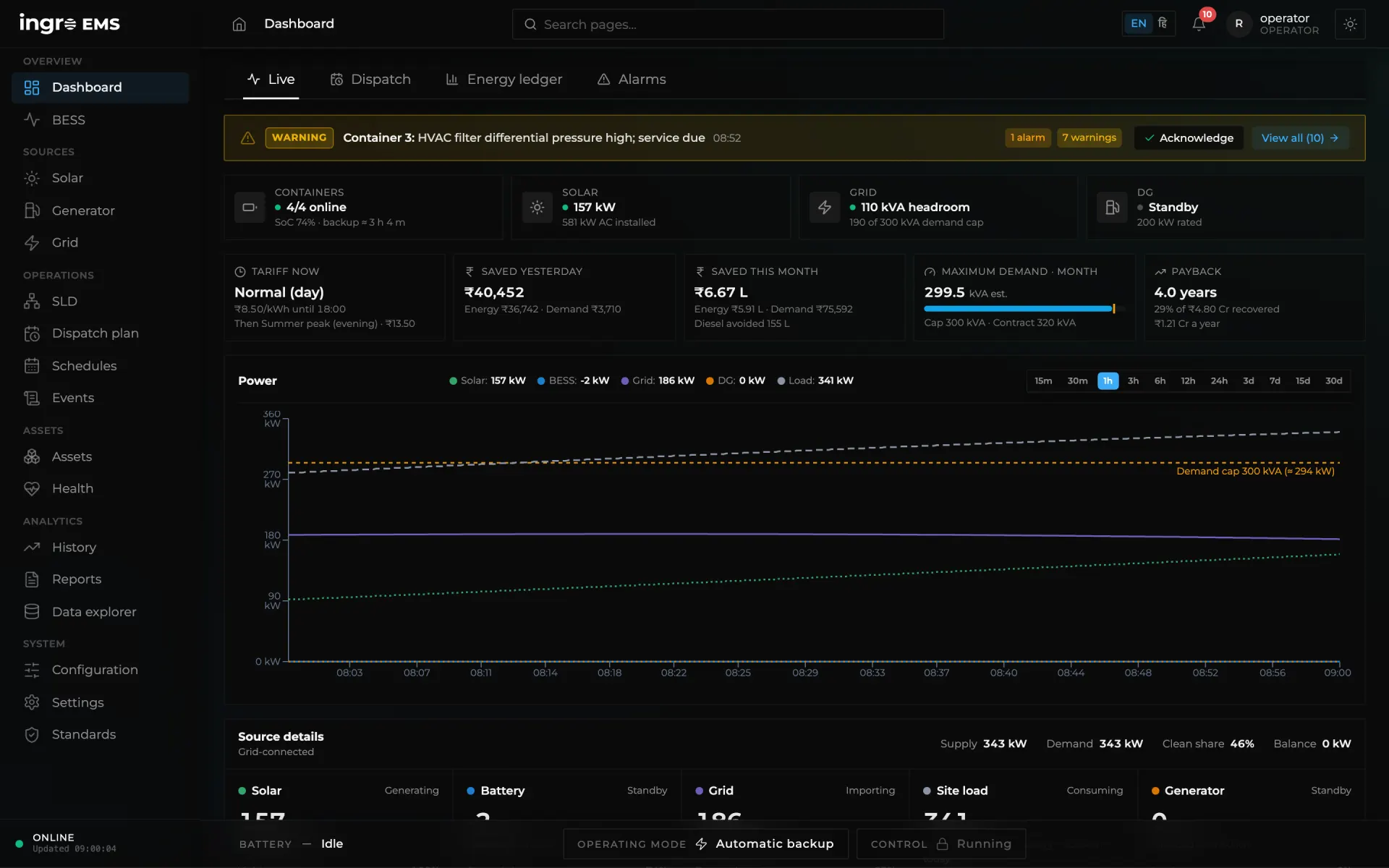
Across these requirements, one system orchestrates the full picture — the EMS. It is what transforms two-fault tolerance from a design spec into operational reality.
Two-fault tolerance is an architectural philosophy
Not a feature added after design. Every layer must be built on the assumption that faults will occur — and that the first must never make the second unmanageable.
Compliance deadline: 1st April 2027 — CEA (Safety & Electric Supply) Amendment Regulations, 2026.
If you want to understand where your project stands against the two-fault tolerance baseline, that’s a conversation Ingro Energy is set up to have.
Opens the original post on LinkedIn — like, comment, or share it there.