Advantages of a Hardware-Agnostic EMS for BESS
EMS Deep-Dive7 min read

Advantages of a Hardware-Agnostic EMS for BESS

Why open protocols and vendor neutrality are becoming non-negotiable for grid-scale and C&I battery storage in India.

A hardware-agnostic EMS for BESS is an energy management system that controls batteries, inverters (PCS) and meters from any manufacturer, rather than only the OEM's own kit. As Indian storage portfolios grow across multiple vendors and sites, this vendor-agnostic approach has shifted from a nice-to-have to a core procurement requirement. Here is why it matters.

What Does a Hardware-Agnostic EMS for BESS Mean?

A hardware-agnostic EMS for BESS is a control and optimisation layer that operates independently of any single equipment brand. Instead of being tied to one manufacturer's batteries, power conversion system (PCS) or battery management system (BMS), it communicates with hardware from many vendors through open industrial protocols. The terms vendor-agnostic, vendor-neutral and open EMS describe the same idea: the intelligence lives in software, not in a proprietary box.

This matters because a battery site is rarely a single product. Cells, racks, PCS, transformers, meters and protection relays often come from different suppliers, and a portfolio built over several years will span multiple generations of equipment. A hardware-agnostic EMS treats all of this as one coordinated system, giving operators a single pane of glass for monitoring, dispatch and compliance.

The Vendor Lock-In Problem with Proprietary EMS

When the EMS is bundled with the battery OEM, the software usually speaks only to that vendor's equipment. This creates vendor lock-in: the supplier that sold you the batteries also controls the brains of the plant. Over a 10 to 15 year asset life, that dependency has real commercial consequences.

  • Pricing power: with no ability to switch, you accept the OEM's terms for spares, expansions and software licences.
  • Forced hardware refresh: augmentation or replacement must use the same brand, even when better-value cells exist.
  • Stranded brownfield assets: an older site cannot be modernised without ripping out and replacing the control layer.
  • Data ownership: operational data may sit inside a closed platform you cannot fully export or analyse.
  • Warranty entanglement: mixing in third-party hardware can void bundled warranties or blur support.

How Open Protocols Enable Hardware-Agnostic Control

Vendor neutrality is only possible if the EMS can speak the languages that industrial hardware already uses. Four open protocols do most of the work in modern BESS projects, and a capable EMS supports all of them.

  • Modbus TCP/RTU: the near-universal protocol for PCS, BMS and meters, ideal for register-level monitoring and control.
  • IEC 61850: substation-grade communication (MMS and GOOSE) used where the BESS interfaces with utility switchgear and protection.
  • DNP3: widely used by Indian utilities and SCADA systems for reliable telemetry over constrained links.
  • OPC-UA: a modern, secure, platform-independent standard for structured data exchange and interoperability.

The role of edge gateways

Because no site uses only one of these protocols, edge gateways sit between the hardware and the cloud, translating between them and normalising data into a common model. They also buffer data locally so control and logging continue even if the network link drops, and they enable fast local control loops for time-critical actions.

Key Advantages of a Vendor-Agnostic EMS

The practical benefits of a hardware-agnostic EMS compound across the life of a project.

  • Multi-vendor and mixed-fleet support: run batteries, PCS and meters from different makers, and manage geographically dispersed sites, from one platform.
  • Best-of-breed procurement: select the most cost-effective, technically suitable hardware for each site instead of accepting a single bundle.
  • Competitive pricing and negotiating leverage: keeping suppliers interchangeable preserves the ability to tender openly and negotiate on price.
  • Brownfield retrofits: modernise existing or ageing sites by adding a smart control layer without replacing functioning hardware.
  • Future-proofing and scalability: add new sites, chemistries and equipment generations over time without re-platforming.
  • No forced hardware refresh: augment or replace batteries with the best available option, not just the original brand.
  • Unified data and compliance: consistent monitoring, analytics and regulatory reporting across an entire heterogeneous fleet.

Risks and Considerations to Plan For

Hardware agnosticism is powerful, but it is not automatic. Connecting equipment from many vendors introduces engineering and governance responsibilities that buyers should plan for.

  • Integration testing: each device model needs mapping and validation. Rigorous factory and site acceptance testing (FAT/SAT) catches register mismatches and edge-case behaviour before go-live.
  • Cybersecurity: more interfaces mean a larger attack surface. Secure gateways, network segmentation, encrypted protocols such as OPC-UA and disciplined access control are essential.
  • Support boundaries: with multiple OEMs plus an EMS vendor, responsibilities can blur. A clear responsibility matrix and defined escalation paths prevent finger-pointing during faults.
  • Latency and control performance: time-critical functions need local edge control rather than round-trips to the cloud, so verify the vendor's real-time capability.

How Ingro Cloud EMS Delivers a Hardware-Agnostic Approach

Ingro Cloud EMS is a cloud-based, hardware-agnostic EMS built in India specifically for BESS. It connects to equipment over Modbus TCP/RTU, IEC 61850, DNP3 and OPC-UA, using edge gateways for protocol translation and local buffering, with edge control from sub-second down to sub-10ms latency for time-critical actions.

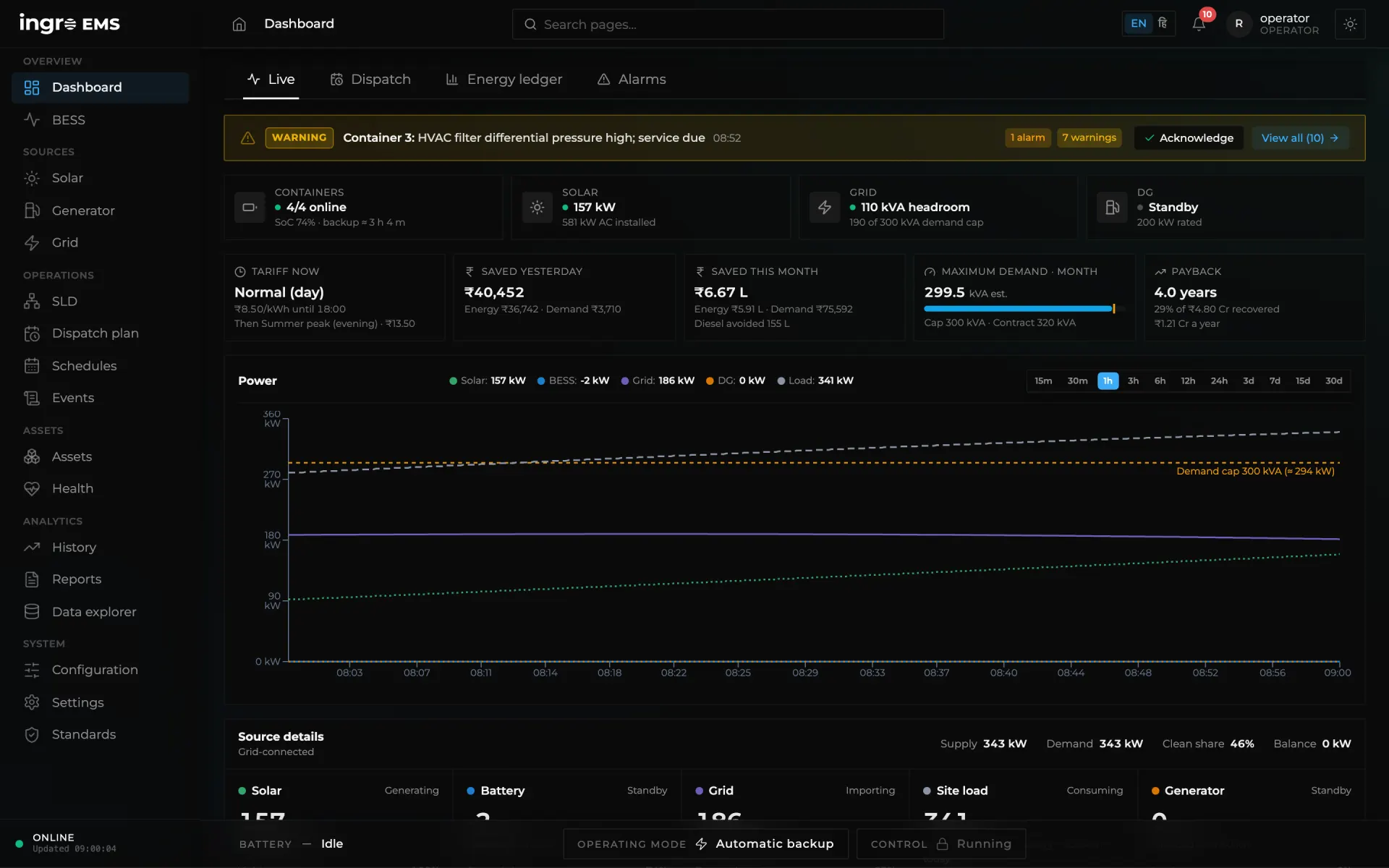
On top of that connectivity, the platform delivers real-time monitoring down to cell level, centralised and remote dispatch control, fleet-wide analytics, multi-level alerts and automated CERC and SERC compliance reporting. This is proven at scale: Ingro operates one of India's oldest grid-scale BESS sites at 99.5%+ availability, coordinates 124 inverters at a single site, and re-optimises dispatch every five minutes.

Cloud EMS is Pillar 1 of Ingro's AI Powered BESS platform. It links hardware through an Integrations layer and feeds higher-level products such as Battery AI and the Battery Passport. Because it is made in India, it can also help grid-scale projects qualify for Viability Gap Funding (VGF) under MNRE guidelines, an increasingly important consideration for developers bidding into government-backed storage tenders.

Key Takeaways

  • A hardware-agnostic (vendor-agnostic) EMS controls BESS hardware from any manufacturer, keeping the intelligence in software rather than a proprietary box.
  • OEM-bundled EMS creates vendor lock-in that raises long-term costs, forces same-brand refreshes and strands brownfield assets.
  • Open protocols (Modbus, IEC 61850, DNP3, OPC-UA) plus edge gateways are what make true vendor neutrality possible.
  • The main considerations are integration testing, cybersecurity and clear support boundaries, all manageable with the right EMS partner.
  • Ingro Cloud EMS delivers a made-in-India, hardware-agnostic approach with a proven grid-scale track record.
FAQ

Frequently Asked Questions

What is a hardware-agnostic EMS for BESS?

A hardware-agnostic EMS for BESS is an energy management system that monitors and controls batteries, PCS, meters and other equipment from any manufacturer, rather than only the OEM's own hardware. It relies on open protocols and edge gateways so the control intelligence lives in software, letting operators run mixed-vendor, multi-site portfolios from one platform.

How is a vendor-agnostic EMS different from an OEM-bundled EMS?

An OEM-bundled EMS typically communicates only with its own manufacturer's equipment, tying you to one supplier for spares, expansions and software. A vendor-agnostic EMS speaks open industrial protocols, so it works across brands and hardware generations. The practical difference is freedom: competitive procurement, mixed fleets and no forced same-brand refresh.

Which protocols does a hardware-agnostic BESS EMS use?

A capable hardware-agnostic EMS supports the main open industrial protocols: Modbus TCP/RTU for most PCS, BMS and meters; IEC 61850 for substation-grade communication with switchgear; DNP3 for utility SCADA telemetry; and OPC-UA for secure, structured data exchange. Edge gateways translate between these protocols and normalise the data into a common model.

Can a hardware-agnostic EMS retrofit an existing battery site?

Yes. Because it connects through open protocols rather than proprietary interfaces, a hardware-agnostic EMS can be added as a control and analytics layer on top of existing or ageing (brownfield) hardware. This lets operators modernise monitoring, dispatch and compliance without ripping out functioning batteries or inverters, protecting the original capital investment.

Does a hardware-agnostic EMS create cybersecurity risks?

Connecting many vendors does widen the attack surface, so cybersecurity must be designed in. Secure edge gateways, network segmentation, encrypted protocols such as OPC-UA, and strict access control keep multi-vendor systems safe. The risk is manageable and should not be a reason to accept vendor lock-in; it is a reason to vet the EMS partner carefully.

Can a made-in-India EMS help with VGF for BESS projects?

Yes. Using a made-in-India EMS, such as Ingro Cloud EMS, can help grid-scale battery storage projects qualify for Viability Gap Funding (VGF) under MNRE guidelines. This is increasingly relevant for developers bidding into government-backed storage tenders, where domestic content and local capability strengthen the case for support.

Keep Learning

Related Guides

See the Cloud EMS for BESS in action

Ingro Cloud EMS gives you real-time monitoring, remote dispatch, and fleet-wide control across every BESS site, from a single dashboard.