Cell Divergence: The Silent BESS Killer
The degradation that eventually breaks a grid-scale BESS doesn't start with aging — it starts at manufacturing. Ingro EMS detects and manages inter-cell voltage divergence before failure, recovering +10.7% discharge energy and +9.2% usable state of charge without any hardware replacements.
The degradation that eventually breaks a grid-scale BESS doesn’t start with aging. It starts at the factory.
No two cells leave the production line identical. Even from the same batch, the same day, the same manufacturer — every cell has slightly different internal resistance and capacity. Small differences. Invisible at first.
In a series-connected string, those differences compound with every charge-discharge cycle. Silently. Continuously.
During the nascent stages, the system still looks healthy. SoH reads fine. Operators see nothing alarming — until it crosses what the industry calls the divergence cliff. The curve that looked linear suddenly breaks. Not because something new went wrong. Because something that was always there finally became unmanageable.
This is exactly the pattern Ingro EMS is built to catch.
Not after the point of failure. Before the threshold is crossed — while there is still room to act.
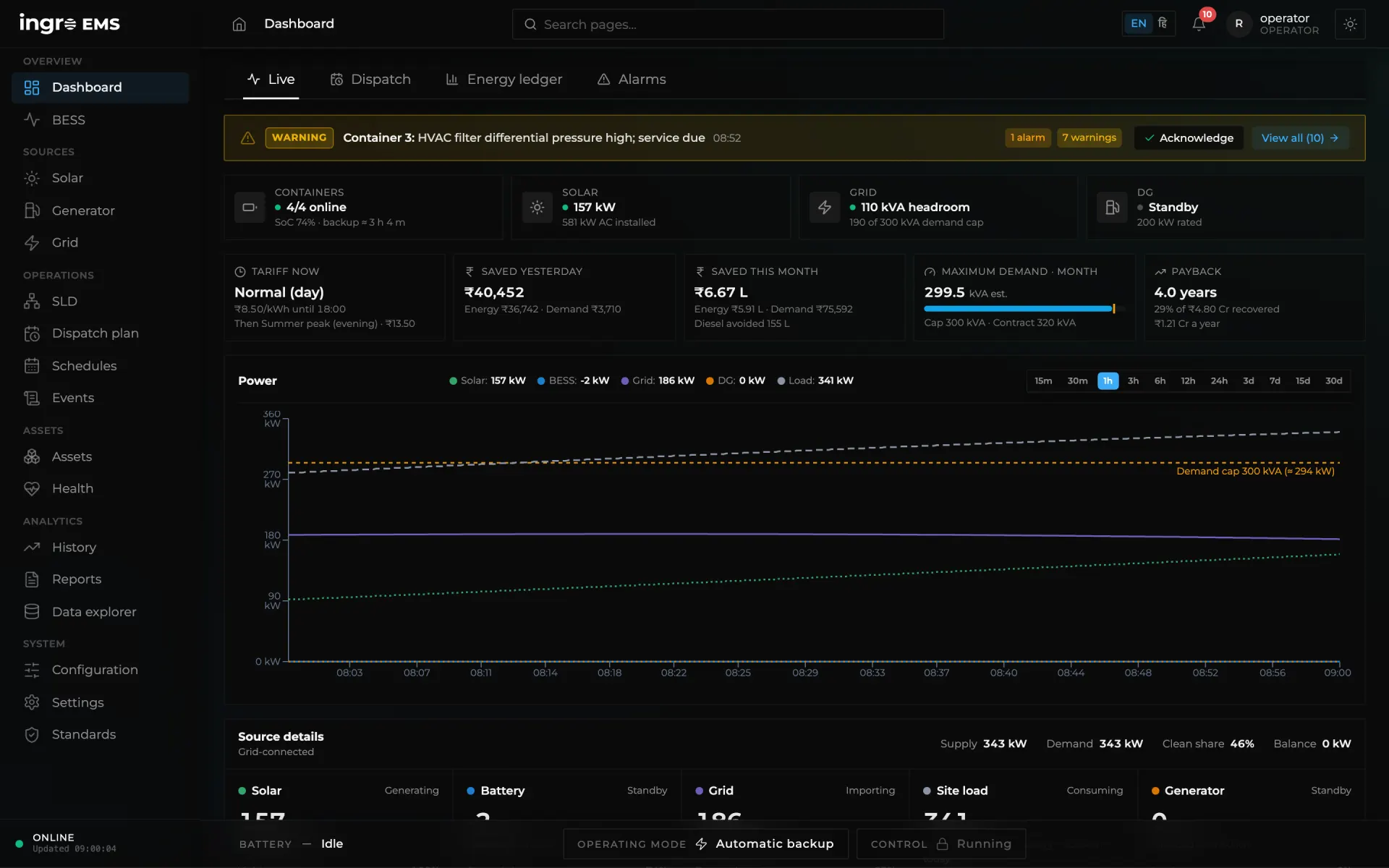
Ingro EMS monitors every module’s max and min cell voltage continuously, flags inter-cell divergence as it builds, and intervenes at the control layer before the OEM BMS is forced into a hard cutoff. The result is not just fault prevention. It is recovery of capacity the system was already losing.
What the data showed
At one of India’s earliest grid-scale BESS deployments, Ingro EMS logged:
- Inter-cell voltage spread exceeding 7x the healthy threshold
- Avg 3.5 voltage faults per week (over-voltage, under-voltage, cell divergence, inter- and intra-module divergence)
- DC bus voltage spikes beyond safe limits, caused by abrupt BMS cutoffs mid-operation
Post-deployment:
- Nearly zero faults over 4 consecutive weeks
- Discharge energy per cycle: +10.7%
- 9.2% recovery in usable SoC range
- Zero hardware replaced
A software intervention at the EMS layer controls the problem — it does not erase it. The divergence is managed, not cured. What changes is that it is now visible, bounded, and no longer compounding unchecked.
What module replacement actually costs
The conventional response to cell divergence is module replacement. Here is what that actually costs — not in rupees, but in reality:
- Supply chain wait — lead times in India are months, not days
- Recommissioning downtime — every rack offline is lost revenue
- No guarantee — new cells enter the same unmanaged conditions. The divergence starts again.
- No learning — hardware replacement generates zero operational intelligence
- Wasted assets — recoverable cells get discarded
Cell divergence is not a hardware problem waiting for a hardware solution.
It is a visibility and control problem. And that is precisely what Ingro EMS is built to solve.
Opens the original post on LinkedIn — like, comment, or share it there.